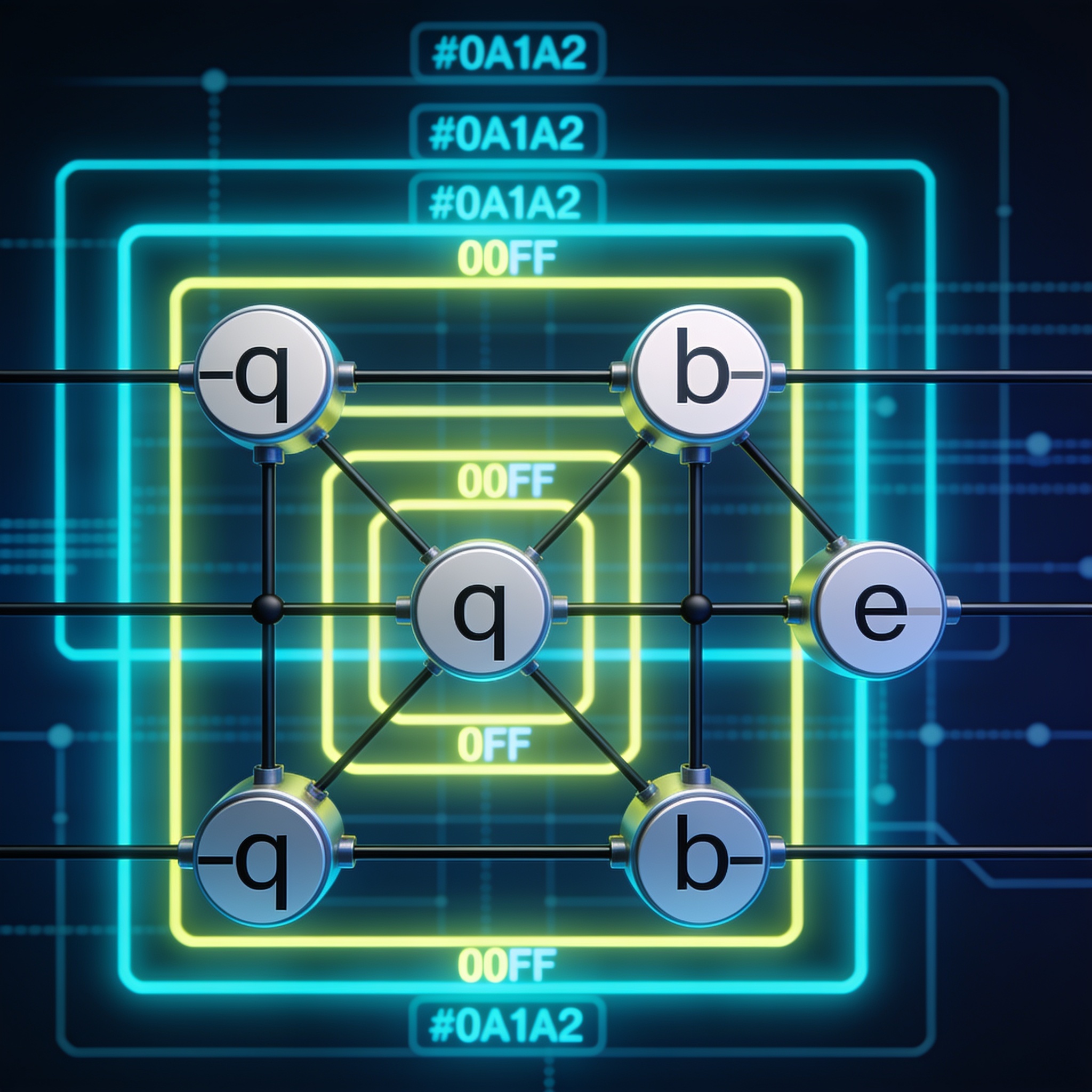
Since 2007, quantum computing researchers have assumed that all gates in the Clifford hierarchy could be decomposed into a simple, predictable form. That assumption, known as the generalised semi-Clifford conjecture, has shaped quantum error correction and fault-tolerant design for nearly two decades. Now, a team of researchers—whose affiliations appear in the paper’s metadata—has proved it wrong. In a counterexample built from just five qubits, they demonstrate that the conjecture is false, and that the Clifford hierarchy itself has a surprising gap: it is not even closed under inverses. [arXiv:2609.11903]
The Core Finding
The paper constructs an explicit five-qubit gate that sits in the fifth level of the Clifford hierarchy yet cannot be written as a generalised semi-Clifford operation, exactly what the conjecture forbid.
“We construct a five-qubit gate that is in the fifth level of the Clifford hierarchy but is not generalised semi-Clifford.”The counterexample is not just a brute-force check; the authors show how its form can be deduced from first principles. Because the gate belongs to level five and fails the semi-Clifford condition, it also reveals a structural weakness: the Clifford hierarchy is not closed under inverses. This is a mathematical disproof, not an incremental improvement—the conjecture is simply false.
The State of the Field
The Clifford hierarchy classifies quantum gates by how they can be implemented fault-tolerantly through gate teleportation and error correction. Zeng, Chen, and Chuang conjectured in 2007 that every gate in this hierarchy is generalised semi-Clifford—that it takes the form C1 Π D C2, where C1 and C2 are Clifford gates, Π is a permutation, and D is diagonal. In 2008, Beigi and Shor proved that the conjecture holds for all third-level gates, giving many researchers confidence that the pattern would extend to higher levels. The past five years have seen intense work on realizing logical qubits and fault-tolerant operations in superconducting and trapped-ion platforms, making any clarification of the gate landscape timely. This new result shows that the clean decomposition of Beigi-Shor is the exception, not the rule.
From Lab to Reality
For error correction theorists, falsifying the conjecture means the search for efficient gate implementations cannot rely on a single universal template. It may drive new techniques for compiling arbitrary higher-level gates from available fault-tolerant primitives. Engineers designing scalable fault-tolerant architectures will need to account for non-semi-Clifford operations that cannot be simplified as expected. The fault-tolerant quantum computing market, estimated to reach $80 billion by 2035 according to a 2024 McKinsey analysis, hinges on being able to execute error-protected logical operations; a more accurate map of the Clifford hierarchy directly informs which gate sets are viable and how to implement them efficiently.
What Still Needs to Happen
Two major obstacles stand between this result and practical deployment. First, the counterexample exists at the fifth level of the hierarchy, but building and controlling five-logical-qubit gates with sufficiently low error rates remains beyond current hardware. Researchers at Google Quantum AI and the IBM Quantum Network are actively improving surface-code logical qubits, yet even two-logical-qubit gates are still being refined. Second, a systematic classification of all non-semi-Clifford gates at higher levels is missing; without it, fault-tolerant compilers lack a complete toolbox. Large-scale classification efforts, such as those pursued by the Simons Institute’s quantum computing program, aim to fill that gap, but a full taxonomy is likely a decade away.
Conclusion
In short: The generalised semi-Clifford conjecture, a 19-year-old assumption about quantum error correction gate structure, is false—and the Clifford hierarchy is not closed under inverses.