Building a quantum internet that can securely connect multiple users over metropolitan distances has been a stubborn challenge. The most promising protocol for beating the loss limits of fiber optics, twin-field quantum key distribution (TFQKD), has until now been trapped in a two-user world. Every long-distance demonstration required delicate, active phase stabilization or computationally heavy postcompensation to keep the quantum signals aligned, making a true multi-user network impractical. A team from an unnamed institution, publishing on the arXiv preprint server, has just broken that barrier. [arXiv:2609.04447]
The Core Finding
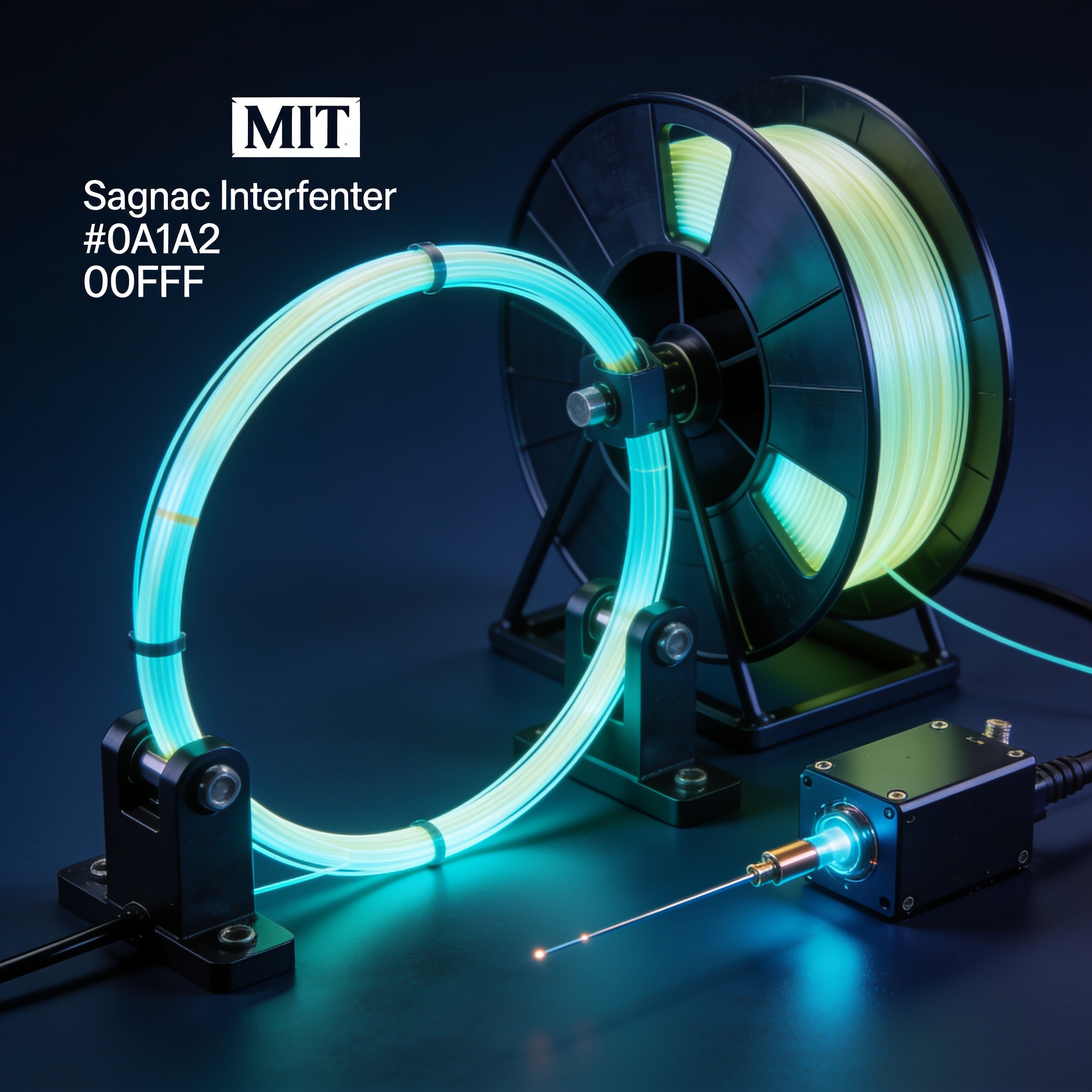
The researchers built a proof-of-principle three-user-pair Sagnac TFQKD network that operates over 127 kilometers of fiber without any active phase stabilization or postcompensation. They used off-the-shelf single-photon avalanche detectors and implemented efficient procedures to maintain polarization stability and suppress Rayleigh backscattering noise. The result was a stable Sagnac interference visibility of 93±1% over one hour. Over an asymmetric channel with 102 kilometers of fiber and 45 decibels of total loss, the system delivered a secure key rate of 1.398×10−5 bits per pulse.
“To our knowledge, this is the first TFQKD network without active phase stabilization or postcompensation achieved over long fibers.”Think of it like sending secret messages through a busy hallway where everyone is jostling, but you manage to keep the message intact without constantly adjusting the path—the Sagnac loop naturally cancels out much of the environmental noise.
The State of the Field
Twin-field QKD was proposed in 2018 by Lucamarini et al. as a way to overcome the rate-loss limit that plagues traditional QKD. By sending weak coherent pulses from two users to a central untrusted node and interfering them, TFQKD can scale the key rate with the square root of channel transmittance instead of linearly. Nearly all long-distance TFQKD demonstrations since then—including the 509-kilometer record by Chen et al. in 2020 and the 830-kilometer experiment by Wang et al. in 2022—have been point-to-point links between exactly two parties. Those setups required active phase-locking loops, frequency combs, or complex post-processing to compensate for thermal drift and fiber stress. The Sagnac interferometer approach changes the game because the clockwise and counterclockwise paths are automatically reciprocal, canceling common-mode phase noise without any active feedback. This inherent stability is what finally opens the door to networking more than two users.
From Lab to Reality
For scientists, this work unlocks a new design philosophy for quantum networks: instead of fighting phase noise with expensive hardware, you can let the interferometer geometry do the work. The demonstration shows that a passive Sagnac loop can support multiple user pairs, each sharing a different wavelength or time slot, all within the same fiber infrastructure. For engineers, the immediate implication is that metropolitan-scale QKD networks could be built using existing dark fiber and standard telecom components, without the need for ultra-stable lasers or active tracking systems. The quantum cryptography market, projected to reach $3.8 billion by 2030 according to industry analysts, could see a faster rollout of secure government and financial communication links. For investors, the cost reduction from eliminating active stabilization hardware makes TFQKD networks commercially viable sooner than previously thought, potentially within the next five years for city-wide deployments.
What Still Needs to Happen
Two major technical challenges remain before this proof-of-principle becomes a deployed product. First, the secure key rate of 1.398×10−5 bits per pulse is still too low for high-throughput applications; improving detector efficiency and reducing dark counts will be essential. Groups at the University of Science and Technology of China and Toshiba Europe are actively developing superconducting nanowire single-photon detectors that could boost rates by an order of magnitude. Second, the current network supports only three user pairs, and scaling to dozens of nodes will require careful management of multiple wavelength channels and crosstalk. Researchers at the Institute for Quantum Computing in Waterloo are exploring dense wavelength division multiplexing schemes that could pack many Sagnac loops into a single fiber. Real-world deployment is likely 5 to 10 years away, but the passive stabilization breakthrough removes one of the biggest roadblocks.
Conclusion
In short: twin-field quantum key distribution can now support multiple users over long distances without the crutch of active phase stabilization, transforming a delicate lab technique into a practical networking tool. The quotable sentence: “A three-user Sagnac twin-field QKD network maintained 93% interference visibility over 127 km with no active stabilization, proving passive quantum cryptography networks are feasible.”