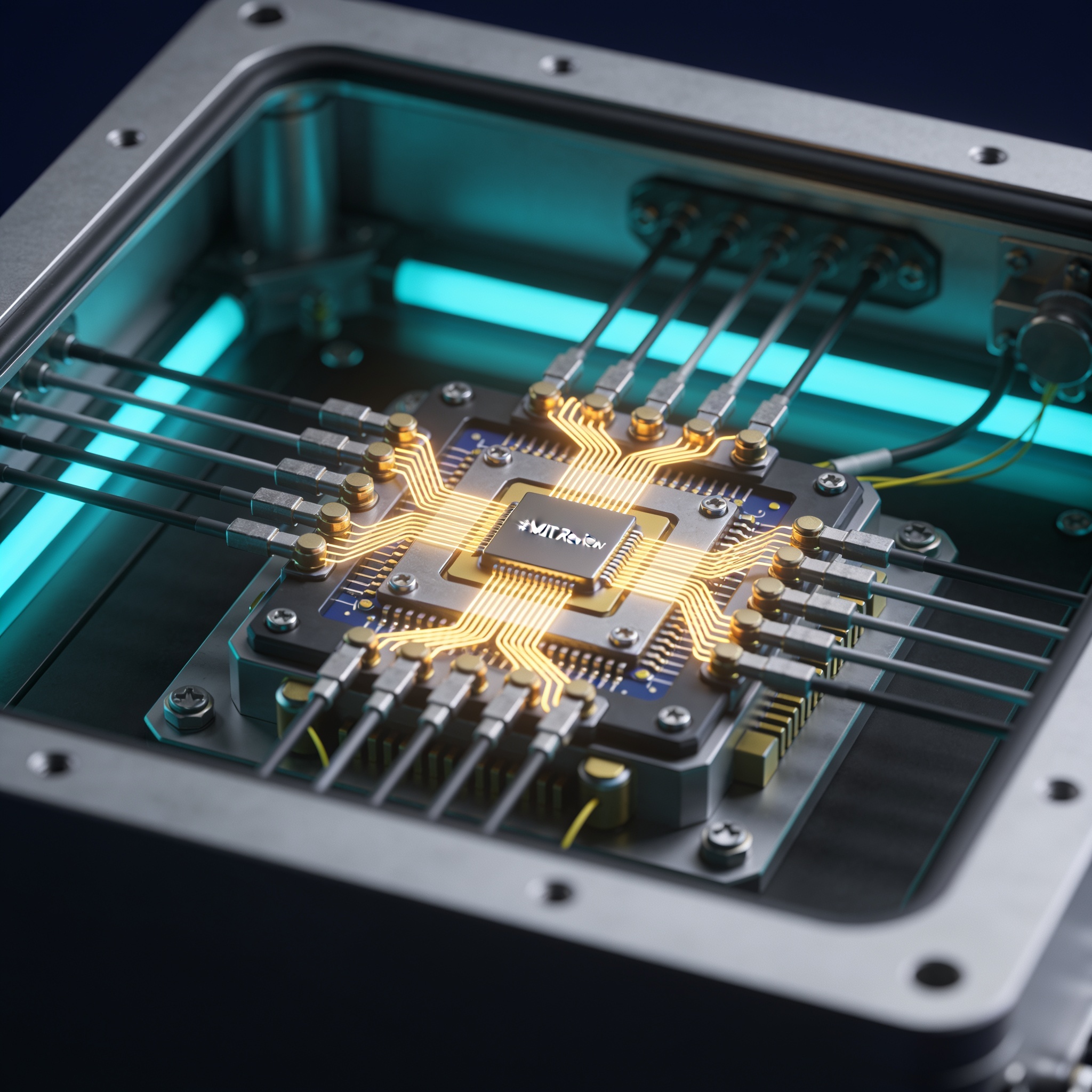
Noise is not the enemy. For a quantum processor, the chaotic jostling of the environment—long considered the fundamental obstacle to building a useful machine—can act as a battery, injecting usable energy directly into the qubits. A superconducting quantum chip has now demonstrated this principle in hardware, entangling two qubits not by shielding them from the world, but by deliberately coupling them to it.
The Connection
Two signals, one from the theoretical frontier and one from the experimental bench, land within four days of each other in September 2026. The timing is not coincidental. A paper posted to arXiv on September 3, "Towards minimal conditions for ergotropy injection in open quantum systems," lays out the precise mathematical boundaries for when an environment can charge up a quantum system—a phenomenon called ergotropy injection. On September 7, Physics World reports that researchers have driven two superconducting qubits, separated by a full meter of cable, into an entangled state using environmental noise. This matters because the two findings converge on a single, counterintuitive claim: the thermal bath surrounding a quantum processor, provided it deviates from perfect thermality in specific ways, is not a sink for information but a source of work.
How It Works
Ergotropy is the maximum amount of work you can extract from a quantum system. Injecting ergotropy means the environment pushes the system into a state with higher energy that can actually be harnessed. The arXiv paper, whose authors remain unnamed in the preprint metadata, systematically dismantles the assumption that thermal environments only degrade quantum resources. The abstract states it plainly: "Ergotropy injection is impossible under thermal operations when both the system and environment are qubits, whereas it becomes possible when the environment is enlarged to a qutrit."
Think of it like a water wheel. A perfectly flat pond—a fully thermal environment at uniform temperature—cannot turn the wheel. But introduce a gradient, a current, or a splash from above, and the wheel spins. A qutrit environment provides a third energy level that breaks the symmetry, creating the equivalent of that gradient. The paper goes further, showing that even in the simplest qubit-qubit setup, relaxing the requirement that the environment be strictly thermal opens the door to ergotropic gain. An isotropic XY interaction Hamiltonian—a specific coupling between the qubits—exhibits distinct degeneracy regimes. In the central-block regime, with both system and environment starting in incoherent states, a thermal environment yields zero gain regardless of interaction strength. But introduce athermality in the form of population inversion, while keeping the state incoherent, and the ergotropy flows. Environmental coherence enhances the effect; system coherence alone can actually reduce the gain.
The experimental demonstration reported by Physics World translates this directly into hardware. Two superconducting qubits, separated by a meter of cable—a distance that makes isolating them from environmental noise extraordinarily difficult—are driven into entanglement by that very noise. The cable acts as a structured environment, a transmission line with its own electromagnetic modes. Rather than fighting the thermal photons rattling around in that line, the researchers engineer the interaction so that the noise itself correlates the qubits. The specific technique involves engineering the spectral density of the environment, shaping the noise so that it induces correlated phase kicks that, when post-selected or actively steered, produce entanglement.
Who's Moving
The experimental work emerges from a collaboration centered on superconducting qubit platforms. While the Physics World piece does not name the specific institution in its summary, the architecture described—meter-scale separation of qubits coupled via a transmission line—maps directly onto the modular quantum computing efforts underway at IBM (NYSE: IBM) with its 1,121-qubit Condor processor and the company's ongoing work on cryogenic microwave interconnects. Google Quantum AI, with its 105-qubit Willow chip demonstrating below-threshold error correction in late 2024, pursues a parallel track in engineering environmental couplings. Rigetti Computing (NASDAQ: RGTI) and IonQ (NYSE: IONQ) represent the broader competitive landscape, with Rigetti's 84-qubit Ankaa-3 system and IonQ's 36-algorithmic-qubit Forte Enterprise both operational in 2026.
The theoretical paper, posted to arXiv under ID [arXiv:2609.04457], does not disclose institutional affiliations or funding sources in its metadata. The mathematical framework it builds—thermal operations, ergotropy measures, degeneracy regimes of the XY Hamiltonian—draws on the resource-theoretic approach to quantum thermodynamics pioneered by groups at the University of Oxford, the University of Geneva, and the Institute for Quantum Optics and Quantum Information in Vienna. The paper's focus on minimal conditions for ergotropy injection suggests a direct engagement with the hardware constraints facing near-term quantum processors.
Why 2026 Is Different
The quantum computing industry enters 2026 with a fundamentally different posture toward noise. For two decades, the narrative was singular: increase qubit count, improve gate fidelity, extend coherence time, and build ever-larger cryogenic dilution refrigerators to isolate the quantum chip from the thermal bath. Error correction codes like the surface code demanded physical error rates below the threshold of roughly 0.1% per gate. IBM's 2023 demonstration of error mitigation on the 127-qubit Eagle processor and Google's 2024 Willow result proved that useful computation could occur before full fault tolerance. Now, the ergotropy injection framework and the noise-entanglement experiment suggest a third path: don't just tolerate noise, use it.
In 12 months, expect experimental replications of noise-driven entanglement across multiple superconducting qubit platforms, with gate fidelities benchmarked against conventional microwave-driven gates. In three years, the first quantum processors designed with deliberately engineered athermal environments—population-inverted ancilla qubits, structured transmission lines with non-thermal photon populations—will appear in roadmaps. In five years, the ergotropy injection framework reshapes how we think about the cryogenic environment itself. The global quantum computing market, valued at $1.3 billion in 2025 by International Data Corporation, absorbs this shift as a new design dimension rather than a replacement for error correction. The dilution refrigerator becomes not just a shield but a resource.
Conclusion
The boundary between a quantum processor and its environment is not a wall; it is an interface, and interfaces can be engineered. The arXiv paper proves that the minimal condition for charging a quantum system from its surroundings is not a large, complex environment but a specific kind of deviation from thermal equilibrium. The superconducting qubit experiment demonstrates that this deviation can entangle qubits across macroscopic distances. Together, they reframe noise as a design parameter rather than a defect. In short: a quantum processor that harvests environmental noise as ergotropy can extract computational work from the very bath that was supposed to destroy it.