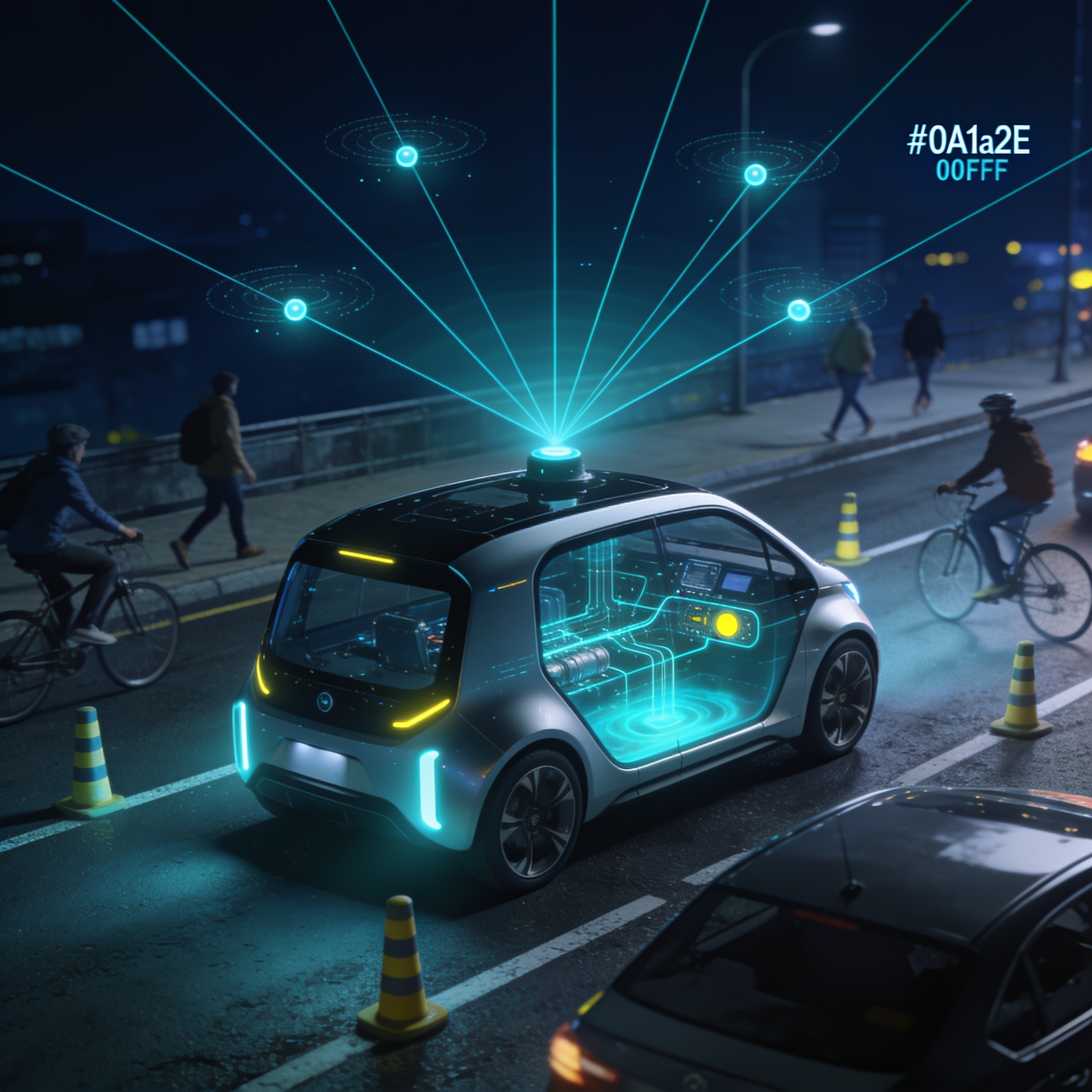
Autonomous vehicles promise to transform logistics, surveillance, and urban mobility, but they face a stubborn physical reality: the very sensors that make them smart generate torrents of data that must be offloaded over wireless links. Millimeter-wave (mmWave) channels offer the necessary bandwidth, yet they are notoriously fragile. A single moving obstacle—a truck, a pedestrian, even a swaying tree—can block the narrow beam and sever the connection. Until now, no one had solved the real-time problem of jointly optimizing a vehicle’s motion and its communication energy when those blockages are themselves moving and unpredictable. A research team has now closed that gap. [arXiv:2609.04436]
The Core Finding
The researchers formulated the challenge as a coupled optimization problem: an autonomous vehicle must navigate among dynamic obstacles to reach a destination while transmitting onboard sensing or telemetry data over a mmWave link that suffers time-varying blockages. They designed a nonlinear model predictive control (NMPC) framework that simultaneously plans the vehicle’s path and its communication schedule, looking ahead to anticipate when the channel will be clear. A control barrier function (CBF) is woven into the controller to mathematically guarantee collision avoidance. Think of it like a self-driving car that not only weaves through traffic but also times its data uploads to the moments when the mmWave beam has a clear line-of-sight, much as a radio operator waits for a break in interference before transmitting.
“reducing total energy consumption by up to 37.3% compared to baseline strategies.”Extensive simulations show that this anticipative co-optimization slashes total energy use by more than a third, a leap over conventional approaches that treat motion and communication as separate, reactive tasks.
The State of the Field
Prior work on connected autonomous vehicles typically decoupled path planning from wireless transmission. Motion planners focused on obstacle avoidance, while communication engineers optimized data rates assuming a static or slowly varying channel. In dynamic mmWave settings, that separation fails because a moving obstacle can abruptly attenuate the signal by 20–40 dB, forcing the radio to ramp up power or delay transmission—both of which waste energy. Earlier attempts at joint optimization either ignored moving obstacles or relied on offline computation that cannot adapt to real-time changes. The new approach is different because it uses NMPC to solve a rolling-horizon optimization that continuously updates both the trajectory and the transmission plan based on predicted obstacle motion and channel state. The broader landscape of autonomous systems is shifting toward tighter integration of sensing, control, and communication, driven by the rollout of 5G-Advanced and early 6G research, where mmWave and sub-THz bands will be essential for high-throughput vehicular links.
From Lab to Reality
For scientists, this work unlocks a new research direction: co-design of safety-critical control and anticipatory communication at the algorithmic level. The NMPC-CBF framework can be extended to multi-agent scenarios, where fleets of drones or delivery robots coordinate their maneuvers and data offloading to avoid mutual interference. For engineers, the immediate promise lies in autonomous ground vehicles and aerial drones that operate in cluttered urban environments. A delivery robot could reduce battery drain by 37% on a single mission, extending range or enabling more frequent data uploads for remote oversight. The market for autonomous last-mile delivery, projected to reach $40 billion by 2030, stands to benefit directly. Investors should watch companies building software stacks for connected autonomy, as well as chipmakers developing low-power mmWave beamforming arrays that can be steered in sync with vehicle motion.
What Still Needs to Happen
Two technical hurdles remain before this framework moves from simulation to real-world deployment. First, the computational load of solving a nonlinear optimization with safety constraints at every time step is substantial. The current results are simulation-based; porting the solver to embedded automotive-grade hardware without sacrificing real-time performance will require further algorithmic streamlining or hardware acceleration. Researchers at MIT’s Robust Robotics Group and the University of California, Berkeley, are actively working on lightweight NMPC solvers for agile robots. Second, the framework assumes accurate short-term prediction of obstacle motion and channel state. In practice, mmWave channel estimation is noisy and obstacle behavior can be erratic. Integrating robust perception and uncertainty quantification into the CBF constraints is an open challenge that groups at Stanford and ETH Zurich are tackling. Real-world validation on test tracks with moving blockers and live mmWave links is likely three to five years away.
Conclusion
In short: Joint optimization of motion and communication energy via nonlinear model predictive control with safety barriers cuts total energy consumption by up to 37.3% for autonomous vehicles navigating dynamic mmWave-blocked environments.