A quiet but consequential debate is unfolding in quantum computing’s foundational literature: what exactly constitutes a fault-tolerant logical state preparation? Two recent papers—one from Colmenarez et al. ([arXiv:2601.05113]) and another from Peham et al. (PRX Quantum 6, 020330, 2025)—offer definitions that, while overlapping in spirit, diverge in rigor and practical implications. The distinction matters because claims of fault tolerance underpin every roadmap from IBM to Quantinuum, and investors are increasingly asking for standardized benchmarks.
The core issue is not academic. A circuit that passes one definition may fail the other, meaning a company could advertise a “fault-tolerant” logical qubit operation that, under stricter criteria, is not truly resilient against errors. As the industry pushes toward the first useful error-corrected machines, the definitions we choose will determine whether milestones are real or merely semantic.
What They’re Actually Building
Fault tolerance is the property that a quantum circuit can suppress logical errors even when its physical components suffer faults. The two definitions in question address the preparation of logical states—the encoded qubits that form the basis of error-corrected computation.
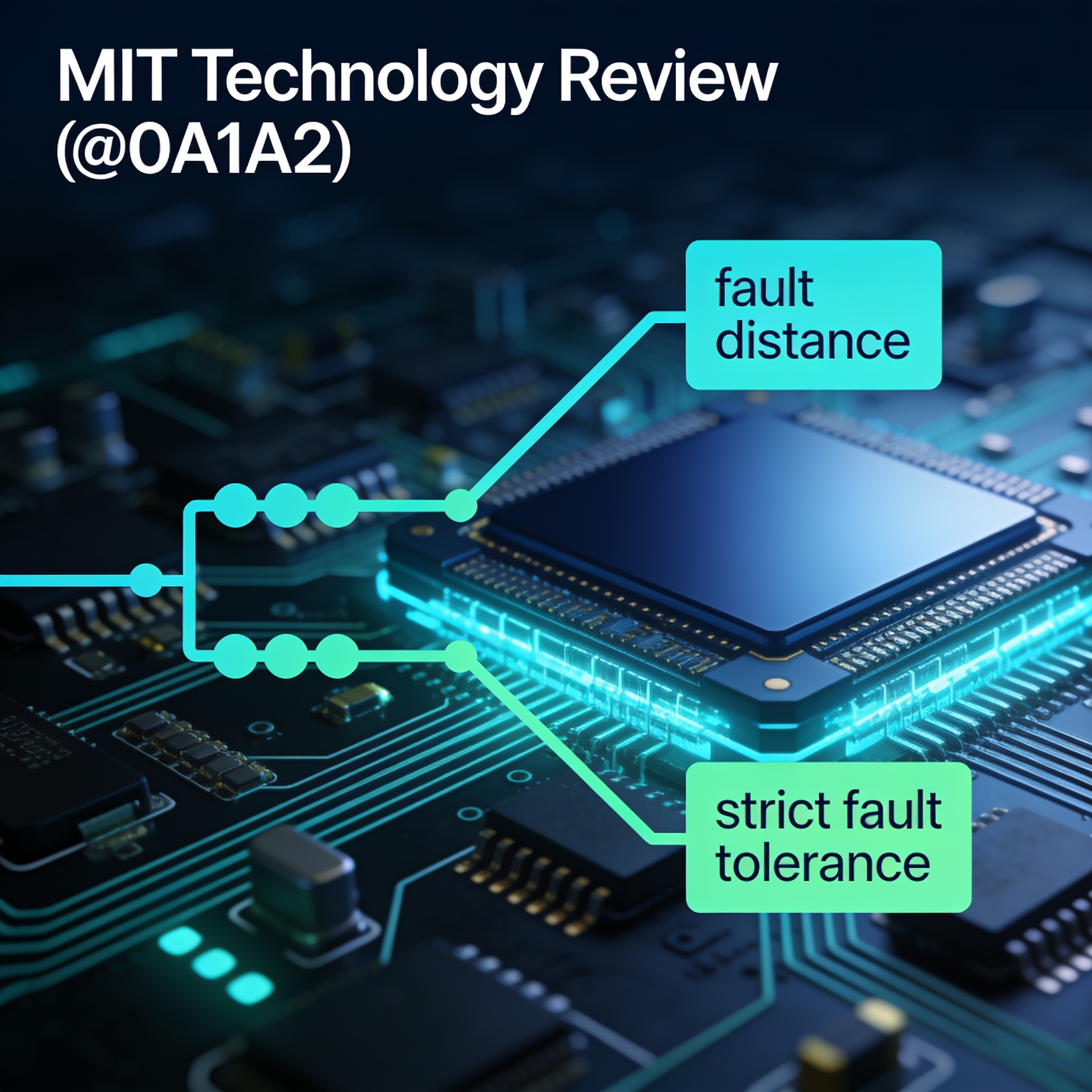
Definition A (fault distance / distance-preserving): Colmenarez et al. introduce the “fault-distance,” the minimum number of faults required to produce an undetectable logical error. A circuit is distance-preserving if its fault distance equals the code distance d. In a distance-3 surface code, for example, a distance-preserving state preparation would require at least 3 faults to cause an undetectable logical error.
Definition B (strict fault tolerance): Peham et al., building on Aliferis–Gottesman–Preskill (quant-ph/0504218) and Chamberland–Beverland (Quantum 2, 53, 2018), define a state preparation circuit as strictly fault-tolerant if for all t ≤ ⌊d/2⌋, any error of probability O(pt) on the physical qubits leads to a logical error of probability O(pt). This condition must hold for every possible fault path, not just the worst-case one.
“The difference is subtle but critical: Definition A focuses on the minimum number of faults for an undetectable error, while Definition B demands that the error probability scaling holds for all fault combinations up to half the code distance,” explains a quantum error correction researcher familiar with both works.
In practice, a circuit might be distance-preserving yet fail strict fault tolerance if a single fault can spread in a way that, while detectable, produces a logical error with probability higher than O(p2) in a distance-3 code. This has direct consequences for how companies design their error correction pipelines.
Winners and Losers
The definitional split creates asymmetric pressure on quantum computing firms. Companies that have invested heavily in surface-code architectures—Google Quantum AI, IBM, and Quantinuum—must now ensure their logical state preparation circuits satisfy the stricter Peham et al. criteria if they want to claim full fault tolerance. A circuit that is merely distance-preserving could still be vulnerable to correlated errors that strict fault tolerance would catch.
Quantinuum, which demonstrated a distance-3 logical qubit with real-time error correction in 2025, publicly emphasized “fault-tolerant” operations. If those operations were validated only under the fault-distance definition, they might need re-evaluation under the stricter standard. IBM’s 2026 roadmap targets a 100,000-qubit system by 2033, with logical qubits as the central metric; the definition of fault tolerance directly affects how those logical qubits are benchmarked.
Smaller players and startups could benefit if the stricter definition becomes the norm, as it raises the bar for incumbents and creates an opening for architectures that natively satisfy strict fault tolerance. IonQ’s trapped-ion approach, with all-to-all connectivity, may have an easier time designing circuits that avoid the correlated error pathways that plague superconducting qubits. Conversely, photonic quantum computing companies like PsiQuantum, which rely on fusion-based error correction, will need to demonstrate that their logical state preparation meets the strict criteria, not just the fault-distance one.
For the quantum software and cloud ecosystem, the definitional uncertainty complicates benchmarking. AWS Braket and Microsoft Azure Quantum offer logical qubit simulators and early error-corrected services; if customers cannot compare fault-tolerance claims apples-to-apples, adoption will stall.
The Bigger Picture
This debate lands in a 2026 quantum landscape where governments and corporations have poured over $40 billion cumulatively into quantum technologies. The U.S. CHIPS and Science Act continues to fund quantum R&D, and the EU Quantum Flagship is entering its second phase. With that level of investment, the pressure to show tangible progress is immense—and the temptation to use the most favorable definition of fault tolerance is real.
Industry consortia like the Quantum Economic Development Consortium (QED-C) and the IEEE Quantum Computing Standards Working Group are actively discussing benchmarking standards. The fault tolerance definition could become a de facto standard if adopted by a major player or a government procurement requirement. In 2025, the U.S. Department of Energy issued a request for information on quantum computing benchmarks, explicitly asking about fault tolerance metrics. The Colmenarez vs. Peham distinction is precisely the kind of nuance that such standards bodies must resolve.
Comparable definitional battles have occurred in classical computing: the transition from MIPS to SPEC benchmarks, or the debate over what constitutes an “AI model.” In each case, the definition that won shaped billions in investment. Quantum computing is now facing its own version of that inflection point.
The Signal
The signal here is that quantum computing is maturing past the era where “fault-tolerant” could be used loosely. The emergence of rigorous, competing definitions is a healthy sign of a field moving from physics experiments to engineering discipline. However, it also means that any company claiming fault tolerance without specifying which definition it uses is either unaware of the nuance or deliberately obfuscating. Investors and technical evaluators should now demand that fault-tolerance claims come with a clear statement of the criterion applied—fault-distance or strict—and the code distance tested. The next milestone to watch is whether a major quantum vendor publishes logical state preparation results that satisfy the strict Peham et al. definition for a code distance of 5 or higher. That would be a genuine step toward useful error-corrected computation.
In short: Fault tolerance definitions are diverging, and which one a company chooses will determine the credibility of its logical qubit milestones.
FAQ
What is fault tolerance in quantum computing?
Fault tolerance is the ability of a quantum computer to perform reliable computations even when its physical qubits experience errors. It is achieved by encoding logical qubits across many physical qubits using quantum error correction codes, and by designing circuits so that errors do not spread uncontrollably. A fault-tolerant circuit ensures that a small number of physical errors cannot cause a logical error.
How do the two fault tolerance definitions differ?
Definition A (fault distance) counts the minimum number of faults needed to produce an undetectable logical error; a circuit is distance-preserving if that number equals the code distance. Definition B (strict fault tolerance) requires that for any combination of up to ⌊d/2⌋ faults, the logical error probability scales as O(p^t) where p is the physical error rate. Strict fault tolerance is more demanding because it checks all fault paths, not just the worst-case minimum.
Which quantum computing companies are affected by this definition debate?
Every company building error-corrected quantum computers is affected, including IBM, Google Quantum AI, Quantinuum, IonQ, PsiQuantum, and QuEra. Their roadmaps promise fault-tolerant logical qubits, and the definition they use will influence how investors and customers evaluate their progress. Cloud providers like AWS and Microsoft Azure that offer quantum services are also impacted because they must benchmark the fault tolerance of the hardware they host.
Is there an industry standard for quantum fault tolerance?
No universal standard exists yet. Organizations like the IEEE and QED-C are working on benchmarking frameworks, but no single definition has been adopted across the industry. The divergence between the Colmenarez and Peham definitions highlights the need for a consensus standard, which could emerge from government procurement requirements or a major vendor’s published specifications.
What should investors watch for in quantum fault tolerance claims?
Investors should look for explicit statements of which fault tolerance criterion is being used, the code distance tested, and the physical error rates of the underlying qubits. A claim of “fault-tolerant” without these details is insufficient. The most credible demonstrations will satisfy the strict fault tolerance definition at code distances of 5 or higher, with error rates below the threshold required for that code.