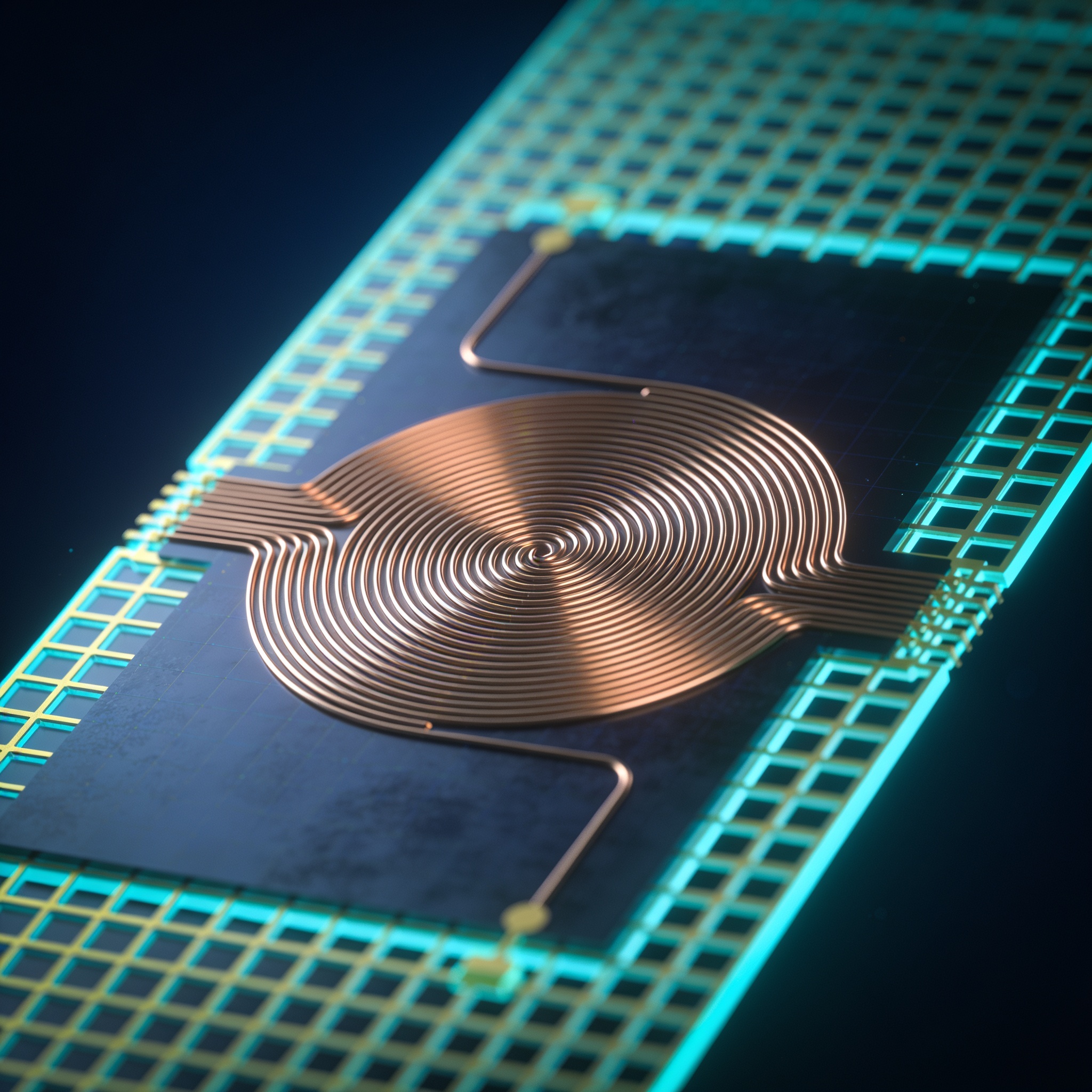
Make a superconductor thin enough and electrons stop moving as if they were in a three-dimensional metal. That confinement shifts the temperature at which superconductivity appears and, more importantly for quantum machines, it rewrites the noise environment that quantum error correction must defeat. [arXiv:2609.01547]
Two September 2026 signals belong together. The first is an arXiv preprint, Irreducibility and regularisation properties of Gaussian quantum Markov semigroups, posted on 1 September 2026. The second is a Phys.org signal on 2 September 2026 describing thin-film superconducting work with Giovanni Ummarino at Politecnico di Torino. This matters because both address how continuous-variable quantum systems lose coherence. Thin superconducting films are the material substrate of transmon and Superconducting Qubits; Gaussian quantum Markov semigroups are the mathematical description of how decoherence propagates through those systems. The timing is not coincidental: as Fault Tolerant Quantum Computing moves from single logical qubit demonstrations toward multi-logical-qubit hardware, the gap between ideal surface code assumptions and real thin-film noise becomes the binding constraint for quantum error correction.
How It Works
The thin-film research starts with a concrete puzzle. In an ordinary three-dimensional superconductor, electrons pair and carry current without resistance, and magnetic fields enter as quantized vortices. When the film becomes thin enough that electrons no longer behave as if they were in a 3D metal, that picture breaks. Giovanni Ummarino at Politecnico di Torino and his colleague develop a theory to calculate how this quantum confinement changes the temperature at which superconductivity appears. The result matters for fabrication because the superconducting films in International Business Machines' 1,121-qubit Condor processor and Alphabet-owned Google LLC's 105-qubit Willow chip are precisely the ones entering this confinement regime.
The arXiv paper attacks the same noise problem from the algebra side. It studies Gaussian quantum Markov semigroups on continuous-variable quantum systems, the mathematical objects that describe how Gaussian states evolve under drift and quantum diffusion. The authors identify a natural notion of regularity and characterize smoothing in terms of drift and diffusion matrices. They link these algebraic conditions to the controllability of quantum linear systems and to decoherence-free subsystems. Then they prove a quantum analogue of Hörmander's condition.
irreducibility is strictly stronger than conditions ensuring regularisation.
In plain terms, a noise process can smooth out errors without making every state reachable; classical intuition does not carry over.
Superconducting qubits such as transmons are fabricated from aluminum or tantalum films that range from 20 to 100 nanometers thick. When confinement sets in, the superconducting coherence length and London penetration depth change how magnetic vortices nucleate and how quasiparticles scatter. These are not abstract shifts; they set the decoherence times that determine whether a physical qubit can reach the 99.9 percent fidelity needed for fault tolerant quantum computing.
Think of Surface Code syndrome measurement as trying to correct a dancer while the stage itself deforms. Regularisation tells you the noise smooths sharp edges; irreducibility tells you whether any deformation is reachable under the noise. Thin superconducting films change the stage; magnetic field penetration, surface losses, and flux noise alter the drift and diffusion matrices. If the semigroup is reducible, some errors hide in subspaces that no syndrome measurement can reveal. That directly tightens the engineering requirements for qubit fidelity.
Who's Moving
International Business Machines (NYSE: IBM) runs the 1,121-qubit Condor processor and the IBM Quantum Heron platform, both built from superconducting qubits. Alphabet-owned Google LLC (NASDAQ: GOOGL) operates the 105-qubit Willow chip, which demonstrated error-corrected Logical Qubit behavior in 2024. Microsoft Corporation (NASDAQ: MSFT) pursues topological qubits but still relies on thin superconducting layers for its Majorana 1 chip. PsiQuantum, which raised $450 million in Series D funding in 2021, applies continuous-variable photonic hardware and GKP states, making the Gaussian noise semigroup formalism directly relevant.
The academic lines are equally concrete. Giovanni Ummarino at Politecnico di Torino works on thin-film quantum confinement. Barbara Terhal at Delft University of Technology has established fundamental surface code thresholds that still guide hardware targets. John Preskill at California Institute of Technology has argued for two decades that quantum error correction is the central engineering challenge. The arXiv paper adds the algebraic framework that links these efforts.
Why 2026 Is Different
In 2026, the field has moved from single error-corrected qubits to multi-qubit logical chips. In the next 12 months, expect superconducting foundries to qualify new niobium and tantalum thin-film stacks with reduced flux noise and fewer two-level system defects. Within three years, fault tolerant quantum computing systems will use surface codes whose thresholds depend on the exact regularisation and irreducibility parameters derived in these papers. Within five years, quantum error correction becomes a materials-science moat as much as an algorithmic one. International Data Corporation (IDC) projects the global quantum computing market will reach $8.6 billion by 2027. That number understates the long-term shift because error-corrected systems unlock revenue only after logical qubit yield crosses threshold.
Conclusion
Thin superconducting films change how they accommodate magnetic fields, and Gaussian quantum Markov semigroups change how we understand decoherence. Both forces converge on one hardware reality: adding raw physical qubits no longer buys error protection unless the semigroup is irreducible and the film is thin enough to control flux noise. In short: quantum error correction will be decided by nanometer-scale superconducting films and by irreducibility conditions, not by adding more raw physical qubits alone.
FAQ
Q: What is quantum error correction? Quantum error correction is a set of techniques that stores one logical qubit across many physical qubits and uses syndrome measurement to detect and reverse decoherence errors without collapsing the encoded information. The Surface Code is the leading candidate because it requires only nearest-neighbor measurements. The goal is to reach fault tolerant quantum computing where logical error rates fall below physical error rates.
Q: How does Gaussian quantum Markov semigroup theory compare to classical Markov semigroups? In classical Markov semigroups, regularity and irreducibility often coincide. The September 2026 arXiv paper shows that in continuous-variable quantum systems irreducibility is strictly stronger than regularisation. This means a Gaussian quantum process can smooth out errors while still leaving hidden decoherence-free subspaces unreachable.
Q: When will quantum error correction be commercially available? Error-corrected quantum computing is already available in early research devices such as Google's 105-qubit Willow chip, which demonstrated error-corrected logical qubit behavior in 2024. Commercial fault tolerant quantum computing is expected within three to five years, provided thin-film fabrication and syndrome measurement fidelity meet threshold targets.
Q: Which companies are leading in quantum error correction? International Business Machines, Google LLC, Microsoft Corporation, and PsiQuantum lead different approaches: superconducting surface codes, topological qubits, and photonic GKP states. Their hardware roadmaps all depend on controlling decoherence in thin superconducting films and continuous-variable noise semigroups.
Q: What are the biggest obstacles to quantum error correction adoption? The largest obstacles are qubit fidelity below code thresholds, decoherence from material defects and flux noise, and the overhead of thousands of physical qubits per logical qubit. Thin-film confinement changes the very noise models that surface code decoders assume.