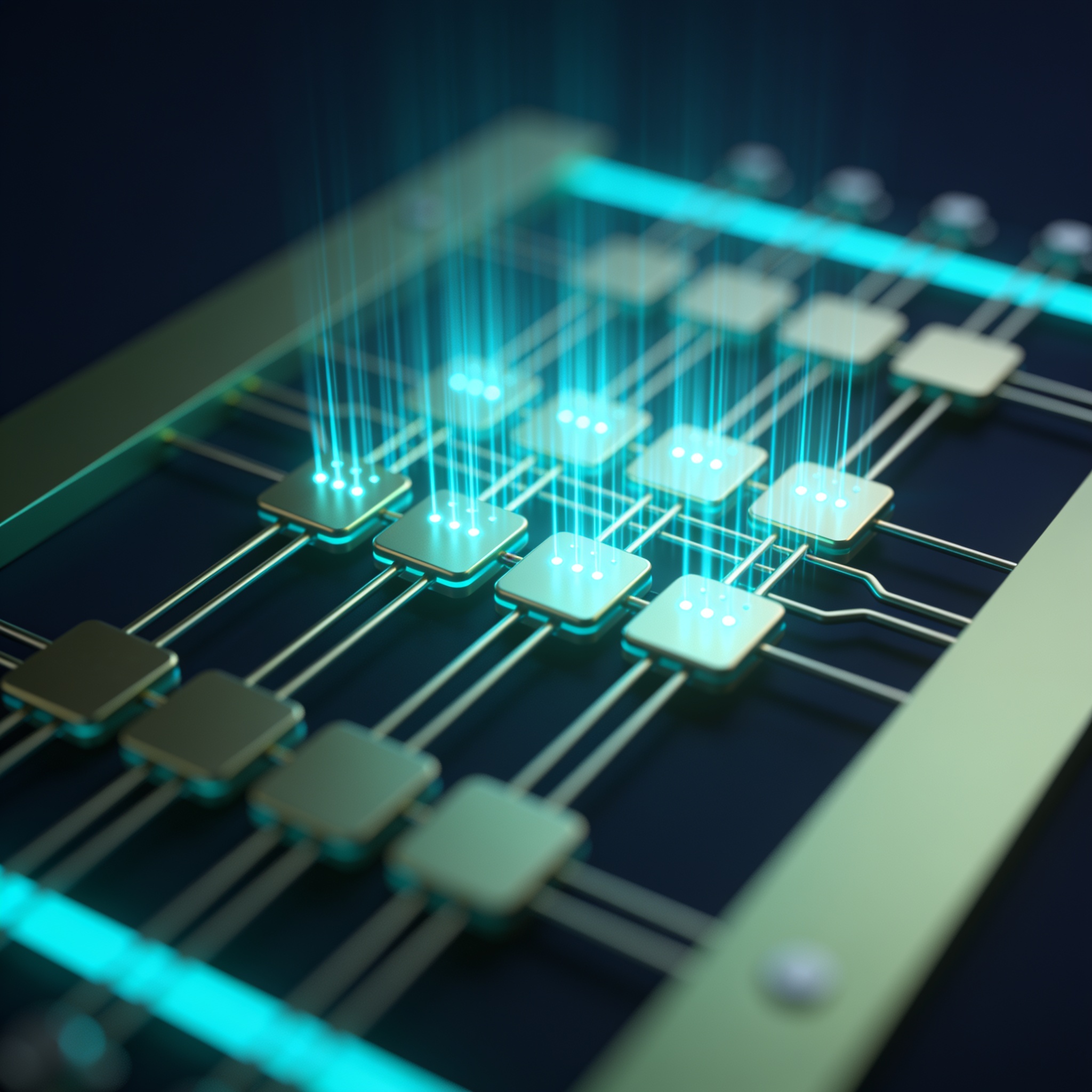
A single layer of quantum gates—applied simultaneously across an entire chip—can now generate the randomness required to protect fragile quantum information. This is not an incremental improvement. It is a structural rewrite of what quantum error correction circuits demand, collapsing a multi-step process into one parallel operation that fights decoherence with the very speed that usually causes it. [arXiv:2609.01605]
The Connection
Two signals from September 2026 converge on the same physical bottleneck. The first is a mathematical breakthrough: a depth-1 quantum expander on the unitary group, published to arXiv on September 1, that constructs constant-degree, constant-gap expanders where each unitary requires only a single layer of Pauli or CNOT gates. The second, appearing on Phys.org on September 2, examines what happens when superconductors become so thin that electrons lose their three-dimensional behavior—a confinement effect that directly limits how densely qubits can be packed before crosstalk and material defects overwhelm coherence. This matters because quantum error correction consumes roughly 90% of every logical qubit's physical footprint. The depth-1 expander attacks the time cost of syndrome measurement cycles. The thin-film superconductor research attacks the spatial cost of qubit fabrication. The timing is not coincidental: the field is converging on the realization that fault-tolerant quantum computing will not arrive through brute-force qubit counts alone. It requires a simultaneous assault on circuit depth and material quality.
How It Works
A quantum expander is a set of unitary operations that, when applied randomly, scrambles quantum information so thoroughly that the resulting state behaves like a Haar-random state—the gold standard for randomness in quantum mechanics. Previous constructions by Bourgain and Gamburd established that such expanders exist, but they left the gap's dependence on dimension uncontrolled. The new paper closes this gap explicitly. The authors construct a constant-degree expander where every unitary is either a single T gate, a single T-dagger gate, or a depth-1 Clifford circuit. "This implies that a random sequence of unitaries from the expander yields a gapped walk on a dense subgroup of the unitary group," the abstract states.
Think of it this way: if previous expanders required a chef to chop, sauté, and plate sequentially, this depth-1 construction does all three steps simultaneously on every ingredient. The circuit depth—the number of sequential gate layers before qubit decoherence erases the computation—drops from logarithmic or linear scaling to exactly one. For surface code implementations, where syndrome measurement circuits typically require four to eight layers of entangling gates per round, this construction opens a path to single-shot stabilizer extraction. The expander also produces a family of frustration-free 1D Hamiltonians whose ground states satisfy an entanglement-gap relation of S = Θ(Δ^{-1/2}), a scaling believed optimal but unproven until now.
The second signal addresses the substrate. When superconducting films thin below approximately 10 nanometers, the electron wavefunction confinement shifts the density of states at the Fermi level. Giovanni Ummarino and his colleague at Politecnico di Torino have mapped how this quantum confinement directly alters the superconducting critical temperature and the material's ability to screen magnetic fields—the Meissner effect that protects qubits from flux noise. Thinner films mean denser qubit packing. Denser packing means shorter interconnects and faster gate operations. But thinner films also mean stronger confinement effects that can suppress superconductivity entirely if not engineered precisely. The two papers together define the boundary conditions for building a million-qubit processor: you need depth-1 randomness to run error correction fast enough, and you need atomically-precise thin films to fit the qubits close enough.
Who's Moving
IBM (NYSE: IBM) operates the largest superconducting quantum fleet, with its 1,121-qubit Condor processor deployed in 2024 and the Heron architecture targeting modular, error-corrected scaling through 2026. Google Quantum AI, a division of Alphabet (NASDAQ: GOOGL), demonstrated below-threshold surface code error correction on its 105-qubit Willow processor in late 2024 and has publicly committed to a 1,000-logical-qubit system by 2029. Both companies rely on superconducting transmon qubits fabricated on thin-film substrates—exactly the regime where Ummarino's confinement physics applies.
Quantinuum, the Honeywell-backed trapped-ion company, takes a different physical approach but faces the same circuit-depth constraints in its error correction protocols. Its H2 processor, with 56 fully-connected qubits and 99.8% two-qubit gate fidelity, runs surface code cycles that still require sequential gate layers. The depth-1 expander construction applies to any platform where Pauli and CNOT gates are native, making it immediately relevant across superconducting, trapped-ion, and neutral-atom architectures. On the materials side, Rigetti Computing (NASDAQ: RGTI) fabricates its own superconducting chips and has invested $40 million in a dedicated foundry capable of sub-10-nanometer film deposition—precisely the thickness regime where confinement effects dominate.
Why 2026 Is Different
Three timelines converge. In 12 months, the depth-1 expander construction will undergo experimental benchmarking on IBM's and Google's open-access quantum platforms, testing whether single-shot syndrome extraction maintains fidelity above the 99% threshold required for surface code error suppression. In three years, foundry processes for superconducting films at 5-10 nanometer thickness will reach the uniformity needed for 10,000-qubit processors—the scale at which 100 logical qubits become viable. In five years, the combination of depth-1 error correction circuits and confinement-optimized thin films enables the first demonstration of a logical qubit with error rates below 10^{-10} per gate operation, the threshold for running Shor's algorithm on cryptographically relevant integers. The quantum computing market, valued at $1.2 billion in 2025, projects to $6.5 billion by 2030 according to McKinsey's Quantum Technology Monitor, driven almost entirely by progress in quantum error correction.
Conclusion
The depth-1 expander and the thin-film confinement research solve complementary halves of the same problem: error correction overhead. One shrinks the time cost of syndrome measurement to a single clock cycle. The other shrinks the spatial cost of qubit fabrication to atomic scales. Neither alone delivers fault-tolerant quantum computing. Together, they define the physical limits of how small and how fast a logical qubit can be. In short: quantum error correction at depth-1 removes the sequential circuit bottleneck that has kept logical qubit counts below 100, clearing the path to fault-tolerant machines within five years.
Frequently Asked Questions
What is a quantum expander?
A quantum expander is a small set of unitary operations that, when applied in random sequence, produces quantum states indistinguishable from truly random (Haar-random) states. It functions as a randomness amplifier for quantum circuits, essential for error correction, randomized benchmarking, and cryptographic protocols. The new depth-1 construction achieves this with a single parallel layer of gates.
How does depth-1 quantum error correction compare to standard surface code approaches?
Standard surface code syndrome extraction requires four to eight sequential layers of entangling gates per round, each layer adding decoherence risk. Depth-1 correction collapses this to a single parallel gate layer, reducing the time qubits spend unprotected by a factor of four to eight. This directly improves logical error rates without requiring higher physical qubit fidelity.
When will fault-tolerant quantum computing be commercially available?
The first commercially useful fault-tolerant systems—capable of running algorithms that classical computers cannot match—will appear between 2029 and 2031. Google Quantum AI targets 1,000 logical qubits by 2029. IBM's roadmap places error-corrected systems in the same window. The depth-1 expander accelerates this timeline by reducing the circuit overhead that dominates current error correction protocols.
Which companies are leading in quantum error correction?
Google Quantum AI demonstrated below-threshold surface code error correction on its 105-qubit Willow processor in 2024. IBM operates the largest superconducting fleet with its 1,121-qubit Condor processor and Heron architecture. Quantinuum's H2 trapped-ion processor achieves 99.8% two-qubit gate fidelity. Rigetti Computing fabricates its own superconducting chips optimized for error correction experiments.
What are the biggest obstacles to quantum error correction adoption?
The primary obstacle is overhead: protecting a single logical qubit requires roughly 1,000 physical qubits with current surface code implementations. Circuit depth compounds this problem by requiring sequential gate operations during which qubits decohere. The depth-1 expander directly attacks the depth problem. Thin-film material quality, addressed by Ummarino's confinement research, attacks the qubit density problem.