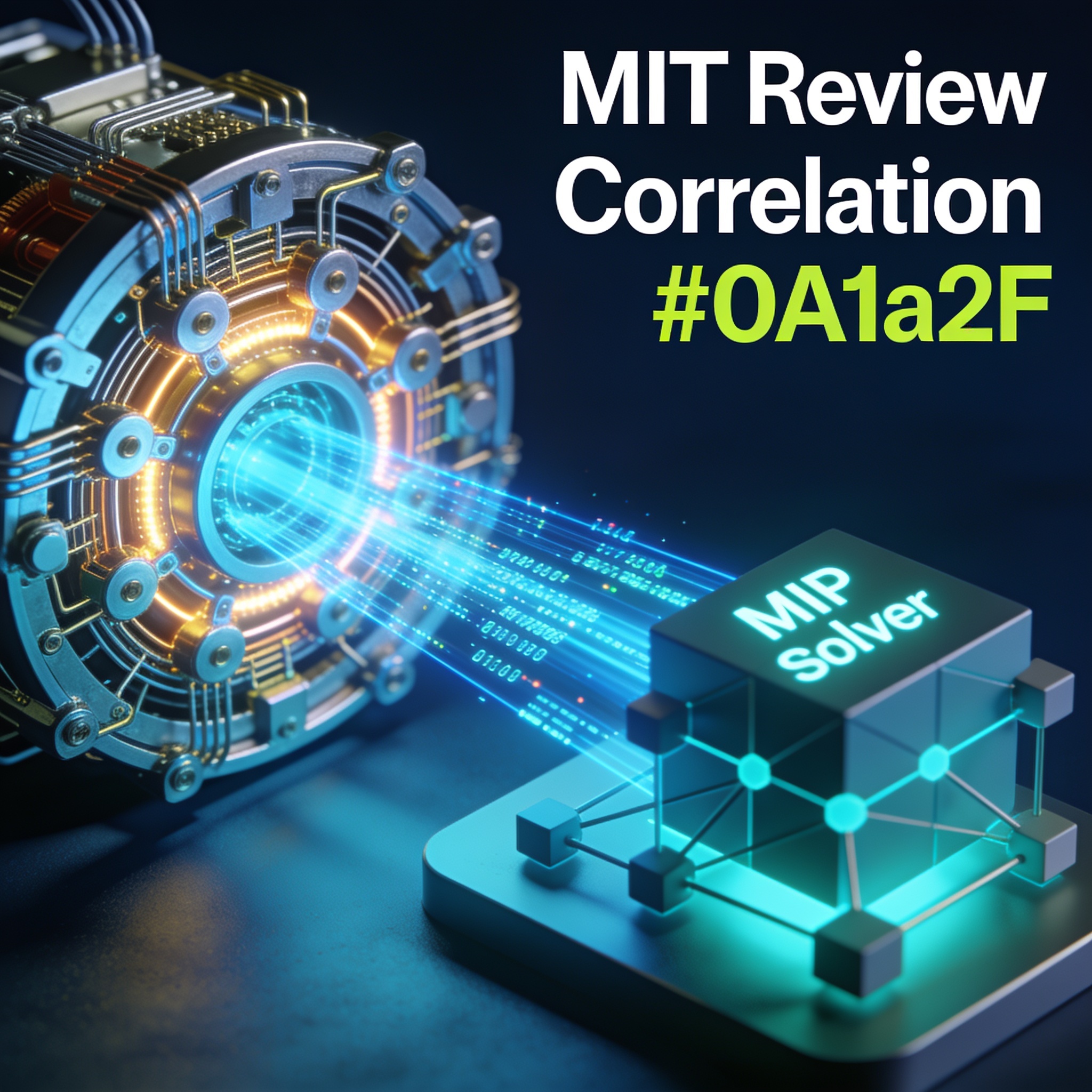
On September 3, 2026, Rigetti Computing and Purdue University researchers published a joint paper extending Rigetti’s quantum preconditioning framework to hard-constrained combinatorial optimization problems. The work uses correlation data from shallow Quantum Approximate Optimization Algorithm (QAOA) circuits to adjust objective functions before handing them to classical Mixed-Integer Programming (MIP) solvers. The goal is to improve solution quality without requiring fault-tolerant quantum hardware.
What They’re Actually Building
The quantum preconditioning approach relies on extracting two-point variable correlations from QAOA runs with minimal circuit depth—often just a single layer. These correlations form a matrix that quantifies how likely variable pairs are to share the same value in a near-optimal solution. That matrix is then used to modify the linear objective function of a MIP model, effectively “rewarding” or “penalizing” decision variables in a way that guides the classical solver toward high-quality feasible regions.
Rigetti previously demonstrated the technique for unconstrained problems. The new work extends it to constrained formulations—the bread and butter of industrial optimization in logistics, finance, and manufacturing. The team tested the framework on small-scale instances of the capacitated vehicle routing problem and other NP-hard constrained models, using Rigetti’s Ankaa-3-class 84-qubit superconducting processors with two-qubit gate fidelities around 99.5%.
This remains a NISQ-era technique. The QAOA circuits are too shallow to provide a true quantum speedup; instead, the idea is to leverage even a poor quantum signal to give classical solvers a better starting point. The paper does not claim to beat purely classical methods on time-to-solution. It only demonstrates that the quantum correlation matrix can alter the solver’s trajectory—a necessary but not sufficient condition for practical advantage.
Winners and Losers
If the technique matures, the immediate winners would be the commercial MIP solver vendors—Gurobi, IBM CPLEX, FICO Xpress—who could integrate such quantum preconditioners as plugins. Rigetti would benefit by positioning its cloud platform as a source of “correlation data” for these solvers. Purdue researchers gain publication and IP.
Losers are harder to identify because the performance bar is still low. Pure-play quantum optimization startups, such as the annealing-focused D-Wave Systems (which already offers hybrid quantum-classical solvers) or algorithm startups like QC Ware and 1QBit, face another competitor in the hybrid race. However, D-Wave’s Leap service already delivers CQM (Constrained Quadratic Model) hybrid solvers that tackle constrained problems directly, often returning solutions faster than classical heuristics for some problem classes. Rigetti’s offering is currently a research result, not a product.
For enterprise buyers, the development does not yet tip any procurement decision. The competitive moat remains with companies that can demonstrate end-to-end solution quality improvements on production-scale instances.
The Bigger Picture
In 2026, the quantum computing industry is increasingly split between two narratives: the long road to fault-tolerant logical qubits, and pragmatic hybrid workflows that might extract value from noisy hardware sooner. Rigetti’s preconditioning framework falls squarely into the second camp. Government agencies like DARPA (via the US2QC program) are actively funding utility-scale quantum demonstrations, but those remain at least several years away.
Comparable hybrid efforts include IBM’s warm-start optimization techniques using approximate quadratic programs or QAOA, and IonQ’s partnership with Zapata Computing on generator-enhanced optimization with trapped ions. The unique angle for Rigetti is the use of correlation matrices from QAOA to reshape MIP objectives—a choice that sidesteps direct quantum-classical competition and instead tries to make the quantum device a “co-processor for correlations.”
Still, the landscape is littered with hybrid optimization papers that promise potential but never beat Gurobi’s default heuristics on anything practical. Rigetti’s paper does not break that pattern yet. The milestone that would matter is a reproducible benchmark showing that the quantum preconditioner, when added to a state-of-the-art MIP solver, reduces optimality gap or time-to-solution by a factor of, say, 2x or more on industry-relevant instances of constrained problems.
The Signal
The signal here is that Rigetti is building a narrative around hybrid optimization software that rides on its cloud hardware, but the absence of a clear performance advantage over classical-only approaches keeps the work at the level of academic exploration. Preconditioning is a known trick in numerical optimization; using a quantum device to generate it is conceptually interesting, but the quantum resource must be so cheap and the classical benefit so clear that users are willing to pay for quantum compute minutes. That business case has not been made. The collaboration with Purdue suggests Rigetti is keeping its research pipeline active while it continues to ship its Ankaa-class systems and prepare for the 336-qubit Lyra architecture. What would validate the approach is a peer-reviewed study showing statistically significant improvement on a recognized MIP benchmark set—not just feasibility on toy instances.
In short: Rigetti’s quantum preconditioning framework now addresses constrained optimization, but the field still awaits evidence that QAOA-generated correlations can beat purely classical presolve heuristics on real-world scale.