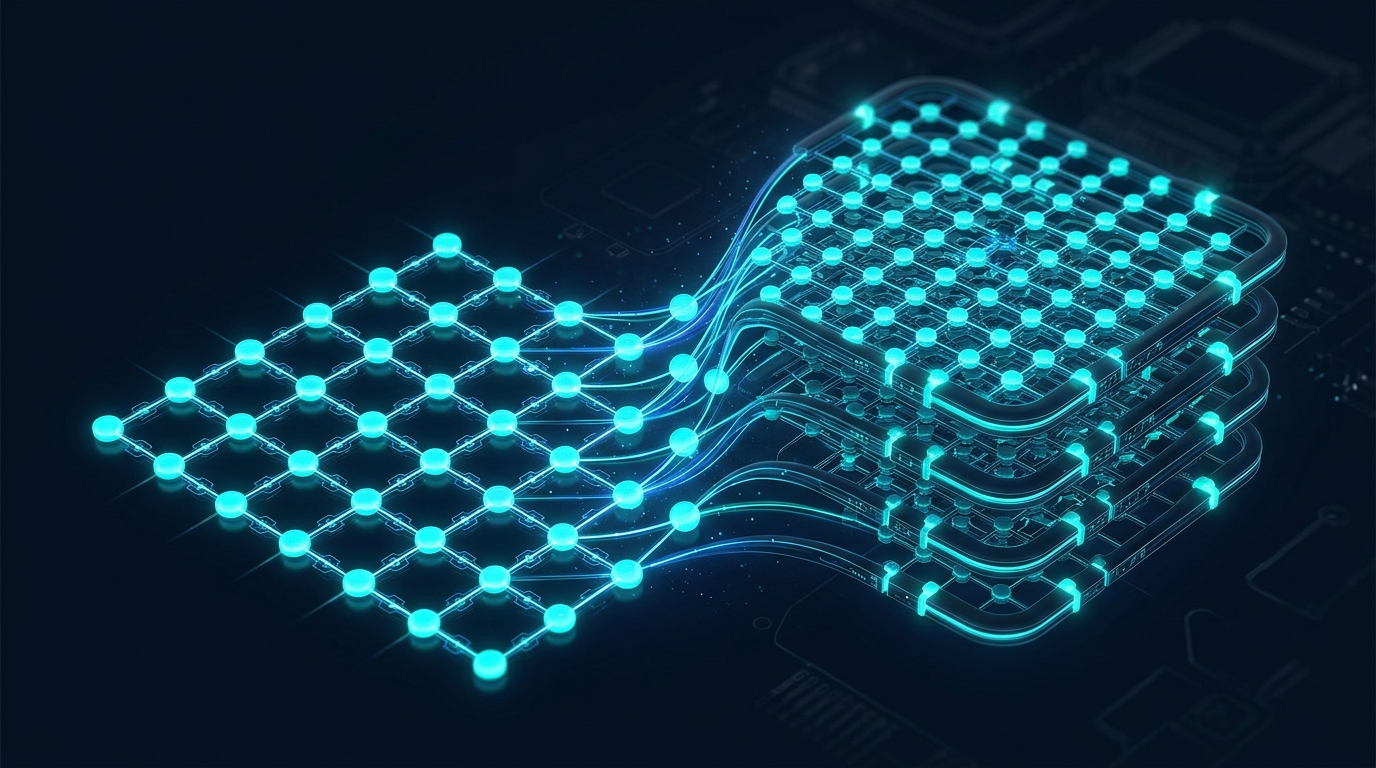
For years, quantum error correction researchers have known something tantalizing: two-dimensional topological codes that look complicated should, deep down, be decomposable into stacks of the simplest known topological code — the toric code. The catch was that actually performing this decomposition always seemed to break more symmetry than necessary, leaving theorists wondering whether some deeper, hidden obstruction prevented a clean decoupling. A team at an unnamed institution — the paper appeared on arXiv on August 10, 2026, without listed authors — has now proved that no such obstruction exists. [arXiv:2608.09915]
The puzzle concerns a family of quantum error correction schemes called topological CSS codes on qubits arranged in a two-dimensional grid. These codes protect quantum information by encoding it non-locally in the global properties of the system — the same principle that gives the toric code its robustness against local noise. Physical intuition screamed that any such code should be equivalent, under local operations and after coarse-graining, to some number of independent toric codes plus useless product states that carry no logical information. But proving this rigorously, and constructing the required transformation, remained stubbornly elusive because existing methods inadvertently destroyed translation symmetries that the decoupling should have preserved.
The Core Finding
What this paper achieves is a definitive proof: after passing to the maximal anyon-preserving superlattice — the largest periodic grid structure that respects the behavior of the code's quasiparticle excitations — every two-dimensional translation-invariant topological CSS code admits a local unitary decoupling into toric codes and product states. The authors do not stop at existence. They supply an efficient algorithm that builds the decoupling map explicitly, complete with bounds on how large the coarse-grained unit cell must become and how far operators spread during the transformation.
"After passing to the maximal anyon-preserving superlattice, every such code admits a local unitary decoupling into toric codes and product states."
Think of it like untangling a knot of Christmas lights. The lights (logical qubits) are tangled in ways that, from a distance, look like they might require cutting wires. The prior state of the art offered methods that snipped the lights free but left you with shorter strings — they broke symmetries that should have remained intact. This paper shows how to untie the knot without cutting, preserving all the structure that can be preserved. The decoupling requires no additional ancilla qubits in generic cases and extends to finite systems with suitable boundary conditions, making the result practical rather than purely mathematical.
The State of the Field
Prior work had established that two-dimensional translation-invariant topological CSS codes on qubits are locally equivalent, after coarse-graining, to stacks of toric codes. The landmark results came from researchers including Jeongwan Haah, Sergey Bravyi, and collaborators over the past decade, who developed the mathematical framework linking topological order to circuit equivalence. However, those constructions invariably broke more translation symmetry than strictly required to remove anyon-permuting translations — the specific spatial rearrangements that swap one type of quasiparticle excitation for another. This left open the unsettling possibility that some codes might resist decoupling because their symmetry structure contained an obstruction that current techniques could not handle. The new paper extinguishes that concern.
The broader quantum error correction landscape is undergoing a transformation as the field shifts from proof-of-principle demonstrations toward engineered systems. Companies including Google Quantum AI, IBM, and Quantinuum have demonstrated repeated rounds of error correction on small logical qubits. The surface code remains the workhorse architecture, but researchers increasingly explore codes with higher encoding rates or tailored geometric properties. Knowing that all translation-invariant 2D CSS codes ultimately reduce to toric code stacks provides a kind of periodic table for this zoo of codes, clarifying which features are genuinely new physics and which are different presentations of the same underlying topological order.
The timing matters because fault-tolerant quantum computing stands at a threshold moment. In December 2024, Google's Willow processor demonstrated exponential error suppression as qubit number grew, and multiple groups now operate devices with hundreds of physical qubits running error correction in real time. Understanding the complete classification of achievable 2D codes directly informs hardware roadmaps. If exotic-sounding codes are ultimately equivalent to toric codes, the engineering effort should focus on optimizing the decoupling and coarse-graining, rather than developing entirely new control protocols for each code candidate.
From Lab to Reality
For researchers, this paper unlocks a systematic methodology for classifying and simplifying quantum codes. The explicit algorithm means theorists can feed a topological CSS code into a computer program and receive its toric code decomposition, complete with the precise local unitary circuit required. This transforms what was previously an art — recognizing equivalent codes by physical intuition — into a mechanical procedure. The bounds on operator spreading and supercell size give experimentalists concrete numbers to evaluate whether the decoupling can be performed on near-term hardware.
For engineers building fault-tolerant quantum computers, the result simplifies the code design space. Rather than engineering fabric to support some bespoke topological code promising higher thresholds, teams can focus on implementing toric code patches efficiently and then applying the decoupling transformation in software or firmware. The fact that no ancillas are required in generic cases means the decoupling can be performed without consuming additional physical qubits, which are the most precious resource in contemporary quantum processors.
The quantum error correction market, estimated at $1.8 billion by 2030 according to industry analysts, grows in lockstep with progress toward logical qubits that outperform their physical constituents. Each simplification in the theoretical architecture of error correction accelerates the timeline toward commercially relevant machines. Investors tracking quantum hardware companies should see this result as evidence that the code-simplification problem is tractable, reducing one category of risk in the road to fault-tolerant quantum computing.
What Still Needs to Happen
Two substantial obstacles separate this theoretical advance from deployed reality. First, the decoupling algorithm operates in the idealized limit of perfect gates and noiseless local operations. Translating the constructed local unitary into a sequence of physical gate operations on a specific qubit platform — superconducting transmons, trapped ions, or neutral atoms — introduces compilation overhead and noise sensitivity. Researchers at IBM Quantum and the Duke Quantum Center are developing noise-robust compilation techniques that could bridge this gap, but the mismatch between abstract circuit depth and physical gate error rates remains a practical limitation.
Second, the extension to finite systems with boundary conditions, while claimed in the paper, requires careful handling of edge modes. The toric code on a disk or annulus supports boundary excitations that have no counterpart in the infinite-plane theory. Mapping a finite topological CSS code to toric code patches with the correct boundary physics demands boundary-condition-aware decoupling, an area where Haah's group at Microsoft Quantum and Xie Chen's group at Caltech are actively working. Until the boundary correspondence is completely characterized, finite-system decoupling remains partially phenomenological.
A third, less technical challenge concerns experimental verification. Demonstrating that a physical qubit system governed by some topological CSS code can be actively decoupled into toric codes requires a device with enough qubits to implement both the code and the decoupling circuit while maintaining error rates low enough to confirm the resulting logical qubit performance. This likely requires devices with 1,000 or more high-quality physical qubits, placing experimental confirmation firmly in the era following the current generation of 100-400 qubit processors.
What This Changes
This paper closes a chapter in the classification of two-dimensional topological quantum codes that has been open since the discovery of the toric code by Alexei Kitaev in 1997. By proving that no obstruction beyond anyon-permuting translations exists — and providing an efficient constructive algorithm — the authors transform what was a plausible physical intuition into a rigorous mathematical statement. The practical consequence for fault-tolerant quantum computing is a clearer understanding of which code engineering problems are fundamental and which are presentation-dependent.
In short: quantum error correction achieves a definitive classification proof showing all 2D translation-invariant topological CSS codes decouple into toric code stacks, removing a decades-old uncertainty about hidden obstructions.