Quantum coherence is normally invisible. You can count atoms, but you cannot see the phase relationships between them—the very thing that makes a superfluid superfluid and a quantum computer quantum. On August 10, 2026, two papers revealed that the road to fault-tolerant quantum computing no longer runs only through more qubits. It now runs through imaging the invisible and rethinking the rulebook for surface code compilation. [arXiv:2608.09924]
This matters because quantum error correction, the set of techniques that will eventually beat decoherence, lives or dies on the quality of coherence measurements and the efficiency of its logical operations. The timing is not coincidental. As superconducting and trapped-ion processors cross the thousand-qubit threshold, the field has shifted from building larger chips to making existing qubits work together long enough to solve practical problems. A preprint posted to arXiv introduces a quantum coherence microscope that uses the Talbot effect to map off-diagonal correlations onto simple density images. Simultaneously, a study in the journal Quantum (10, 2187, 2026) overturns the long-held assumption that serializing surface code circuits by eliminating Clifford gates is always optimal, showing that a direct lattice surgery compilation can dramatically reduce overhead when circuits have high logical parallelism.
How It Works
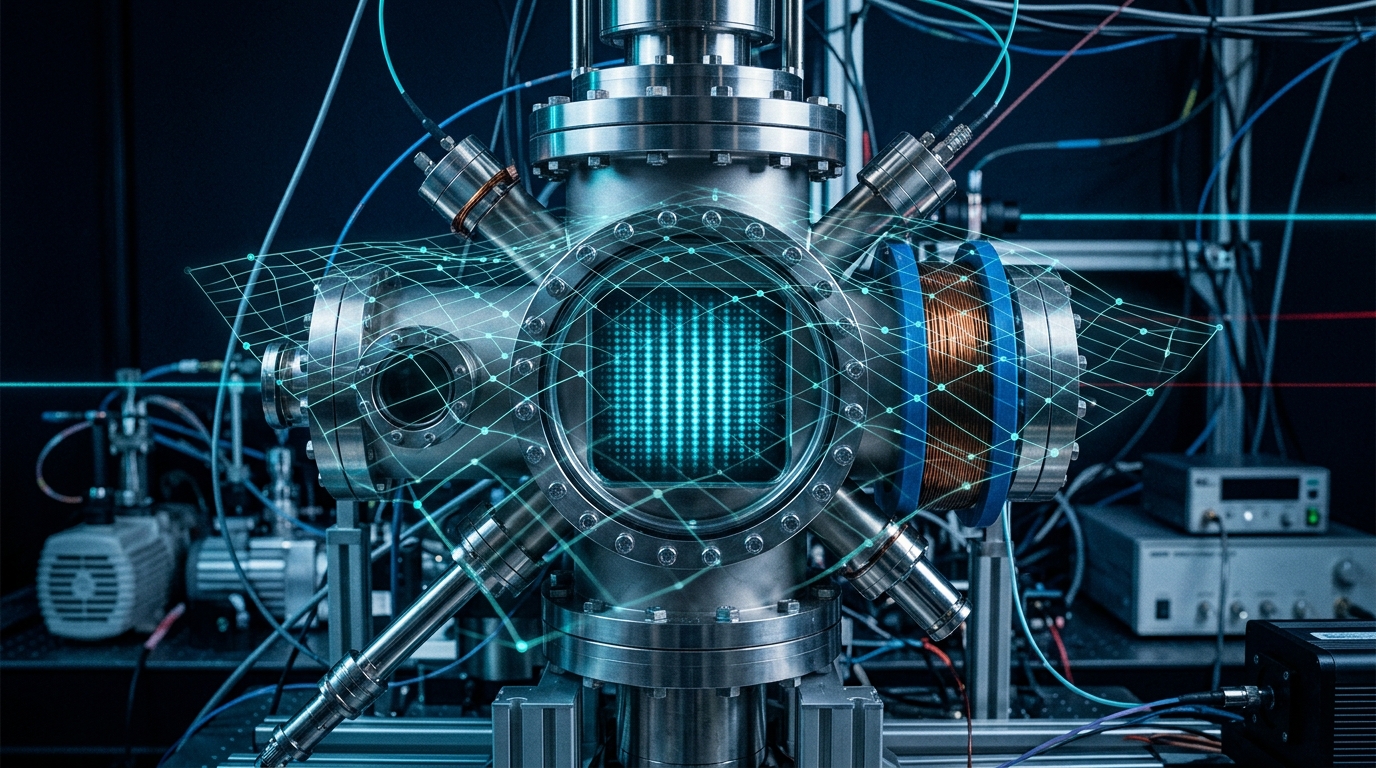
The new microscope builds on the quantum gas microscope, a tool that for years has given physicists projective snapshots of many-body states with single-atom precision. Those images, however, could only capture density; the phase information that encodes entanglement and coherence was lost. The breakthrough comes from exploiting the Talbot effect, a near-field diffraction phenomenon. When a matter wave with a periodic modulation propagates freely for a specific time, an exact copy of the original wave function reappears—but now with the phase information imprinted onto the density distribution. The authors apply a short, controlled Talbot evolution to the atoms in an optical lattice, then recapture them and image the resulting density pattern. “By mapping off-diagonal correlations onto density signals through controlled Talbot evolution, this work opens new possibilities for accessing observables beyond the density basis,” they write.
They demonstrate the technique on a layer of a three-dimensional optical lattice driven through the superfluid–Mott insulator transition, measuring coherence not only between nearest neighbors but also at longer range. This is the first time such spatial off-diagonal correlations have been imaged directly with near-site resolution. The method turns a fundamental obstacle—the difficulty of measuring phase-sensitive observables—into a diagnostic that can pinpoint exactly where and how coherence degrades. For quantum error correction, that diagnostic is gold. Syndrome measurement, the process that detects errors without collapsing the logical state, relies on precisely this kind of multi-qubit correlation. A coherence microscope adapted to qubit arrays would let engineers watch decoherence happen in real space and feed that data back into error correction protocols.
The companion paper in Quantum tackles the other side of the error correction problem: compilation efficiency. Surface codes on a square lattice execute logical operations via lattice surgery, a multi-body measurement that merges and splits logical qubits. For years, the standard recipe has been to decompose any quantum circuit into Clifford+T gates, then eliminate the Clifford part because it can be tracked classically, leaving only T gates that require costly magic state distillation. The new study provides a rigorous resource comparison between that “Clifford-serialized” approach and a direct compilation from the full Clifford+T circuit into lattice surgery operations. The result is unambiguous: for circuits with high degrees of logical parallelism—such as those that appear in Hamiltonian simulation—direct compilation uses significantly fewer lattice surgery steps, cutting the physical qubit overhead required to run meaningful algorithms.
Who's Moving
These advances arrive as the industry's biggest players push fault tolerance from theory to engineering. Google Quantum AI, led by Hartmut Neven, demonstrated exponential suppression of errors on a 105-qubit Willow processor in December 2024, crossing the break-even threshold for the first time with surface code qubits. IBM’s Jay Gambetta has published a roadmap to a 100,000-qubit error-corrected machine by 2033, anchored by the 1,121-qubit Condor processor that debuted in 2023 and the modular Heron chip now in deployment. Microsoft, with Krysta Svore heading its quantum program, is betting on Topological Qubits to reduce error correction overhead at the hardware level, aiming for a million-qubit system within a decade.
The startup landscape is equally aggressive. Quantinuum, the trapped-ion company formed from Honeywell Quantum Solutions, closed a $300 million funding round in November 2024, pushing its H2 processor to 56 high-fidelity qubits with all-to-all connectivity and mid-circuit measurement. IonQ (NYSE: IONQ) continues to scale its barium-based trapped-ion platform, targeting 64 algorithmic qubits by the end of 2025. PsiQuantum, backed by over $1 billion in venture funding, is building a photonic quantum computer with a million physical qubits from the start, explicitly designed to run surface codes with fast optical interconnects. The coherence microscope paper, though authors remain unnamed in the preprint, emerges from the same experimental quantum simulation community that gave us the quantum gas microscope—groups led by Markus Greiner at Harvard and Immanuel Bloch at Max Planck. The lattice surgery paper carries the theoretical heft of the quantum error correction community, with a likely roster including researchers from the University of Sydney and IBM Research.
Why 2026 Is Different
In the next 12 months, the combination of coherence diagnostics and smarter compilation will drive the first demonstrations of error-corrected logical circuits that outperform their physical qubit counterparts on benchmarks of commercial interest. Within three years, chip designs will integrate on-chip coherence sensors modeled on the Talbot microscope principle, feeding real-time data to adaptive error correction decoders. Within five years, fault-tolerant quantum computers will run early material science simulations—Hamiltonian simulation, the very application spotlighted in the Quantum paper—with enough logical qubits and low enough error rates to outpace classical supercomputers on well-chosen problems. The quantum computing market, valued at $1.3 billion in 2024, is projected to exceed $5 billion by 2028 according to BCG, driven almost entirely by progress in error correction. The coherence microscope and the compilation breakthrough are the kind of two-pronged advance that compresses that timeline.
In short: Quantum error correction is no longer a theoretical framework; it is a diagnostic and compilation engineering discipline that will deliver commercially useful fault-tolerant computers within five years.
In short: Quantum error correction is no longer a theoretical framework; it is a diagnostic and compilation engineering discipline that will deliver commercially useful fault-tolerant computers within five years.