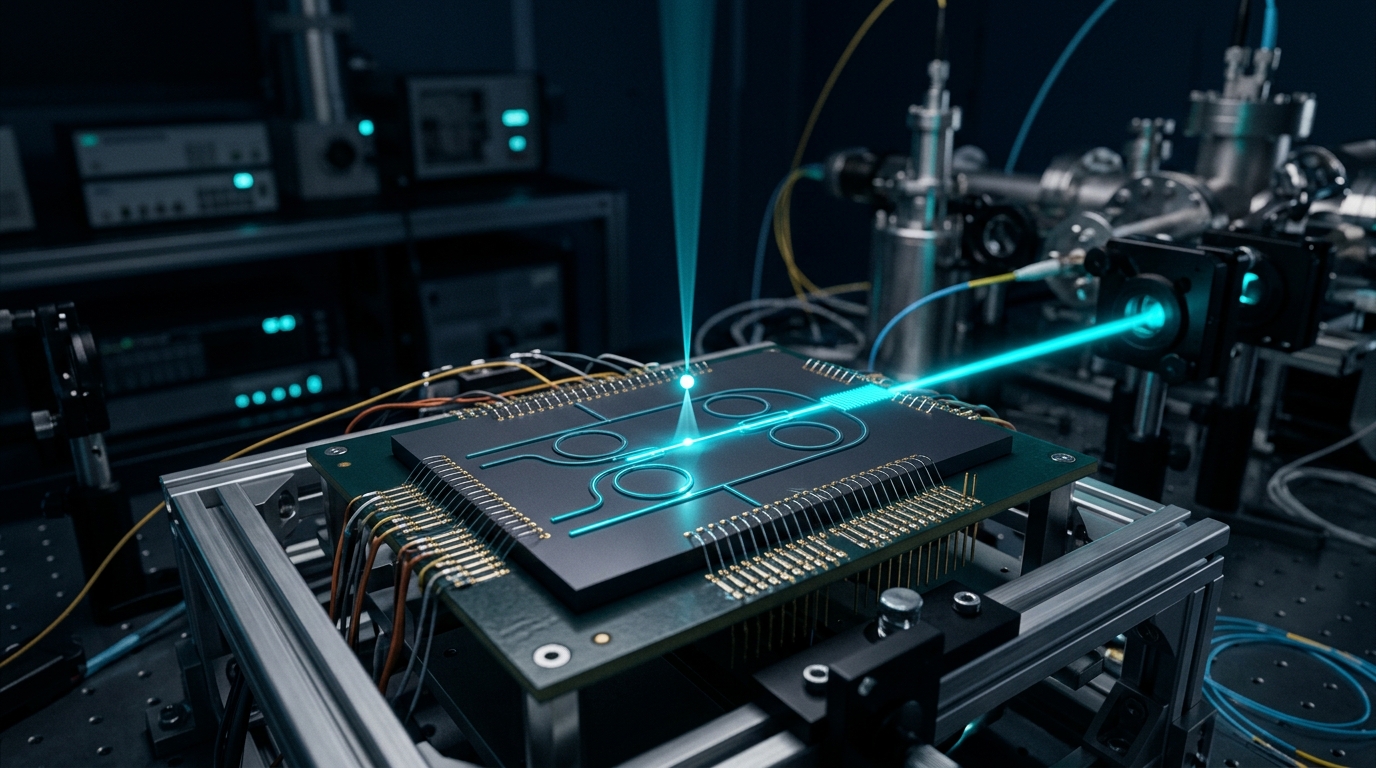
On August 11, 2026, Pasqal announced it had trapped individual neutral atoms using laser light generated and routed entirely through a photonic integrated circuit (PIC). The French quantum computing company, in collaboration with its subsidiary Aeponyx, replaced the bulky free-space optical tables typical of neutral-atom systems with a solid-state silicon nitride chip. The achievement, developed less than 18 months after acquiring Aeponyx, marks the first time on-chip photonics has been used for neutral-atom qubit trapping.
What They're Actually Building
Neutral-atom quantum computers use arrays of ultracold atoms—typically rubidium or strontium—held in optical tweezers, which are laser beams focused to micron-scale spots. Each atom acts as a qubit, with its internal states encoding quantum information. To control and read out hundreds of atoms, existing systems require a forest of free-space lenses, mirrors, and modulators spread across optical tables. That approach becomes a scaling nightmare as qubit counts rise.
Pasqal’s demonstration shrinks the optical control system onto a photonic chip. The silicon nitride PIC generates the laser light, shapes the beams, and routes them to precisely defined points on the chip surface, where atoms are trapped in evanescent fields just above the waveguides. This is a classic systems-integration problem: the physics of neutral-atom trapping is well understood, but the engineering of reliable, mass-producible optical delivery has been a bottleneck.
Pasqal has delivered 100-qubit processors to research customers and targets 1,000 qubits by 2026 and 10,000 qubits within the decade. The PIC milestone is a building block for that roadmap. It does not immediately improve gate-fidelity, which for neutral atoms currently hovers around 99.5% for two-qubit operations. Instead, it addresses the physical footprint, assembly complexity, and cost of the optical control layer. Competitor QuEra, for example, has demonstrated 48 logical qubits on a 256-atom array using free-space optics. Atom Computing and Infleqtion also rely on conventional optics. If Pasqal can integrate the PIC with active qubit control and readout, it could leapfrog in system density and reliability.
Winners and Losers
The immediate losers are the neutral-atom rivals that lack in-house photonic integration capabilities. QuEra, a Harvard spinout, has deep expertise in optical tweezers but has not announced a PIC trapping demo. Atom Computing, which uses strontium, faces similar integration challenges. Infleqtion (formerly ColdQuanta) focuses on compact vacuum systems but still uses free-space optics for its atom chips. Replicating Pasqal’s achievement would require a dedicated photonics team or acquisition—a path that takes time and capital.
Winners include the silicon photonics foundry ecosystem. TSMC, GlobalFoundries, and specialized fabs such as LioniX International and VTT could see increased demand for silicon nitride PICs from the quantum industry. Cloud providers—AWS, Microsoft Azure, and Google Cloud—stand to benefit from smaller, more robust quantum processors that can be deployed in standard data-center racks rather than research-lab basements. For investors, Pasqal’s early acquisition of Aeponyx now looks like a prescient move that creates a moat around integrated neutral-atom hardware. The company, which raised a €100 million Series C in 2023, may see its valuation rise further if it can demonstrate full qubit control on the same platform.
The Bigger Picture
The 2026 quantum computing landscape is defined by three races: to logical qubits with error correction, to thousands of physical qubits, and to component-level integration that makes systems deployable. In the past 18 months, QuEra achieved 48 logical qubits in 2025, IBM showed a modular 1,121-qubit Condor chip, and IonQ delivered a 64-qubit trapped-ion system with all-to-all connectivity. Meanwhile, Intel is integrating cryogenic control chips for spin qubits, and D-Wave is pushing annealing-scale. Pasqal’s PIC milestone inserts itself into the integration narrative.
Government funding continues to fuel these developments. Europe’s Quantum Flagship, which counts Pasqal as a key partner, has earmarked €1 billion for the next decade. France’s national quantum plan, launched in 2021, has supported Pasqal’s growth. The U.S. CHIPS Act and the National Quantum Initiative are funneling billions into quantum hardware and packaging. The ability to fabricate quantum control optics in a semiconductor foundry aligns with the geopolitical push for sovereign quantum supply chains. Pasqal’s French-German collaboration with Aeponyx (originally a spin-off from the University of Münster) strengthens Europe’s position in quantum hardware manufacturing.
The Signal
This is a genuine engineering milestone, not a press-release placeholder. The signal here is that neutral-atom quantum computing is following the trajectory of transistors and integrated circuits: moving from discrete, hand-assembled components to wafer-scale fabrication. Trapping a single atom with on-chip optics proves that the concept works. The critical next step is to perform a high-fidelity two-qubit gate and readout using the same photonic platform. Until that is shown, the commercial impact remains speculative. But the direction is clear: the quantum industry is betting that integration, not just qubit count, will determine who builds a useful machine first. Pasqal has just placed a chip on that bet.
In short: on-chip neutral-atom qubit trapping via a photonic integrated circuit shrinks the optical control system of a quantum computer from a tabletop to a silicon chip, a necessary step toward the 1,000-qubit systems that could unlock early business value.