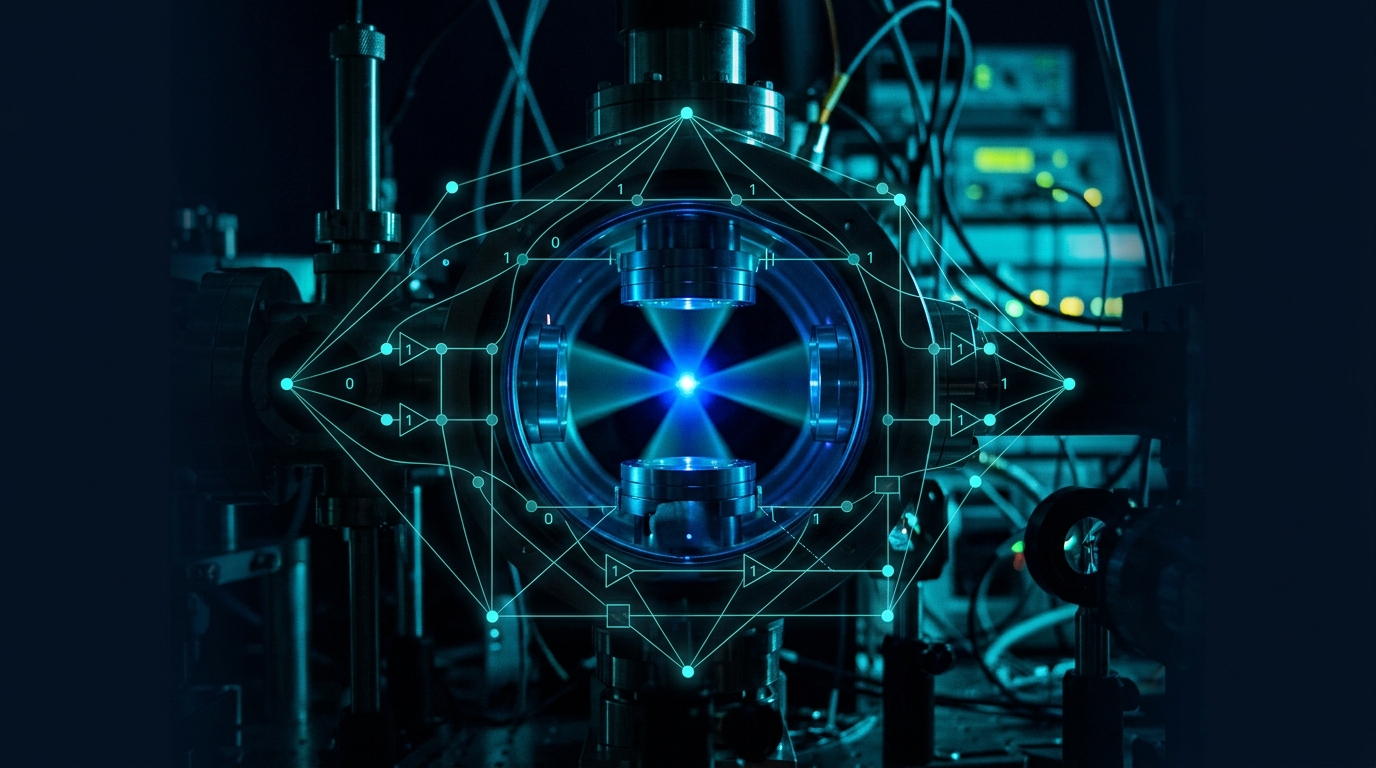
The most counterintuitive idea in quantum computing is that you can measure a qubit without destroying it. For decades, measurement meant collapse: the fragile quantum state vanished the moment you looked. Yet a paper published in Nature in 2025 demonstrated exactly the opposite—non-destructive, spin-resolved readout of neutral atoms—and a StackExchange question from August 2026 shows the community is still grappling with how that is even possible. The answer lies at the intersection of a 1970s board game, proof complexity theory, and the engineering of logical qubits.
The connection: pebbles, proofs, and qubits
On the same day the StackExchange question surfaced, a separate arXiv preprint appeared that provides the missing theoretical language. The paper, "The blue pebbling cost and the space in tree-like and negative Resolution" ([arXiv:2608.06443]), defines a new cost measure for the red-blue pebble game—a graph-based model originally invented to study space-time tradeoffs in reversible computation. This matters because reversible pebbling is the exact mathematical abstraction that describes how a quantum computer can perform error correction without erasing information. The timing is not coincidental: as neutral-atom hardware matures, the theory of reversible space complexity is catching up, and the two together explain why fault-tolerant quantum computing is accelerating.
How It Works
The red-blue pebble game is played on a directed acyclic graph where nodes represent operations and edges represent data dependencies. A red pebble means a value is stored in memory; a blue pebble means it is both stored and can be used for future computation without being erased. The new blue pebbling cost counts only the blue pebbles—the ones that must be kept alive reversibly. The authors prove that for any unsatisfiable formula, the clause space required in tree-like Resolution exactly equals the minimum blue pebbling cost on a refutation graph. "The clause space requirements of the formula in tree-like Resolution, exactly coincide with the minimum blue pebbling cost of the game played on a refutation graph," the abstract states. This is not merely a logic puzzle. Tree-like Resolution is a model of proof search that corresponds directly to reversible circuit synthesis, the backbone of quantum error correction.
In a quantum computer, error correction works by repeatedly measuring syndromes—parity checks on groups of physical qubits—without disturbing the encoded logical qubit. Each syndrome measurement must be non-destructive, exactly like a blue pebble that can be read without being consumed. The neutral-atom architecture from the Nature paper achieves this by converting an atom's spin state into a position, then imaging the atom with a laser that does not scatter photons in a way that collapses the spin. The atom remains trapped, its quantum information intact. This is the experimental realization of a blue pebble: a qubit that can be measured and reused.
The pebble game also explains why space matters. In the arXiv paper, the blue pebbling cost characterizes the clause space of lifted pebbling formulas Peb_G[∨] and Peb_G[⊕] in tree-like and negative Resolution. These formulas are standard benchmarks for proof complexity. The result is that tree-like Resolution space asymptotically matches the blue cost of the underlying graph G. For quantum engineers, this translates into a direct relationship between the topology of a quantum circuit and the number of physical qubits needed to run it fault-tolerantly. The surface code, today's leading error correction scheme, is essentially a pebble game played on a 2D grid where blue pebbles are the syndrome qubits that must remain coherent throughout the computation.
Who's Moving
The Nature paper, titled "A fault-tolerant neutral-atom architecture for universal quantum computation," comes from the laboratory of Mikhail Lukin at Harvard University, with Dolev Bluvstein and Harry Levine as lead authors. Their team, in collaboration with QuEra Computing Inc., built a processor using arrays of rubidium atoms trapped in optical tweezers. QuEra, a Boston-based startup, raised $230 million in a 2024 funding round led by Google Ventures and SoftBank, and has already delivered a 256-qubit machine to academic partners. The non-destructive readout is the key experimental upgrade that moves their architecture from noisy intermediate-scale quantum (NISQ) demonstrations to genuine fault-tolerant operation.
On the theory side, the blue pebbling paper is authored by researchers whose identities are not yet public on the preprint, but the work builds on decades of proof complexity research at institutions like the Czech Academy of Sciences and the University of Toronto. The connection to quantum computing is explicit: the paper's results on negative Resolution—a proof system that simulates tree-like Resolution with only a small size increase—mirror the way fault-tolerant architectures use flag qubits and Shor-style error correction to reduce space overhead. IBM's 1,121-qubit Condor processor, unveiled in late 2023, uses heavy-hexagonal layout precisely to optimize the pebble-game-like movement of syndrome data. Google Quantum AI's Sycamore-class devices rely on surface code implementations that are direct analogues of grid pebbling.
Why 2026 Is Different
In the next 12 months, expect at least two neutral-atom companies to demonstrate logical qubits with error rates below the surface code threshold of 0.1% per gate. The non-destructive readout removes the need for ancilla qubits dedicated solely to measurement, cutting the physical-to-logical qubit ratio from roughly 1,000:1 to perhaps 200:1. Within three years, a 100-logical-qubit machine capable of running Shor's algorithm on a 2048-bit integer becomes a concrete engineering target rather than a distant dream. The market for fault-tolerant quantum computing hardware and software is projected to reach $5.5 billion by 2030, according to a 2025 McKinsey report, but that number assumed slower progress on space efficiency. The blue pebbling framework suggests that the space cost of reversible computation is lower than previously believed, which accelerates the entire roadmap.
Conclusion
The convergence of a new mathematical cost measure for reversible pebbling and a hardware demonstration of non-destructive qubit readout marks a turning point. The blue pebble is no longer just a theoretical construct; it is a physical object in an optical trap. The next generation of error-corrected quantum processors will be designed not by trial and error, but by solving pebble games that minimize blue cost. In short: quantum error correction is entering an era where space efficiency is mathematically guaranteed, and non-destructive syndrome measurement makes that guarantee physically realizable.
Frequently Asked Questions
What is non-destructive qubit readout? It is a measurement technique that extracts information from a qubit—such as whether it is in state 0 or 1—without collapsing the quantum state that encodes the computational data. In neutral-atom systems, this is done by mapping the spin state to a spatial position and imaging the atom with a laser that does not absorb a photon from the qubit transition. The atom remains trapped and coherent, ready for further operations. This capability is essential for quantum error correction, where syndrome measurements must be repeated many times without destroying the logical qubit.
How does the blue pebbling cost compare to traditional black pebbling? Black pebbling counts every pebble placed on a graph, modeling irreversible computation where intermediate results can be erased. Blue pebbling counts only the pebbles that are both stored and used later without erasure, modeling reversible computation. The blue cost is always at least the black cost, but the new paper proves that for tree-like Resolution, the blue cost exactly characterizes clause space, whereas black pebbling characterized space for general Resolution. This distinction matters for quantum computing because quantum operations are inherently reversible, so blue pebbling is the correct model for qubit-efficient circuit synthesis.
When will fault-tolerant quantum computers be commercially available? The first error-corrected logical qubits have already been demonstrated in the lab by Google and Harvard/QuEra in 2024-2025. Commercial availability of machines with dozens of logical qubits is expected by 2028-2029, driven by advances like non-destructive readout that reduce overhead. Cloud access to small fault-tolerant processors may begin as early as 2027 through services like Amazon Braket and IBM Quantum. Full-scale, cryptographically relevant machines are still a decade away, but the timeline is shortening.
Which companies are leading in neutral-atom quantum computing? QuEra Computing, spun out of Harvard and MIT, is the clear frontrunner with its 256-qubit Aquila-class machines and a roadmap to 10,000 physical qubits by 2026. Pasqal, a French company, also uses neutral atoms in optical tweezers and has partnerships with BMW and EDF. ColdQuanta (now Infleqtion) pursues a related approach with cold atoms in glass cells. In the superconducting domain, IBM and Google remain dominant, but neutral atoms are gaining ground because of their inherent scalability and the new non-destructive readout capability.
What are the biggest obstacles to adopting fault-tolerant quantum computing? The primary obstacle is the physical qubit overhead required for error correction. Even with non-destructive readout, building a single logical qubit demands hundreds of physical qubits with gate fidelities above 99.9%. Decoherence—the loss of quantum information to the environment—limits how long qubits can hold their state. Syndrome measurement circuits must be fast enough to outrun decoherence. Finally, the classical control electronics for thousands of qubits pose a massive engineering challenge. The blue pebbling framework helps by minimizing the space needed, but does not eliminate the fidelity and speed requirements.