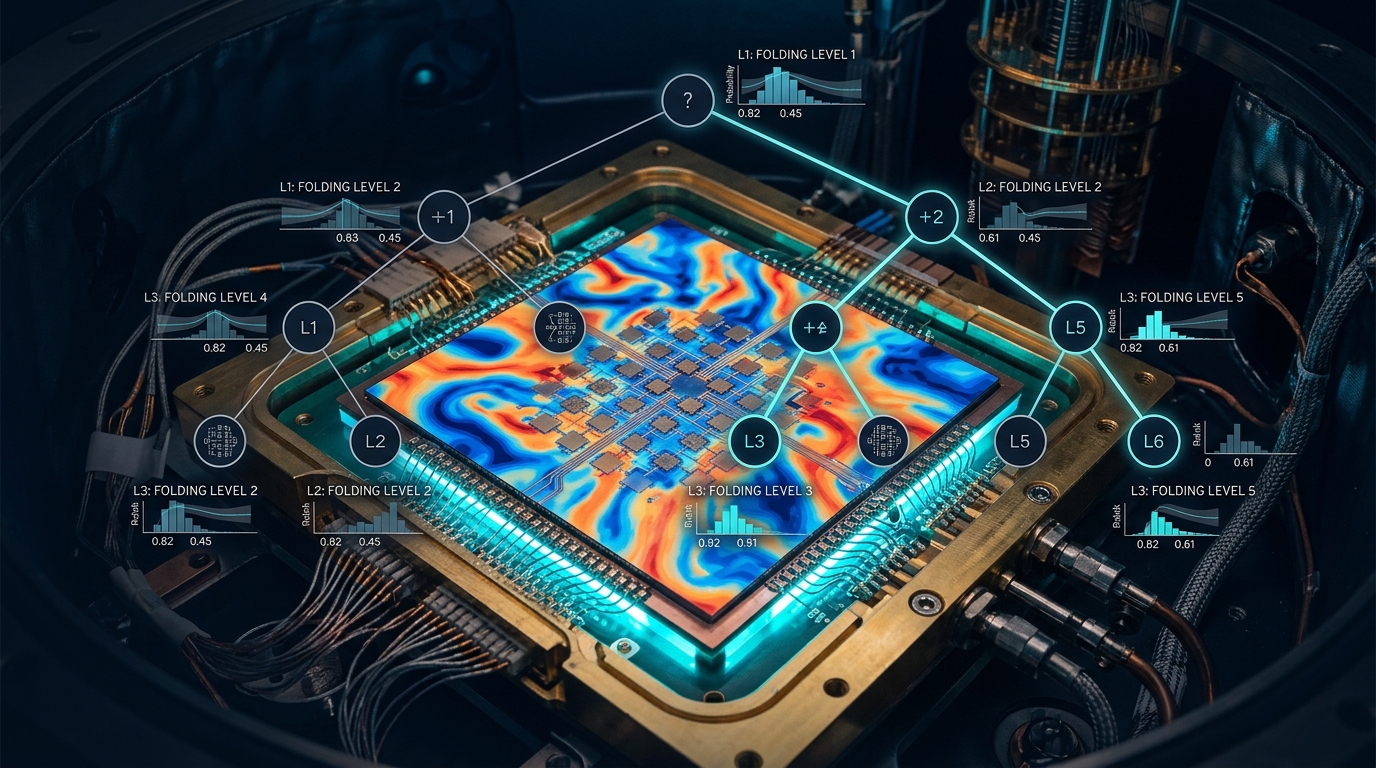
Noise on a quantum processor isn’t a fixed property—it drifts with temperature, control electronics, and even the time of day. That variability makes error mitigation a moving target, and it’s the reason most near-term quantum algorithms fail to deliver on their promise. A paper posted to arXiv on August 5, 2026, demonstrates that treating noise as a dynamic, context-dependent phenomenon can slash circuit execution round trips by up to 40% while boosting estimator fidelity by 6.9% on real hardware. [arXiv:2608.06426]
This matters because the quantum computing industry is scaling hardware faster than its ability to handle noise. Rigetti Computing (Nasdaq: RGTI) reported Q2 2026 revenue up 185% year-over-year on August 8, alongside a $100 million CHIPS Act letter of intent and an expanding partnership with Hewlett Packard Enterprise (HPE) for hybrid high-performance computing. The timing is not coincidental: the new adaptive error mitigation framework directly addresses the dynamic noise that plagues superconducting qubit systems like Rigetti’s, IBM’s 1,121-qubit Condor processor, and Google’s Sycamore-class devices. Without such methods, the economic and computational cost of running variational quantum circuits (VQCs) on real hardware remains prohibitive.
How It Works
The technique, called Adaptive Zero-Noise Extrapolation with Contextual Multi-Armed Bandits, reimagines a workhorse error mitigation strategy. Standard zero-noise extrapolation (ZNE) runs a quantum circuit at multiple noise levels—typically by “folding” gates to amplify noise—then extrapolates back to a zero-noise ideal. The problem: existing ZNE assumes static noise and uses a fixed number of folds, wasting quantum resources when noise is low and failing when noise spikes. The new framework treats the choice of folding level as a decision problem. A contextual multi-armed bandit (CMAB) algorithm observes the ansatz parameters—circuit depth, parameter count, and the current noise environment—and selects the optimal fold in real time.
Think of it like a thermostat that doesn’t just react to temperature but learns the thermal profile of the house and the weather forecast to pre-cool or pre-heat. The CMAB agent balances exploration of new folding strategies with exploitation of known good ones, using context to generalize across different circuits and noise conditions. The authors, who have not disclosed their affiliations, write in the abstract: “CMAB-guided folding cuts quantum circuit execution round trips by up to 40%, bytes exchanged by up to 35%, and end-to-end cost by up to 30% under a 10 Mbps budget, with up to 6.9% higher estimator fidelity.” The experiments span simulations and real quantum hardware, including a CIFAR-10 classification task on a depth-3 VQC at noise band η=0.05.
The approach does not require additional qubits or changes to the underlying hardware. It operates entirely at the software layer, making it immediately deployable on any NISQ device. The source code is publicly released, a move that accelerates adoption by the broader quantum error correction community. By reducing the number of circuit executions, the method also lowers the cloud access costs that dominate near-term quantum computing budgets—a factor that directly impacts companies like Rigetti, which sell quantum processing unit (QPU) time through cloud platforms.
Who’s Moving
Rigetti Computing’s Q2 2026 filing reveals a company transitioning from R&D to revenue. The $100 million CHIPS Act letter of intent, if finalized, would fund domestic superconducting qubit fabrication and packaging—critical for scaling to the thousands of physical qubits needed for fault tolerant quantum computing. The HPE partnership embeds Rigetti’s QPUs inside classical supercomputing workflows, a hybrid model that demands robust error mitigation to keep quantum results from being swamped by noise. Meanwhile, IBM continues to push its 1,121-qubit Condor and the 133-qubit Heron processors, both of which rely on a combination of Quantum Error Correction and mitigation to approach logical qubit performance. Google Quantum AI has demonstrated surface code logical qubits with lifetimes exceeding physical qubit lifetimes, but those experiments still require cryogenic control and massive classical compute for syndrome measurement decoding.
The competitive landscape now includes a wave of startups attacking the noise problem from different angles. Q-CTRL focuses on firmware-level noise suppression using machine learning. Alice & Bob are developing cat qubits with inherent bit-flip protection. Quantinuum’s trapped-ion systems achieve some of the highest two-qubit gate fidelities in the industry, reducing the need for aggressive mitigation. The adaptive ZNE paper adds a new dimension: it doesn’t compete with these hardware approaches but complements them, squeezing more performance out of whatever fidelity the hardware delivers.
Why 2026 Is Different
Three forces converge in 2026. First, government funding is real: the U.S. CHIPS Act is allocating billions to quantum, and the EU’s Quantum Flagship is entering its second phase. Rigetti’s $100 million LOI is one data point; total public investment in quantum technologies exceeds $40 billion globally. Second, hybrid quantum-classical computing is moving from pilot to production. HPE’s supercomputing integration with Rigetti, AWS Braket’s support for multiple QPU backends, and NVIDIA’s CUDA-Q platform all require error mitigation that adapts to changing hardware conditions. Third, the software stack is maturing. The adaptive ZNE paper exemplifies a broader shift toward online learning methods that treat noise as a signal, not a nuisance.
In 12 months, expect cloud quantum services to offer adaptive error mitigation as a default feature, not an experimental toggle. In three years, the combination of hardware improvements and software adaptation will push logical error rates below the threshold where useful quantum advantage emerges for problems in materials science and optimization. In five years, early fault tolerant systems with hundreds of logical qubits will run algorithms that today’s NISQ machines cannot touch—but they will still rely on the kind of dynamic noise management pioneered by this work.
In short: quantum error correction is no longer just about building better qubits—it’s about building smarter software that learns the noise and neutralizes it in real time, cutting costs by 40% while boosting fidelity.
Frequently Asked Questions
What is zero-noise extrapolation?
Zero-noise extrapolation (ZNE) is an error mitigation technique that runs a quantum circuit at multiple artificially increased noise levels, then extrapolates the results back to an estimated zero-noise value. It does not require extra qubits or full quantum error correction codes. ZNE is widely used on today’s noisy intermediate-scale quantum (NISQ) processors to improve the accuracy of variational algorithms.
How does adaptive ZNE compare to fixed-fold or grid-search ZNE?
Fixed-fold ZNE uses the same number of circuit folds regardless of the noise environment, wasting resources when noise is low and failing when noise is high. Grid-search ZNE tries multiple fold levels but does so exhaustively, incurring high overhead. Adaptive ZNE with contextual multi-armed bandits selects the optimal fold level dynamically based on circuit parameters and real-time noise conditions, reducing circuit executions by up to 40% and improving fidelity by up to 6.9%.
When will adaptive error mitigation be commercially available?
The technique described in the August 2026 arXiv paper is software-based and can be deployed immediately on existing cloud quantum platforms. Major providers such as IBM Quantum, Amazon Braket, and Rigetti are expected to integrate adaptive mitigation into their service stacks within 12 months, as the method reduces operational costs and improves user-facing performance metrics.
Which companies are leading in quantum error mitigation?
Rigetti Computing (RGTI) is scaling superconducting QPUs with CHIPS Act backing and HPE partnership. IBM (IBM) integrates error mitigation across its 1,121-qubit Condor and Heron processors. Google Quantum AI advances surface code logical qubits. Q-CTRL provides firmware-level noise suppression, and Quantinuum’s trapped-ion systems achieve high native fidelities. The new adaptive ZNE framework is hardware-agnostic and complements all these platforms.
What are the biggest obstacles to quantum error correction adoption?
The primary obstacles are the sheer number of physical qubits required for a single logical qubit (typically 1,000:1 with surface codes), the complexity of real-time syndrome measurement decoding, and the variability of noise over time. Software advances like adaptive ZNE address the noise variability directly, but achieving full fault tolerance still demands hardware with lower physical error rates and higher qubit counts.