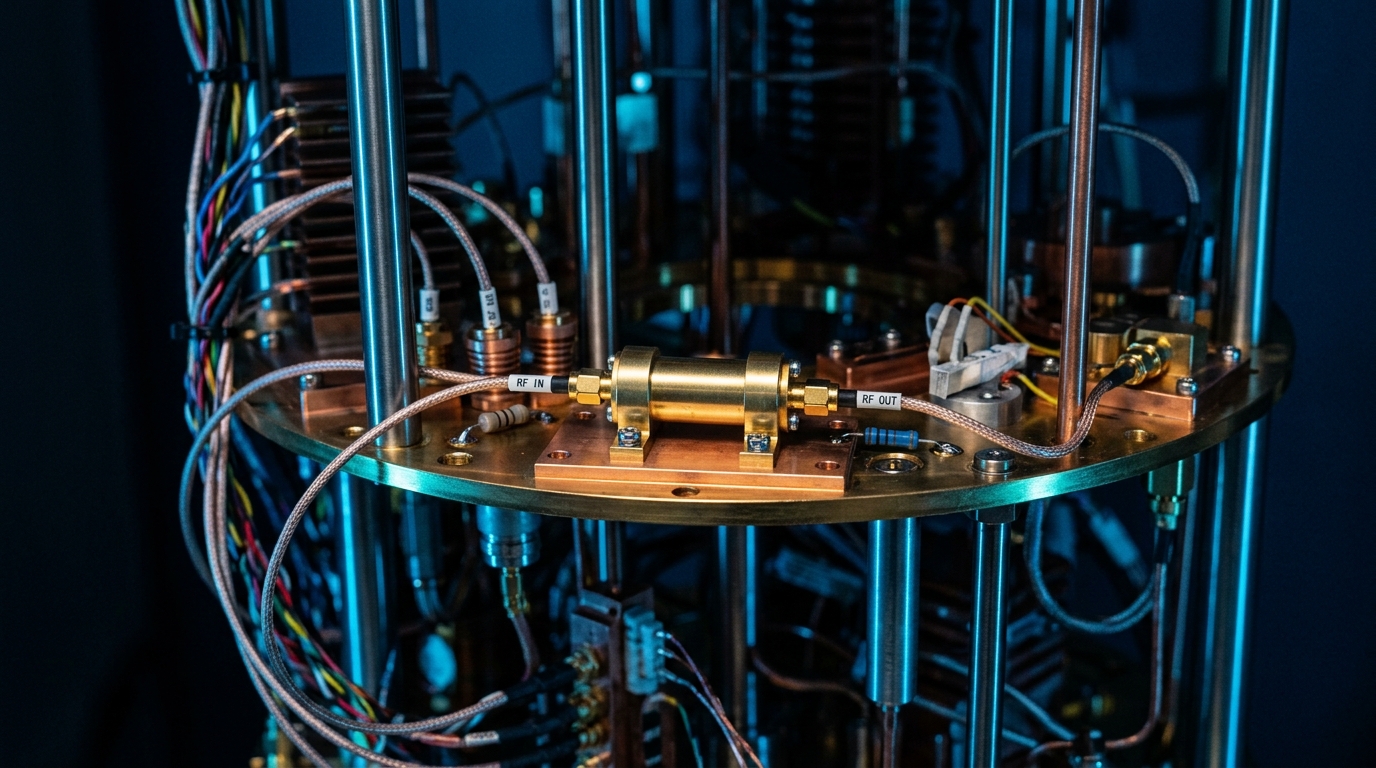
Every modern quantum processor built around superconducting qubits sits at the very bottom of a dilution refrigerator, clinging to temperatures just a few thousandths of a degree above absolute zero. To control and read out the quantum chip, dozens or hundreds of coaxial cables snake their way down from room temperature. Metal is an excellent heat conductor, and the central conductor in each coax acts as a thermal pipeline, leaking heat from warmer stages straight into the quantum chip’s pristine cold environment. Engineers insert a series of microwave attenuators along those lines to shunt away unwanted heat. Among them, 0 dB attenuators—components that pass the RF signal unaltered while supposedly thermalizing the inner conductor—have become indispensable. Yet, until now, nobody had published hard numbers on how well they actually work as heatsinks. A team of experimental physicists publishing in the Journal of Low Temperature Physics has changed that, delivering the first quantitative measurements of inner pin temperature under controlled heat load for three commercial 0 dB attenuators. Without this data, engineers designing cryogenic wiring for the largest quantum chips have been forced to treat these components as ideal heatsinks, a simplification that can lead to unexpected heating at the sample stage. The new measurements cut through that uncertainty. [arXiv:10.1007/s10909-026-03453-0]
The Core Finding
To get the numbers the cryogenic community has been missing, the researchers mounted a resistive heater directly on the center pin of each attenuator and attached a calibrated thermometer, then cooled the entire assembly in a dilution refrigerator. With no RF signal present, they incrementally increased the heat and recorded the temperature rise.
We measured the temperature of the inner pin of several 0 dB attenuators under a heat load.The resulting curves reveal the effective thermal conductance—the slope of heat flow versus temperature difference—and the maximum heat load each attenuator can dissipate before the inner pin warms above a critical threshold, typically a few hundred millikelvin above base. Think of it like testing a heatsink for a computer chip: you inject a known amount of heat and measure how much the chip temperature rises; the smaller the rise, the better the heat path. In a dilution refrigerator operating at millikelvin base temperatures, even an extra 10 microwatts of heat leaking through a coax can saturate the cooling power of the coldest stage. The measured thermal conductances and saturation powers now give engineers the first solid numbers to plug into thermal models of complex wiring looms, replacing guesswork with data. That transforms the 0 dB attenuator from a black box into a component with a known thermal impedance.
The State of the Field
Before this study, engineers designing cryogenic microwave chains for quantum processors had to rely on rules of thumb. Attenuator datasheets typically quoted only RF insertion loss and return loss, not thermal resistance. A 0 dB attenuator’s resistive film is supposed to provide a phonon path from the inner conductor to the grounded outer case, which is bolted to a cold plate. But the exact thermal conductance of that path had never been characterized at dilution refrigerator temperatures, where the physics of thermal boundary resistance can dominate. The quantum computing landscape is pushing wiring complexity to new heights. IBM’s Condor processor in 2023 used 1,121 superconducting qubits; roadmaps point to 100,000 qubits within a decade. Each qubit needs its own high-frequency control and readout line, often with multiple attenuators per line. Thermal management is now as critical as gate fidelity. Heat leaks do not just raise the base temperature; they create temporal fluctuations that can mimic qubit decoherence. This study provides the missing link between component performance and system-level thermal stability. It arrives at a moment when quantum error correction protocols demand millikelvin stability over hours, and when the difference between a well-thermalized line and a subtle heat leak can mean the difference between correctable and uncorrectable error rates.
From Lab to Reality
For scientists working on nuclear demagnetization stages and other ultra-low-temperature platforms that reach microkelvin temperatures, these data are a practical design tool. They can compute exactly how much heat a 0 dB attenuator will inject into a sample and whether that heat load is acceptable for reaching a target base temperature. For engineers building the next massive quantum chip, the data feed directly into thermal simulation software used to lay out dilution refrigerator wiring. A quantum processor with a thousand qubits can have over 2,000 coaxial lines; a per-line heat budget mismatch of a few microwatts multiplies into milliwatts, which can stall cooldown or degrade coherence across the whole chip. A well-designed thermal budget is essential for the operation of error-correction cycles that can run for hours without interruption. Commercially, the dilution refrigerator and cryogenic components market, estimated at roughly $280 million in 2026 and projected to surpass $1 billion by 2032, stands to benefit from quantitative thermal specifications. Attenuator manufacturers can now publish thermal resistance numbers alongside RF specs, giving system integrators the confidence to push margins and reduce overall cryogenic cost. Bluefors, Oxford Instruments, and other cryogenic equipment providers are already building next-generation dilution refrigerators optimized for large-scale quantum computing, where every installed component has a quantified impact on the thermal budget. Having thermal data for 0 dB attenuators means these system builders can specify wiring configurations with tighter thermal performance guarantees.
What Still Needs to Happen
The paper tested three specific commercial 0 dB attenuators. There are many more models on the market, with different resistive materials and geometries, and their thermal performance could vary widely. A broader survey is needed to establish design rules that apply across brands. Another key limitation is that the measurements were done with a pure DC heat load, while real quantum processors drive high-frequency signals through the center conductor. RF currents can heat the resistive film differently, and the interplay between microwave power dissipation and the static thermal conductance is not yet understood. Researchers at national metrology institutes such as NIST in the US and PTB in Germany, along with university cryogenic labs, are developing combined RF-and-DC thermal characterization setups to address this. Long-term stability is also an open question: a 0 dB attenuator might perform well for the first cooldown but degrade after a few thermal cycles as materials relax or oxidize. Those reliability data, needed for commercial confidence, are likely still two to three years away. Until then, the study gives the community the first solid foundation to build on, and it already shifts the conversation from “we hope the heat goes away” to “we know how much heat the attenuator can sink.”
In short: quantitative thermal conductance data for 0 dB cryogenic attenuators gives quantum processor designers the numbers to manage millikelvin thermal budgets with precision, not guesswork.