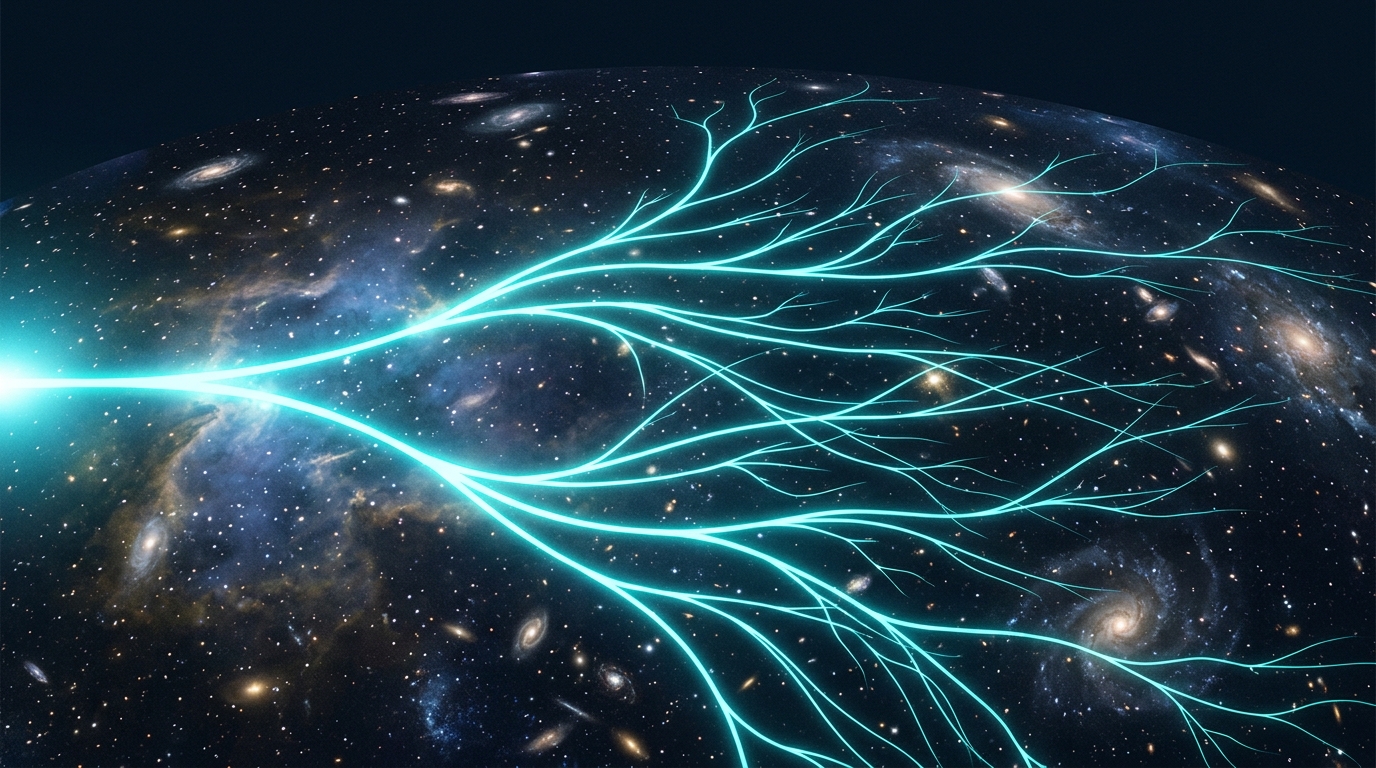
Rare events shape our world—from the formation of galaxies to the sudden crash of a stock market. But in the quantum realm, predicting these extreme fluctuations has remained a stubborn puzzle. Classical physics has a powerful toolkit called large deviation theory, which quantifies the likelihood of rare outcomes in everything from coin flips to climate extremes. Yet when quantum mechanics enters the picture, the familiar rules break down. Now, a paper posted to the arXiv preprint server on August 6, 2026, takes a major step toward a practical quantum theory of rare events, with implications stretching from the laboratory to the cosmos. [arXiv:2608.06319]
The Core Finding
The authors develop a concrete method for calculating rare fluctuations in open quantum systems—those that exchange energy or information with their environment. They first analyze an anharmonic oscillator coupled to a thermal bath, explicitly tracking how the system transitions from dominantly classical, thermal fluctuations to intrinsically quantum ones. Then they generalize the result: the dominant rare fluctuations are those that minimize a quantity called the measurement-induced relative entropy. Think of it like a quantum system's "path of least surprise" when forced to produce an unlikely outcome—the fluctuation that disturbs the system's normal behavior as little as possible while still achieving the rare event.
"The dominant rare fluctuations minimize the measurement-induced relative entropy," the paper states, providing "a thermodynamic description of a wide range of open quantum systems."Applying this to cosmology, the researchers show that the density matrix of long-wavelength fields on a fixed de Sitter background breaks the Kubo-Martin-Schwinger (KMS) symmetry, leading to a stationary state that does not respect detailed balance. This means the forward and reverse probabilities of fluctuations are not equal, a profound departure from equilibrium statistical mechanics.
The State of the Field
Classical large deviation theory, pioneered by S.R.S. Varadhan and others, has been a cornerstone of statistical mechanics since the 1970s. It provides rigorous estimates for the probability of rare events in systems with many degrees of freedom. Quantum large deviation theory, however, has lagged far behind. While mathematical frameworks exist—notably the work of Derezinski, Jaksic, and others on quantum hypothesis testing and entropy production—they have remained largely abstract and disconnected from the practical calculation of rare events in physical systems. The new paper bridges this gap by focusing on measurement-induced relative entropy, a concept that naturally emerges when an open quantum system is continuously monitored. This approach differs from prior work by linking the abstract mathematics directly to observable dynamics, from quantum walks to stochastic inflation. The broader quantum physics landscape is currently witnessing a surge of interest in open quantum systems, driven by advances in quantum computing, quantum thermodynamics, and the study of decoherence. This paper arrives at a moment when the need for a practical theory of quantum fluctuations is acute.
From Lab to Reality
For scientists, this work unlocks a systematic way to compute the probabilities of rare quantum events in settings ranging from ultracold atomic gases to the early universe. It provides a thermodynamic interpretation of measurement-induced phenomena, connecting information theory with the physics of extreme fluctuations. For engineers, the framework could improve the understanding of noise and rare errors in quantum devices, where a single anomalous jump can destroy a delicate superposition. While not directly a quantum error correction paper, the insights into how open quantum systems evolve under monitoring may inform the design of more robust quantum sensors and processors. For investors, the relevant market is the broader quantum technology sector, projected to reach $106 billion by 2040 according to McKinsey, where any tool that enhances control over quantum noise has long-term value. In cosmology, the results offer a fresh perspective on stochastic inflation, the theory that quantum fluctuations during the inflationary epoch seeded the large-scale structure of the universe. The finding that the density matrix breaks detailed balance could alter predictions for primordial non-Gaussianities, a key observational target for next-generation cosmic microwave background and large-scale structure surveys.
What Still Needs to Happen
Several technical challenges remain before this framework becomes a standard tool. First, the paper focuses on relatively simple models—an anharmonic oscillator and a free field on de Sitter space. Extending the method to interacting quantum fields or strongly correlated many-body systems will require new analytical and numerical techniques. Groups at institutions like the Max Planck Institute for the Physics of Complex Systems and the University of Geneva are actively developing tensor network methods that could be adapted for this purpose. Second, experimental verification is still missing. While the theory makes clear predictions for the statistics of rare fluctuations in monitored quantum systems, no experiment has yet probed the measurement-induced relative entropy in a controlled setting. Superconducting qubit platforms and trapped-ion systems are promising candidates, but the required measurement resolution and low noise floors are at the edge of current capabilities. Realistically, a full experimental confirmation is five to ten years away. Third, the cosmological application assumes a fixed de Sitter background; incorporating dynamical gravity and backreaction remains an open problem that touches on deep issues in quantum gravity.
Conclusion
In short: quantum large deviations provide a practical and thermodynamically grounded method for calculating rare fluctuations in open quantum systems, revealing that even the universe's most extreme events follow a principle of minimal measurement-induced surprise. This paper changes the conversation by showing that the mathematics of rare quantum events is not just a formal curiosity but a calculable, observable feature of physical reality.