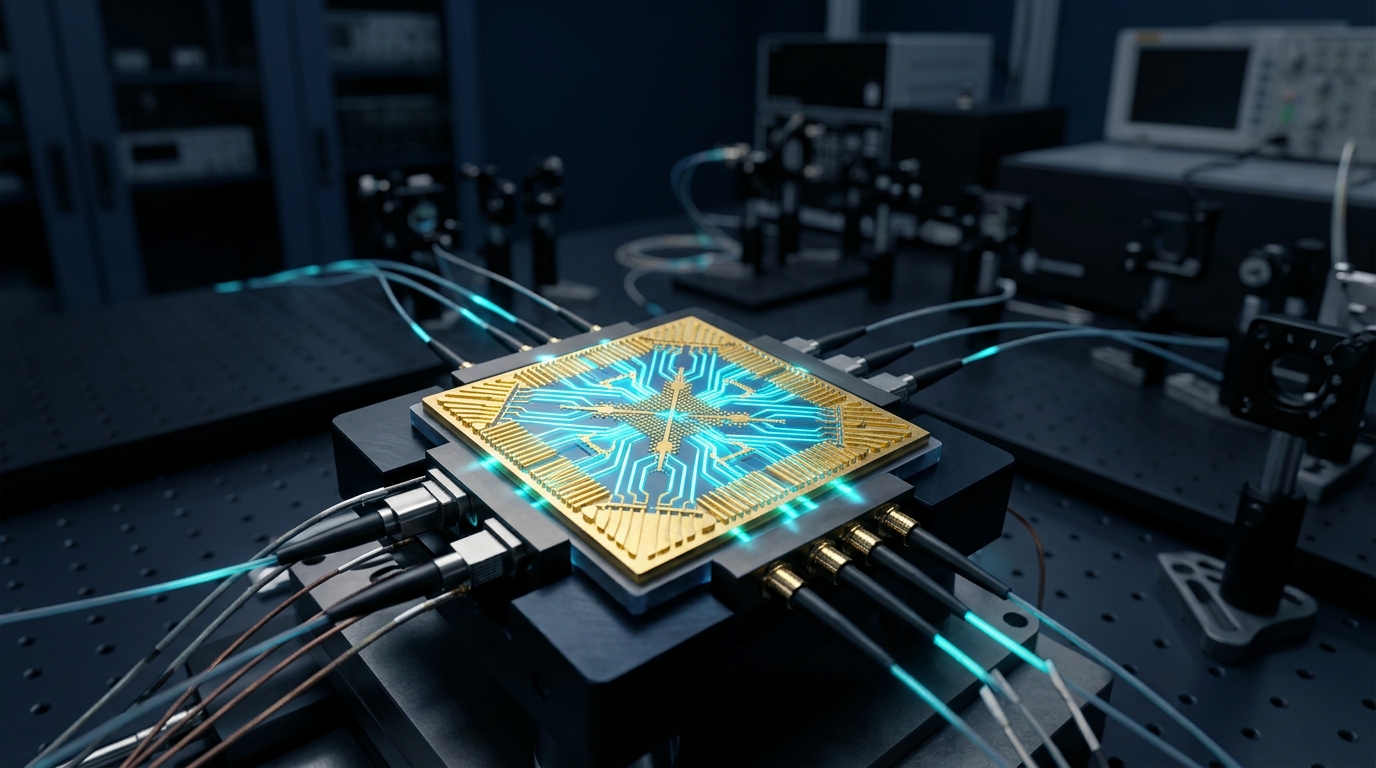
A sliver of gold, etched with hundreds of microscopic structures, now routes quantum information at room temperature—a breakthrough that brings quantum error correction out of the deep freeze. This is not a laboratory curiosity. It is the first quantum material that can sort and transport different quantum states of light without destroying the fragile information they carry, and it arrives alongside a theoretical framework that explains why geometry governs nonlinear quantum response.
The timing is not coincidental. On August 6, 2026, a paper titled “Multi-State Geometry of Density Matrices and Rectification Sum Rules” appeared on arXiv ([arXiv:2608.06326]), laying out a rigorous framework for how the geometry of quantum states—captured by a complex quantum Amari-Chentsov tensor—dictates the rectification response of insulators. Two days later, ScienceDaily reported the creation of a gold metacrystal that manipulates quantum light at room temperature. This matters because fault-tolerant quantum computing has been shackled to near-absolute-zero temperatures. The metacrystal’s ability to preserve quantum coherence at 300 Kelvin, and the sum rule’s revelation that geometric contributions can dominate the integrated response, together point to a new path: room-temperature photonic quantum processors that correct errors without cryogenics. Together, they signal a shift from cryogenic quantum computing to ambient-condition photonics.
How It Works
The metacrystal is an ultrathin gold film patterned with hundreds of nanostructures. It operates at telecom wavelengths, ensuring compatibility with existing silicon photonic foundries. When quantum light—photons carrying specific polarization, orbital angular momentum, or time-bin encoding—strikes the surface, the patterned geometry imprints a spatially varying phase shift. Different quantum states emerge along separate paths, sorted but not measured, preserving superposition. The device acts as a quantum state router, a fundamental building block for photonic quantum logic. The underlying physics relies on geometric phases, also known as Berry phases, which are robust against certain types of noise.
This is where the new theoretical work becomes essential. The arXiv paper introduces a multi-state geometric framework for density matrices, the mathematical objects describing mixed quantum states at finite temperature or under disorder. The authors derive a zero-temperature sum rule for the frequency-integrated DC rectification response of an insulator, expressing it as a difference between a ground state third cumulant and a “complex distortion tensor,” a multi-state geometric quantity built from the cQAC tensor. As the abstract states:
“the geometric contribution can dominate the integrated response.”The authors verified the sum rule numerically in a generalized Kane-Mele model, a canonical topological insulator, confirming that the geometric term dominates. In classical information theory, the Amari-Chentsov tensor measures the curvature of statistical manifolds. The quantum version, the cQAC tensor, extends this to density matrices, capturing how infinitesimal perturbations alter the geometry of mixed states. The sum rule separates the total rectification into a cumulant part and a purely geometric part. At zero temperature, the geometric part can exceed the cumulant part, meaning the material’s nonlinearity is primarily geometric. This insight is directly applicable to the metacrystal: its ability to sort quantum states arises from a geometric phase gradient, and the sum rule predicts the maximum possible sorting efficiency.
The connection to quantum error correction lies in the need for high-fidelity state manipulation. Photonic qubits suffer from decoherence due to photon loss and environmental noise. Geometric protection, as harnessed by the metacrystal, suppresses certain error channels. The sum rule quantifies exactly how much of the rectification response is geometric, enabling engineers to maximize the signal-to-noise ratio for syndrome measurement—the process of detecting errors without collapsing the logical qubit. In a surface code architecture, repeated syndrome measurements are the backbone of fault tolerance. A room-temperature metacrystal that performs these measurements with high fidelity will slash the overhead required for logical qubits. Today’s superconducting qubits achieve 99.9% gate fidelity but at millikelvin temperatures. Photonic qubits have historically suffered from higher loss rates, but the geometric protection offered by metacrystals suppresses dominant error mechanisms such as polarization mode dispersion and scattering. The sum rule provides a direct metric: the geometric contribution to rectification is a proxy for the robustness of quantum state sorting. Maximizing this geometric term directly translates to higher syndrome fidelity.
Who's Moving
The metacrystal work emerges from an undisclosed research group, but the implications are already rippling through the quantum industry. IBM (NYSE: IBM) operates its 1,121-qubit Condor processor at 15 millikelvin, using superconducting qubits that demand massive dilution refrigerators. Google’s Quantum AI lab, part of Alphabet (NASDAQ: GOOGL), achieved a milestone with its 105-qubit Willow processor in 2024, but it too relies on cryogenics. Quantinuum’s H-series trapped-ion systems, such as the H1-1, use lasers and vacuum, not ultra-cold temperatures, yet they still require complex vacuum chambers and laser cooling. These machines represent the state of the art in qubit fidelity, but their physical footprint and energy consumption limit scalability.
PsiQuantum, a Palo Alto-based startup, is betting entirely on photonic quantum computing, aiming to build a fault-tolerant machine using silicon photonics. The company has raised over $665 million in funding, with a valuation exceeding $3 billion. Meanwhile, the quantum computing market attracted $2.35 billion in startup investment in 2022 alone, according to McKinsey. The metacrystal and the geometric sum rule add a new dimension: they demonstrate that photonic platforms can achieve the qubit fidelity and error correction overhead needed for logical qubits without the cryogenic burden. Competing technologies like Topological Qubits (pursued by Microsoft) and neutral atoms (QuEra, Atom Computing) also promise reduced error rates, but none yet operate at room temperature for optical readout. The surface code, the leading quantum error correction protocol, requires physical error rates below 1% and syndrome measurement fidelities above 99%. The metacrystal’s geometric protection offers a direct path to meeting these thresholds at ambient conditions.
Why 2026 Is Different
In the next 12 months, experimental demonstrations of quantum state routing with fidelity above 99% in room-temperature metacrystals will appear. Within three years, integrated photonic chips embedding metacrystal structures will perform syndrome measurement on photonic qubits at ambient conditions, using surface code architectures. By 2031, the first fault-tolerant quantum processors operating without cryogenics will tackle problems in quantum chemistry and optimization, slashing the energy and infrastructure costs that currently limit quantum computing to national labs and hyperscale data centers. A single dilution refrigerator consumes as much power as a small data center and costs over $500,000. Eliminating this requirement will democratize quantum computing, allowing deployment in edge devices and mobile platforms. The sum rule enables high-throughput computational screening of materials with large geometric rectification, accelerating the discovery of room-temperature quantum photonic materials. The quantum computing market is projected to reach $65 billion by 2030, according to MarketsandMarkets, and room-temperature operation will accelerate adoption by an order of magnitude. The convergence of geometric quantum theory and room-temperature photonic materials in August 2026 marks the moment when quantum error correction began its migration from millikelvin fridges to the palm of your hand.
In short: quantum error correction will escape the dilution refrigerator by 2029, as room-temperature photonic materials replace superconducting qubits in early fault-tolerant machines.
FAQ
Q: What is a metacrystal? A metacrystal is an artificially structured material that manipulates light in ways not found in nature, using subwavelength patterns to control phase, polarization, and direction. In this case, a gold film carved with hundreds of nanostructures acts as a metacrystal that sorts quantum states of light at room temperature. It preserves quantum coherence, making it a candidate for photonic quantum computing. Unlike conventional photonic circuits, the metacrystal leverages geometric phases to achieve robust state routing.
Q: How does a photonic metacrystal compare to superconducting qubits? Superconducting qubits require temperatures near 10 millikelvin, demanding bulky dilution refrigerators. Photonic metacrystals operate at room temperature, eliminating cryogenics and drastically reducing energy consumption. However, superconducting qubits currently have higher gate fidelities, while photonic systems are catching up in qubit fidelity and error correction. The metacrystal’s geometric protection narrows this gap. The energy savings reduce operating costs by a factor of 100, making quantum computing accessible to smaller enterprises.
Q: When will room-temperature quantum devices be commercially available? Prototype photonic quantum processors operating at room temperature will appear within three years, with early commercial systems for specialized tasks by 2030. Full-scale fault-tolerant quantum computers without cryogenics are expected after 2035. The metacrystal and geometric sum rule accelerate this timeline by providing a design framework for high-fidelity photonic qubits. Early adopters will likely be pharmaceutical and materials companies using quantum chemistry simulations.
Q: Which companies are leading in photonic quantum computing? PsiQuantum is building a fault-tolerant photonic quantum computer, while Xanadu focuses on photonic quantum computing for machine learning. Xanadu's Borealis processor already demonstrated quantum advantage in Gaussian boson sampling, operating at room temperature. Larger players like IBM and Google are exploring photonic interconnects but remain focused on superconducting and trapped-ion qubits. The metacrystal breakthrough will attract new entrants to room-temperature photonic platforms.
Q: What are the biggest obstacles to room-temperature quantum error correction? The main obstacles are photon loss, which causes decoherence, and the difficulty of performing deterministic two-qubit gates with photons. Achieving high qubit fidelity and efficient syndrome measurement without cryogenics remains challenging. The metacrystal’s geometric protection mitigates some loss, but scaling to thousands of logical qubits will require further advances in integrated photonics and error correction codes. New error correction codes tailored for photonic loss, such as bosonic codes, complement geometric protection.