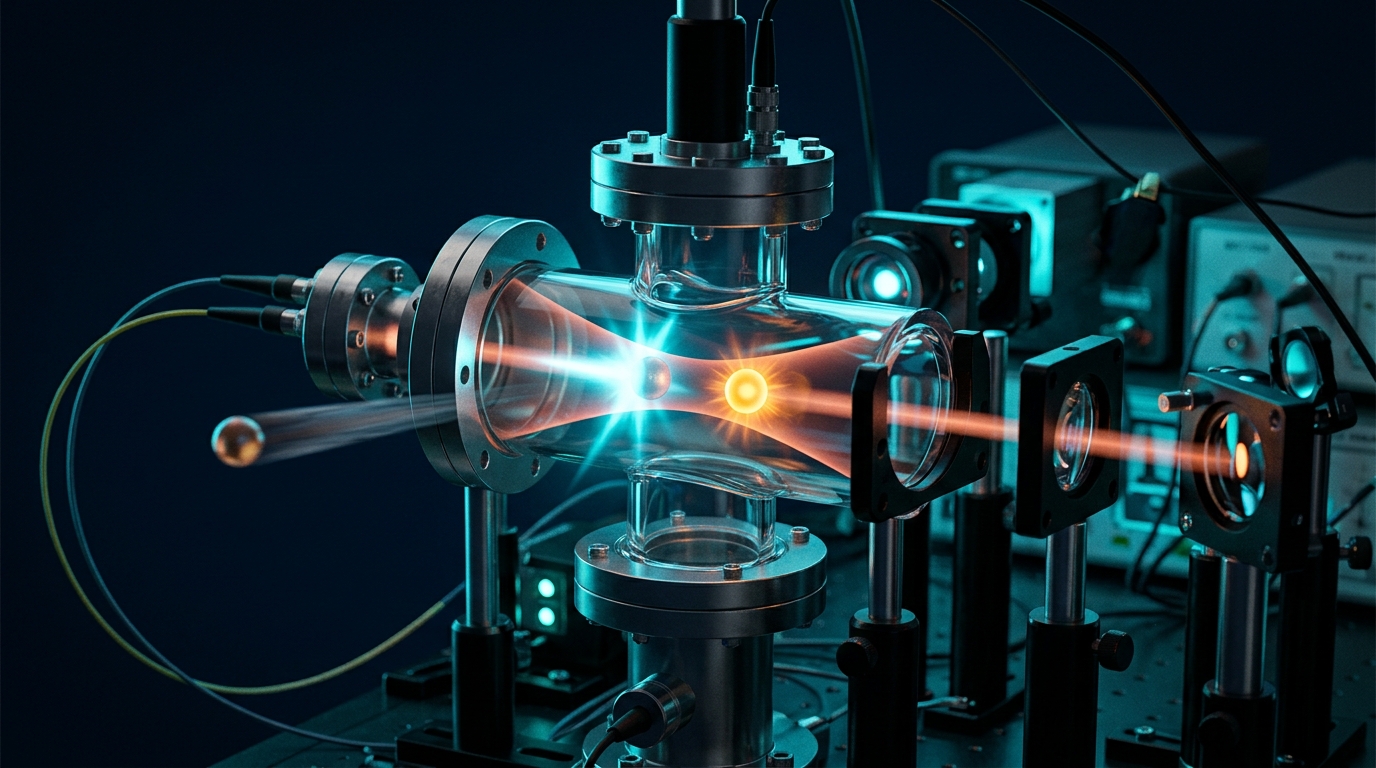
A research team led by Harvard University and QuEra Computing published a detailed fault-tolerant quantum computing architecture in Nature on August 9, 2026. The paper, “A fault-tolerant neutral-atom architecture for universal quantum computation,” describes an experimental upgrade that enables non-destructive, spin-resolved readout of neutral-atom qubits. For QuEra, the Boston-based company commercializing this technology, the advance removes a long-standing obstacle to running surface codes and other error-correction protocols at scale.
The claim has generated technical discussion online, particularly around the phrase “non-destructive.” A question on the Quantum Computing StackExchange highlighted a common point of confusion: any projective measurement collapses a quantum state, so how can a readout be non-destructive? The answer lies in what is being destroyed—not the quantum state, but the physical qubit. In earlier neutral-atom schemes, measuring the state of an atom often meant losing the atom from the trap. The new architecture instead maps the spin state to a spatial degree of freedom. An atom in one state is pushed out of the trap and its absence is detected; an atom in the other state remains in place, intact and available for further operations. The quantum state is still collapsed, but the atom itself survives. This is precisely what error correction demands: ancilla qubits that can be measured without being consumed.
What They're Actually Building
Neutral-atom quantum computers trap arrays of individual atoms using optical tweezers—tightly focused laser beams. Qubit states are encoded in hyperfine ground states of atoms like rubidium or strontium. Gates are performed by exciting atoms to Rydberg states, where they interact strongly over micron distances. This platform has scaled fast: QuEra demonstrated a 256-qubit machine in 2024 and has publicly targeted 1,000 physical qubits by late 2026, with logical error rates below 10⁻⁴ on a few dozen logical qubits.
The non-destructive readout mechanism is a state-selective push-out. After the computation, a laser pulse resonantly drives one spin state to a short-lived excited state, imparting a momentum kick that ejects the atom from the trap only if it was in that state. High-fidelity fluorescence imaging on the trap site then reveals whether the atom is present or absent—a proxy for its spin state—without destroying the atom that stays. The authors report spin-readout fidelity above 99.5% with atom survival probability exceeding 99.9% for the retained state. In the StackExchange discussion, users noted this technique has parallels to the electron shelving method used in trapped-ion computers for decades, but implementing it in a neutral-atom array with high parallelism and low crosstalk required solving significant optical engineering challenges.
This capability matters because every round of syndrome extraction in a surface code needs mid-circuit measurements. If measurements destroy the physical qubits, the code loses ancillas and must constantly replenish them from a reservoir, ballooning overhead. Non-destructive readout lets the same physical atoms serve multiple syndrome cycles, slashing the resource overhead. QuEra’s roadmap now projects 100 logical qubits with real-time error correction using fewer than 3,000 physical qubits—a ratio that is competitive with the best superconducting and trapped-ion plans.
Winners and Losers
QuEra is the most immediate beneficiary. The company already holds contracts with Japan’s AIST and the UK’s National Quantum Computing Centre. A clear path to reusable ancillas strengthens its pitch to enterprise customers who need error-corrected machines for materials science or logistics optimization.
The neutral-atom cohort as a whole—including Paris-based Pasqal and Berkeley’s Atom Computing—gets a tailwind. Pasqal has emphasized analog quantum processing, but its digital gate roadmap will eventually need similar non-destructive readout. Having a demonstrated, published method from a peer lowers the perception of risk for the entire modality.
Trapped-ion competitors, particularly Quantinuum and IonQ, had until now held a clear advantage in mid-circuit measurement fidelity and qubit reuse. Quantinuum’s H2 system routinely performs non-destructive state detection on its ytterbium ions with >99.9% fidelity. The QuEra-Harvard result does not surpass that benchmark, but it shrinks the gap enough that neutral atoms can no longer be dismissed as “measurement-challenged.” Investors who were betting on trapped ions because of superior error-correction readiness may now re-weight their portfolios.
Superconducting-circuit players—IBM, Google Quantum AI—are largely unaffected by this specific readout advance, as their qubits are measured destructively by design through dispersive readout resonators. Their error-correction strategies have always budgeted for qubit replacement. However, any demonstration that lowers the physical-to-logical qubit ratio tightens the competition on total resources required for a useful quantum computer.
The Bigger Picture
In 2026, quantum computing has moved firmly into the logical-qubit era. IBM’s Condor-class processors have exceeded 1,100 qubits, and the company aims to demonstrate a 100-logical-qubit system by 2029. Quantinuum announced a 99.9% fidelity two-qubit gate across 99 qubits in a fully connected trap earlier this year. Governments continue to pour funds into quantum: the U.S. CHIPS and Science Act allocated an additional $500 million for quantum testbeds in 2025, while the EU’s Quantum Flagship entered its second decade with a €1.2 billion budget.
Non-destructive readout in neutral atoms also de-risks the supply chain. Atoms are inherently identical and do not suffer from fabrication variability, a persistent challenge for superconducting qubits. If neutral atoms can now match the mid-circuit measurement capabilities of ions while retaining their superior scaling density—arrays of 10,000 tweezers have already been demonstrated in the lab—they could become the first platform to cross the threshold of 1,000 logical qubits within the decade.
Comparable milestones in 2025-2026: Atom Computing raised a $400 million Series D in March 2026 to build a 5,000-physical-qubit machine; QuEra’s $230 million Series B from 2023 was followed by a quieter $150 million infrastructure round in early 2025. The Nature paper will likely be cited in QuEra’s next fundraising deck.
The Signal
The signal here is that a specific technical barrier—the inability to re-use ancilla qubits after measurement—has fallen for neutral atoms. This is not hype; the StackExchange question inadvertently surfaced the exact nuance that separates a press release from a real experimental result. The paper acknowledges that the quantum state still collapses, but the physical atom survives. That is precisely the engineering property that fault-tolerant architectures need. What remains unproven is whether this readout can be parallelized to hundreds of qubits simultaneously with the same fidelity and survival probability under the duty cycle of continuous error correction. If QuEra demonstrates that in a 300-qubit array by mid-2027, neutral atoms will have matched the error-correction capabilities that have made trapped ions the gold standard. Until then, this is a necessary step—not a sufficient one.
In short: Neutral-atom non-destructive readout removes a key roadblock to scalable error correction, giving QuEra’s architecture a line of sight to 100 logical qubits with a sub-3,000 physical qubit budget.