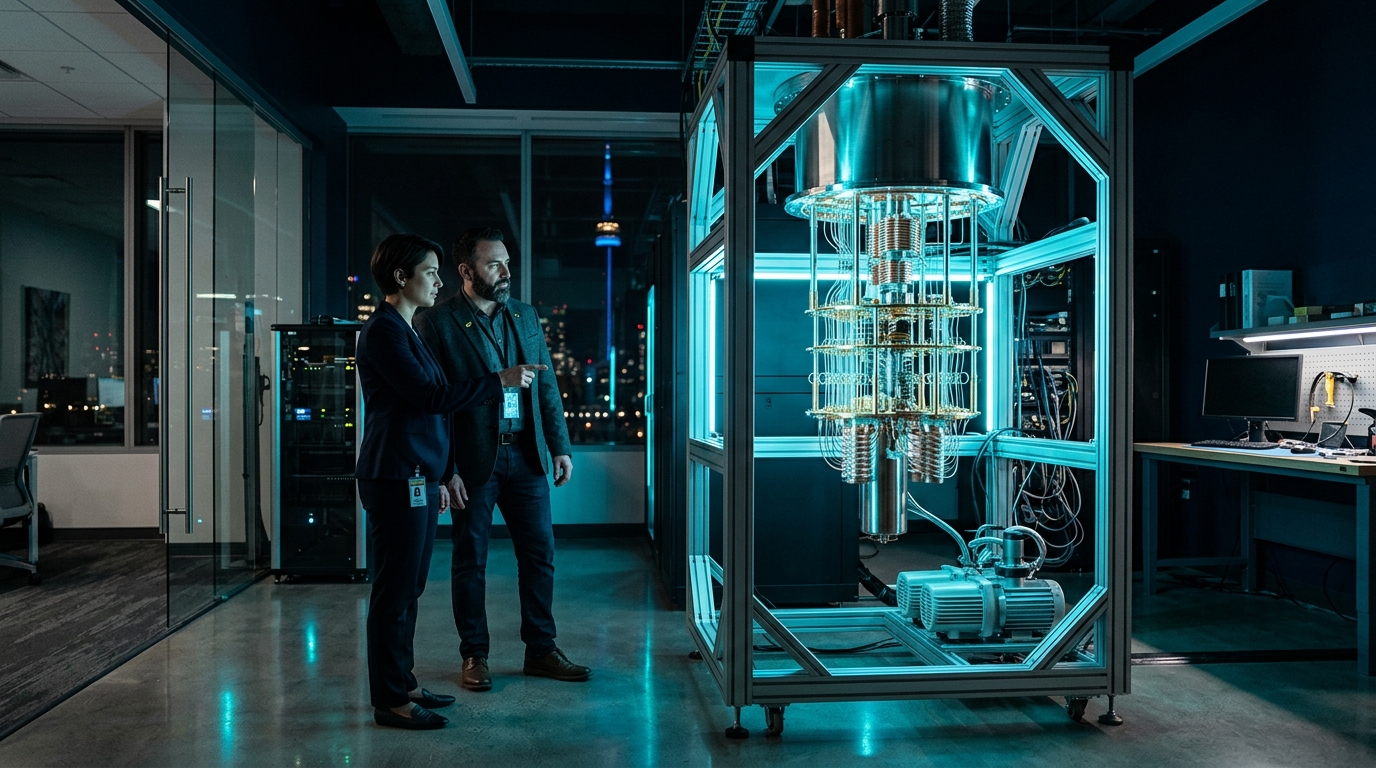
Ernst & Young has installed a quantum computer at its Toronto innovation hub, marking the first time a Big Four professional services firm has brought quantum hardware in-house rather than relying solely on cloud access. The deployment, led by EY Canada, was announced August 1, 2026 and sits within a broader $3 billion global investment in artificial intelligence and emerging technologies. EY did not disclose the vendor, qubit count, or architecture of the installed system.
What They're Actually Building
The announcement is thin on technical specifications. EY describes the installation as a "quantum computer hub" for internal capability building, client demonstrations, and algorithm development. No gate fidelity metrics, coherence times, or qubit modality were disclosed. This absence of detail is itself a signal: the machine is almost certainly a small-scale, room-temperature system—likely a few dozen to low-hundreds of noisy qubits—suitable for workforce training and proof-of-concept work, not production computation.
For calibration: IBM's 2026 roadmap targets 2,000+ qubit systems with the Heron-class architecture and error mitigation tooling. IonQ Forte Enterprise, shipping since late 2025, delivers 36 algorithmic qubits with gate fidelities above 99.5%. Quantinuum's H-Series operates at 56 high-fidelity trapped-ion qubits with real-time error correction. Whatever EY installed, it is not competing with these systems on raw capability. The value proposition is proximity and organizational embedding—having a machine in the same building where partners and clients work.
The $3 billion figure is an aggregate AI investment, not a quantum-specific allocation. EY's quantum budget is almost certainly a small fraction of that total. The firm has been building quantum consulting capabilities since at least 2021, primarily through partnerships with IBM Quantum Network and Microsoft Azure Quantum. This on-site deployment extends that strategy from consumption to ownership.
Winners and Losers
The immediate winner is whichever quantum hardware vendor supplied the system. The leading candidates are IonQ (which has emphasized enterprise on-premises deployments with its Forte Enterprise rack-mounted systems), IBM (which offers on-premises Quantum System Two installations), or potentially a smaller player like QuEra or Xanadu seeking a marquee enterprise reference customer. EY's refusal to name the vendor is unusual and may reflect ongoing negotiation over co-marketing rights.
Quantum cloud platforms—Amazon Braket, Microsoft Azure Quantum, Google Cloud Quantum—face a subtle threat. If professional services firms begin acquiring hardware directly, the cloud-only access model loses its monopoly on enterprise quantum experimentation. This is not an immediate revenue risk; the installed base of on-premises quantum computers in non-research settings remains in the single digits globally. But it establishes a precedent: quantum is becoming enterprise infrastructure, not just a cloud service.
Quantum software startups—Zapata Computing, Classiq, QC Ware—benefit from this development. More on-premises hardware means more demand for platform-agnostic development tools that abstract away hardware details. EY's consultants will need to write algorithms that run across multiple backends, which is precisely the value proposition these software companies offer.
Competing consultancies—Accenture, Deloitte, KPMG, McKinsey—will face pressure to respond. Accenture has invested heavily in quantum through its Quantum Computing Practice and partnerships with IonQ and 1QBit, but has not publicly deployed on-premises hardware. Deloitte's Quantum Climate Hub operates primarily through cloud access. EY's move raises the competitive bar for talent recruitment and client demonstrations.
The Bigger Picture
This deployment fits a 2026 pattern: quantum computing is transitioning from physics experiment to enterprise IT asset. In May 2026, Cleveland Clinic installed an IBM Quantum System Two on-premises for healthcare research—the first permanent quantum deployment in a US hospital. In March 2026, the UK's National Quantum Computing Centre opened with multiple on-site systems from different vendors. EY's installation is the professional services vertical's equivalent: a signal that quantum is becoming operational infrastructure, not just a research curiosity.
The $3 billion EY investment context matters. In December 2025, EY announced a $1.4 billion AI platform buildout with Microsoft, including Copilot integration and custom AI agents for audit and tax. The quantum hub is positioned as an extension of this AI strategy, not a separate initiative. This bundling is strategic: quantum computing budgets are easier to justify when they ride alongside AI investments that already have clear ROI.
Government quantum investment continues to accelerate. The US National Quantum Initiative Act was reauthorized in early 2026 with $3.7 billion in additional funding. The EU Quantum Flagship entered its second phase at €1 billion. Canada's National Quantum Strategy, launched in 2023, has deployed C$360 million. EY Canada's location choice is not coincidental; Toronto-Waterloo is one of North America's densest quantum research corridors, home to the Perimeter Institute, University of Waterloo's IQC, and startups like Xanadu.
The Signal
The signal here is not technological breakthrough but organizational commitment. EY is telling its clients—Fortune 500 CFOs, audit committees, risk officers—that quantum computing is real enough to warrant capital expenditure, not just cloud subscriptions. The firm is betting that quantum literacy will become a competitive differentiator in professional services within 3-5 years, and that having a machine in the office accelerates that literacy faster than booking time on a remote system.
What would validate this as more than a PR move: EY publishing a peer-reviewed paper demonstrating a quantum advantage on a business-relevant problem—portfolio optimization, fraud detection, or audit sampling—run on their on-premises system. Without that, this remains a training tool and client conversation piece. The specific technical milestone to watch is whether EY's quantum team can demonstrate a provable speedup on a problem class that matters to their audit or tax practices, even at small scale.
In short: EY's on-site quantum computer is an enterprise capability signal, not a computational milestone—and its real value will be measured in consultant training hours, not qubit counts.
Frequently Asked Questions
Q: What does EY actually do with quantum computing?
EY applies quantum algorithms to business problems in financial services, supply chain optimization, and risk modeling. The firm does not build quantum hardware or software products; it sells consulting services that help clients understand and prepare for quantum computing's impact on their industries. The Toronto hub will train EY consultants and provide a physical demonstration environment for client workshops.
Q: How does an on-premises quantum computer compare to cloud quantum access?
On-premises systems offer lower latency, dedicated availability, and physical access for hardware-level experimentation. Cloud access provides elastic scaling across multiple qubit modalities and vendors. For enterprise learning and workforce development, on-premises deployment eliminates queue times and usage costs that can inhibit experimentation. For production workloads, cloud access to larger, higher-fidelity systems remains superior.
Q: Is quantum computing ready for enterprise use in 2026?
No. No quantum computer in 2026 has demonstrated a commercially relevant quantum advantage—a provable, useful speedup on a business problem that justifies the cost over classical alternatives. Current systems are useful for research, algorithm development, and workforce training. Production deployment for business-critical workloads remains years away, with most roadmaps targeting 2028-2030 for early fault-tolerant systems.
Q: What is EY's business model for quantum computing?
EY sells quantum readiness assessments, algorithm prototyping, and strategic advisory services to enterprise clients. The on-premises quantum computer is a cost center that supports this consulting revenue—it is not a product EY sells. The firm also integrates quantum awareness into its audit and tax practices, preparing for a future where quantum computers could break current encryption standards or enable new forms of financial modeling.
Q: What quantum computing milestones matter most in 2026?
Three milestones define the 2026 landscape: demonstration of logical qubits with error rates below the physical qubit threshold (Quantinuum achieved this in late 2025 with 12 logical qubits); delivery of the first quantum computers with more than 1,000 high-fidelity qubits; and publication of the first end-to-end quantum application showing a wall-clock speedup over classical HPC on a commercially relevant problem. None of these have been fully achieved as of August 2026.