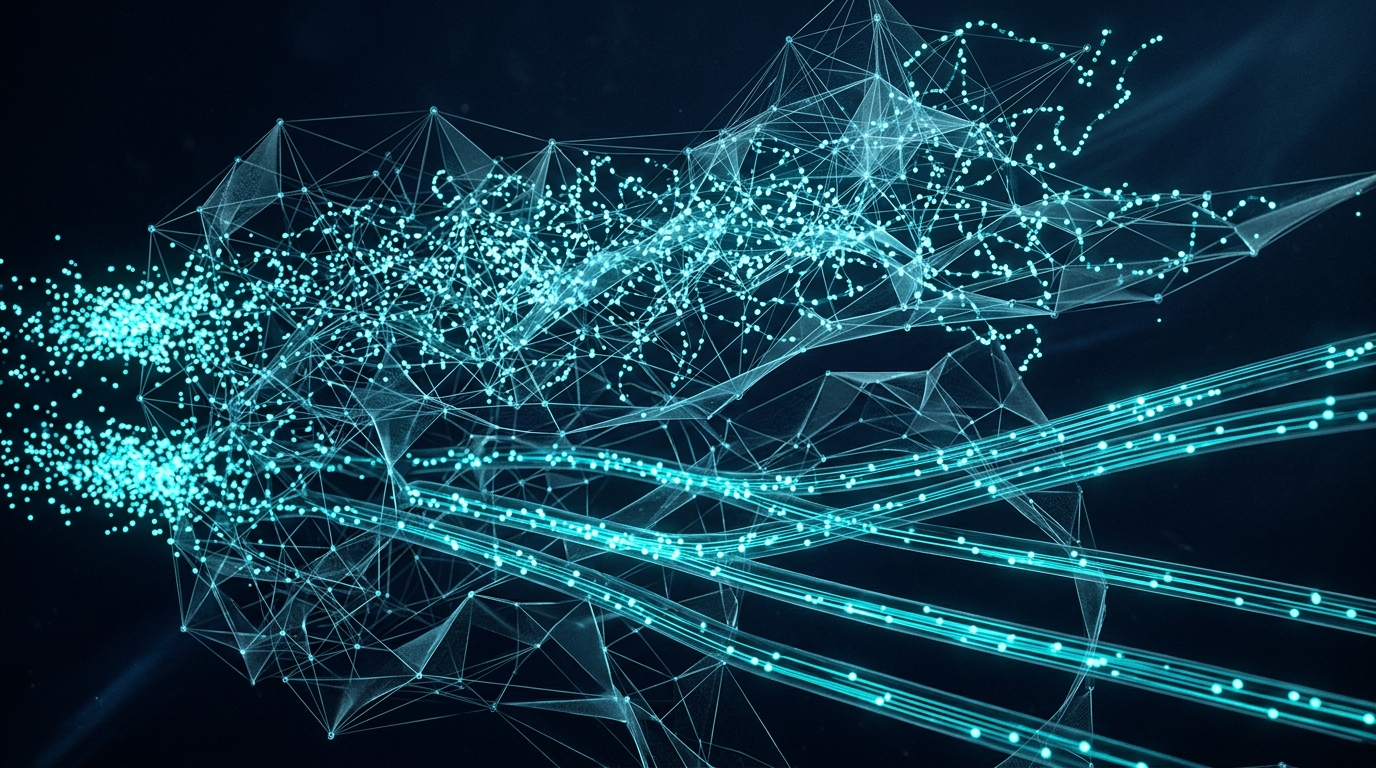
For decades, physicists have believed that quantum chaos — the universal, unpredictable behavior of quantum systems — demands either microscopic disorder or many-body interactions. A new study now upends that assumption, showing that pure geometric randomness, without any impurities or particle interactions, can give rise to full quantum chaos and diffusive transport. The finding, posted on the arXiv preprint server on July 30, 2026, introduces an entirely new axis for tuning chaotic dynamics: the shape and connectivity of space itself. [arXiv:2607.28579]
The researchers study non-interacting quantum particles moving on random, layered tree-like graphs. These graphs are not mere mathematical abstractions; they are structural generalizations of regular square lattices and ladders, or equivalently, multi-component one-dimensional chains with random links between components. By adjusting the effective dimensionality — from broad, high-connectivity layers to a narrow, quasi-one-dimensional limit — the team uncovers a stark transition in quantum behavior.
The Core Finding
The paper demonstrates that geometric randomness alone can be a fundamental mechanism for quantum chaos. Think of it like a map of a futuristic city: a dense grid of interconnected streets forces any traveler to wander diffusively, never quite knowing where they’ll end up; a single long avenue with occasional cross-streets lets some travelers race through ballistically while others remain trapped in dead ends. In the graphical language of the study, an extensive layer size, corresponding to a high-dimensional connected structure, produces robust quantum chaos, characterized by level repulsion — a telltale signature that energy levels avoid each other like random matrices. Particles in this regime spread diffusively, their mean-square displacement growing linearly with time. The energy eigenvalue spacing follows a Wigner-Dyson distribution, a gold standard for chaotic quantum spectra.
In stark contrast, when the layer size shrinks to the quasi-one-dimensional limit, the system supports an extensive number of localized states that never spread, coexisting with a few delocalized states. The level repulsion is suppressed, and the eigenvalue statistics become Poisson-like, signaling non-chaotic, integrable-like behavior. Yet the delocalized states drive ballistic transport — a clean, straight-line motion where the displacement grows quadratically with time. This dual behavior emerges purely from the topology, with all link strengths kept uniform.
“geometric randomness as a fundamental and independent mechanism for generating and tuning quantum chaos.”
The effective graph dimensionality acts as a control knob, tuning across a chaotic-to-non-chaotic boundary. No on-site randomness or particle interactions are required; connectivity alone dictates whether a quantum state repels its neighbors in energy and how it travels.
The State of the Field
Quantum chaos research has traditionally orbited two suns: Anderson localization, where disorder in on-site energies traps wavefunctions, and many-body quantum chaos, where interactions between particles scramble information. Seminal works in the 1980s by Bohigas, Giannoni, and Schmit connected spectral statistics of quantum systems to random matrix theory, establishing level repulsion as a universal signature. Yet all these studies assumed either intrinsic randomness in the Hamiltonian parameters or inter-particle forces. The idea that pure connectivity — who is linked to whom — could independently generate chaos had remained largely unexplored.
Quantum graphs have been studied before as models of chaotic scattering, most notably by Kottos and Smilansky in 1997, but those graphs used fixed, deterministic structures and relied on vertex boundary conditions to produce spectral complexity. The new work is the first to treat random connectivity itself as the sole driver, isolating topological randomness from any material disorder. At the same time, advances in engineered quantum systems — photonic lattices written in glass, ultracold atoms in optical tweezer arrays, and superconducting circuit graphs — have made arbitrary, disorder-free geometric networks experimentally accessible. This paper arrives at a moment when experimentalists need theoretical frameworks to interpret transport in such designer geometries, offering a blueprint where no impurities or interactions are needed.
From Lab to Reality
For fundamental scientists, this work unlocks a clean playground to study random matrix universality, quantum transport, and the interplay between localization and delocalization without complicating factors. It predicts that by simply varying the connectivity of a graph, one can switch from a diffusive regime useful for energy spreading to a ballistic regime that preserves quantum information over distances. This insight could inform the design of quantum network nodes, where controlled transport matters.
For engineers working on photonic integrated circuits, the finding suggests that geometric randomness might be harnessed to create light-based channels with tailored diffusion properties. Experimental groups, such as those at the University of Rostock and the Weizmann Institute, have already fabricated random waveguide lattices where transport transitions have been observed with intentional refractive index disorder. This theory predicts that even without such material disorder, purely positional randomness of waveguides could produce the same diffusive-to-ballistic crossover. In quantum communication, ballistic transport channels are desirable to minimize decoherence — the market for quantum communication devices, while nascent, is projected by CIR to exceed $5 billion by 2030. While this study is far from a product, it plants a seed for geometry-based transport control.
What Still Needs to Happen
Theoretical purity comes at a price: the models assume identical, uniform coupling strengths and neglect decoherence, losses, and interactions. Real-world graphs — whether written in light or in cold atoms — suffer from fabrication imperfections, stray couplings, and environmental noise. These could wash out the clean transition from diffusive to ballistic behavior. Researchers at the Max Planck Institute for the Physics of Light are investigating how non-Hermitian perturbations (loss and gain) affect transport on random graph topologies, a necessary next step toward experimental relevance.
Another open frontier is the interacting case. What happens when particles on these random graphs repel or attract each other? Many-body localization in geometrically random networks could reveal entirely new phases of matter. Groups led by Anatoli Polkovnikov at Boston University are probing many-body chaos on random graphs, and this study provides a new template. Experimental verification of the geometric randomness predictions might require a decade of effort, starting with simple photonic realizations and progressing to more complex quantum simulators that can isolate the spectral signatures of chaos without stray disorder.
In short: geometric randomness is a standalone axis for controlling quantum chaos, enabling a transition from diffusive to ballistic quantum transport solely by tuning graph dimensionality.