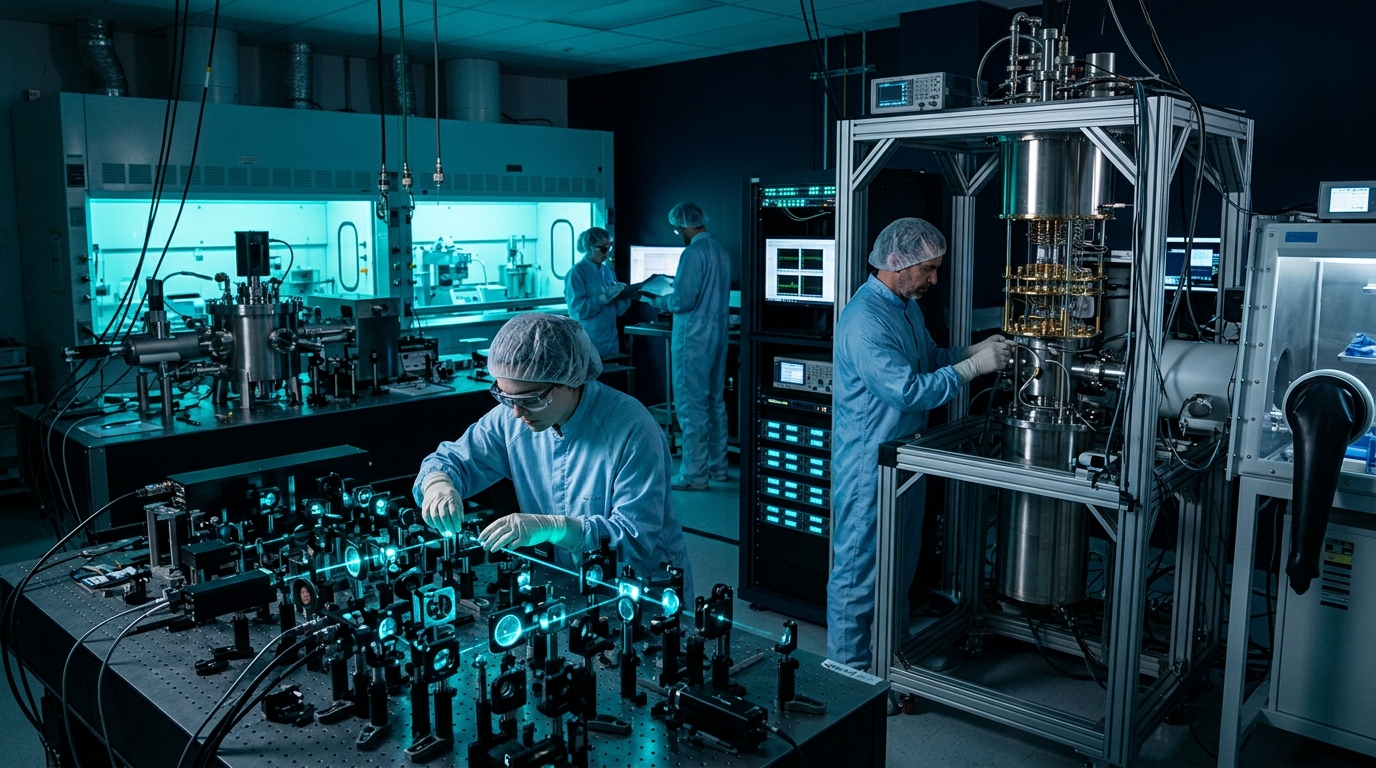
The U.S. National Science Foundation has awarded the University of California San Diego an $18 million, six-year grant to establish a Materials Research Science and Engineering Center (MRSEC) focused on quantum materials. The award, designated NSF Award #2614051, is part of a broader $108 million NSF investment that will fund six new MRSECs nationwide in 2026.
The UC San Diego center will concentrate on synthesizing and characterizing quantum materials—substances that exhibit exotic electronic, magnetic, or optical properties governed by quantum mechanics. These materials are foundational to next-generation qubits, quantum sensors, and energy-efficient computing devices. The grant runs from 2026 to 2032.
What They're Actually Building
The MRSEC at UC San Diego will not produce a commercial quantum computer. Instead, it will tackle the materials science bottlenecks that currently limit qubit coherence, gate fidelity, and scalability. The center’s research is expected to span several classes of quantum materials: topological insulators and superconductors for topological qubits, 2D materials like transition metal dichalcogenides for spin qubits, and novel superconductors for improved Josephson junctions in superconducting qubits.
According to the NSF, the center will integrate theory, synthesis, and advanced spectroscopy. One likely focus is engineering interfaces between superconductors and semiconductors to create hybrid systems with lower noise. Another is exploring van der Waals heterostructures that can host Majorana zero modes—elusive quasiparticles that Microsoft and others are betting on for topological quantum computing. The center will also develop in-situ characterization tools to observe quantum states during material growth, a capability that remains rare in academia. Techniques such as molecular beam epitaxy (MBE) and scanning tunneling microscopy (STM) will be central, enabling atomic-scale control and imaging of quantum phenomena like quantum spin liquids and skyrmions.
This is fundamental research at Technology Readiness Level (TRL) 1–3. No qubits will be delivered to end users. The output is knowledge, patents, and trained researchers. The MRSEC program also mandates education and outreach, so the center will produce a pipeline of graduate students and postdocs skilled in quantum materials synthesis—a critical workforce need for the quantum industry. For CTOs and VCs, the timeline from such a center to a fab-ready process is typically 10–15 years.
Winners and Losers
The immediate beneficiaries are the quantum computing hardware companies that rely on advanced materials: IBM, Google, IonQ, Rigetti, Quantinuum, and Microsoft. All of them face materials challenges—dielectric loss in superconducting qubits, charge noise in spin qubits, and the absence of confirmed topological qubits. Better materials could lower error rates and reduce the overhead for quantum error correction. The MRSEC’s open-science model means findings will be published, potentially leveling the playing field for smaller startups that cannot afford in-house materials research.
Suppliers of specialized scientific instruments—such as molecular beam epitaxy systems, cryostats, and angle-resolved photoemission spectroscopy (ARPES) tools—may see increased demand as the center builds out its infrastructure. The grant includes funds for equipment, though specific vendors were not disclosed. Photonic quantum computing companies like PsiQuantum could benefit indirectly if the center’s work on 2D materials yields efficient single-photon emitters, but that is not a stated focus. Historically, MRSECs have spun off startups; UC San Diego’s center could seed new ventures in quantum materials characterization or fabrication.
No company is directly threatened by this academic grant. However, if the center makes breakthroughs in topological materials, it could accelerate Microsoft’s topological qubit roadmap, indirectly pressuring competitors that have placed smaller bets on that approach. Conversely, if the center’s work on improved superconductors leads to better transmon qubits, it reinforces the dominant superconducting paradigm.
The Bigger Picture
The $108 million MRSEC package is part of the NSF’s ongoing commitment to materials research, which has funded MRSECs since 1994. In 2026, the NSF is also channeling funds from the CHIPS and Science Act into quantum information science. This grant is not part of the National Quantum Initiative directly, but it complements the Department of Energy’s quantum materials efforts at national labs like Argonne and Brookhaven. The six new centers each receive roughly $18 million, a standard MRSEC award size, and will join existing centers at Princeton, the University of Chicago, and elsewhere that already focus on quantum matter.
Comparable recent investments include the $25 million NSF Quantum Leap Challenge Institute for Robust Quantum Simulation, launched in 2025, and the European Union’s €1 billion Quantum Flagship, which also funds materials research. The UC San Diego MRSEC is smaller in scale but highly focused. It creates a distributed network of centers that collectively aim to solve the materials bottleneck—a recognition that no single institution can cover all quantum material classes.
For the quantum industry, 2026 is a year of engineering milestones: IBM targets its 1,000-qubit Condor processor, and Quantinuum continues to push logical qubit counts. But without better materials, error rates will plateau. This grant addresses that long-term need, sustaining the pre-competitive science that private capital often overlooks.
The Signal
The signal here is that the U.S. government continues to fund the fundamental science that underpins quantum computing, even as private investment has cooled from its 2021–2024 peak. The $18 million is not large by venture standards—it’s roughly the cost of a single Series A round for a quantum startup—but it sustains the pipeline of materials discoveries that industry will need in the 2030s. What this reveals is a recognition that quantum computing’s hardware roadmap is ultimately a materials science problem. The specific technical milestone that would validate this investment is the demonstration of a new superconducting material with dielectric loss tangents below 10⁻⁵ at millikelvin temperatures, or the unambiguous detection of Majorana zero modes in a scalable platform. Both are at least five years out. This is not hype; it is the necessary, unglamorous work of building the foundations for fault-tolerant quantum computing.
In short: The NSF’s $18 million MRSEC grant to UC San Diego funds quantum materials research that could unlock better qubits, but commercial impact is a decade away.