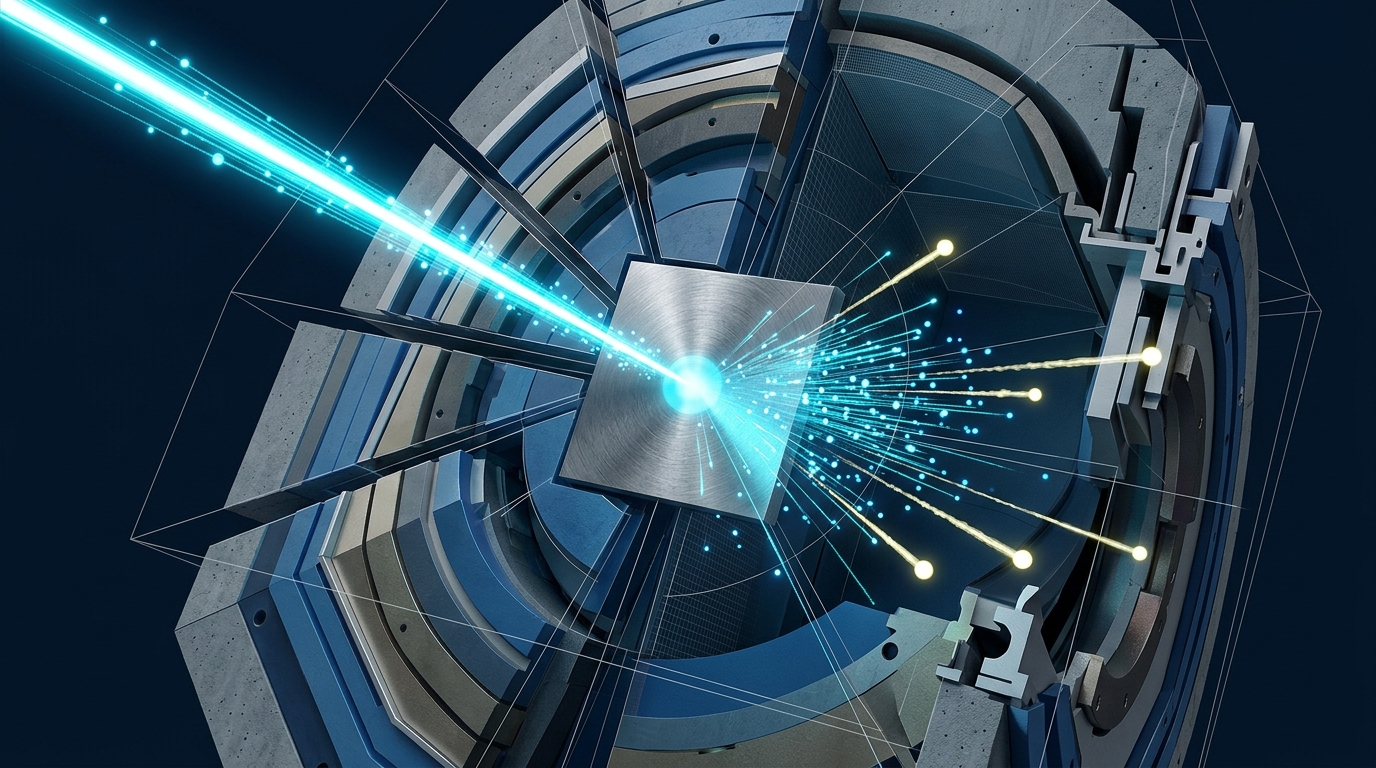
For years, engineers designing accelerator-driven neutron sources, radiation shields for medical linacs, and fusion reactor components have faced a quiet but persistent problem. When high-energy photons slam into matter, they can knock neutrons loose—a process called photonuclear reaction. Simulating this reliably is crucial for safety and performance, yet the open-source Monte Carlo code OpenMC, widely loved for its transparency and flexibility, has never offered a verified photonuclear capability. The physics was there, buried in an unofficial development branch, but no one had systematically checked whether its answers could be trusted. Without independent verification, the community couldn't use it for serious work, and the code's maintainers couldn't merge it into the official distribution. A team of researchers has now filled that gap. [arXiv:2607.26045]
The Core Finding
The study puts OpenMC's photonuclear implementation through a gauntlet of six single-collision broomstick benchmarks—idealized geometries that strip away complexity to test the physics in its purest form. Targets of deuterium, beryllium-9, and uranium-238 were bombarded with monoenergetic 5 MeV and 15 MeV photons, and with a continuous spectrum mimicking a 1–20 MeV linear accelerator. OpenMC's results were compared against the industry stalwart MCNPX using identical ENDF7u nuclear data, against the FLUKA code with its own native models, and against a first-collision analytical solution that provides an exact mathematical truth line. When OpenMC and MCNPX shared the same data library, their integrated neutron yields agreed to within 0.7% across all cases.
OpenMC and MCNPX agreed within 0.7% in integrated neutron yield for all benchmark cases when the same ENDF7u data were used.FLUKA, which relies on internal physics models rather than evaluated data, differed from the analytical solution by roughly 6–9% for monoenergetic sources and no more than about 4% for the continuous spectrum. Switching OpenMC's library to IAEA/PD-2019 introduced deviations of up to 11.3%, underscoring how much the answer depends on the underlying nuclear data, not just the transport code.
The State of the Field
Before this work, anyone needing photonuclear simulations had to choose between proprietary codes like MCNPX or FLUKA, both of which carry licensing restrictions and closed-source opacity, or gamble on OpenMC's unverified branch. MCNPX, developed at Los Alamos National Laboratory, has long been the gold standard for coupled neutron-photon transport, while FLUKA, maintained by CERN and INFN, offers its own well-tested physics models. OpenMC, created at MIT and now community-driven, promised a modern, open alternative but lacked the pedigree of verification. The photonuclear capability had been implemented by contributors using the same ENDF data format that MCNPX reads, but no one had run a controlled, multi-code comparison with an analytical benchmark. This study provides that missing link, transforming a promising feature into a credible tool.
From Lab to Reality
For scientists, this verification unlocks OpenMC as a legitimate platform for photonuclear research. It means that studies on neutron production in radiotherapy bunkers, non-destructive assay of nuclear materials using photon interrogation, and shielding design for next-generation electron accelerators can now be performed with a fully open-source code, enabling full reproducibility and community auditing. For engineers, the immediate payoff is the ability to couple OpenMC's photonuclear physics with its existing neutronics and depletion solvers, creating a seamless workflow for, say, designing a compact accelerator-based neutron source for boron neutron capture therapy. The market for radiation transport software and services, though niche, is estimated at several hundred million dollars annually and is growing as medical physics and nuclear security applications expand. OpenMC's entry as a verified, free alternative could reshape that landscape within two to three years, once the photonuclear feature passes the official integration review.
What Still Needs to Happen
Two major hurdles remain before OpenMC's photonuclear capability can be considered production-ready. First, the current verification covers only simple, single-collision geometries. Real-world systems involve complex scattering, secondary particle cascades, and thermalization of neutrons—none of which are tested here. The code must be validated against experimental benchmarks, such as photonuclear neutron yields measured at electron linac facilities, to prove it works when the geometry gets messy. Second, the large sensitivity to nuclear data libraries (up to 11.3% difference between ENDF7u and IAEA/PD-2019) means that users will need clear guidance on which library to choose for which application. The OpenMC development team, along with nuclear data groups at IAEA and Brookhaven National Laboratory, are actively working on improved photonuclear evaluations, but harmonizing these libraries is a multi-year effort. Realistically, a fully validated, officially merged photonuclear module in OpenMC is likely three to five years away.
Conclusion
In short: OpenMC's photonuclear neutron production has been verified against MCNPX and an analytical solution, achieving agreement within 0.7% when using the same nuclear data, which establishes the code's physics implementation as sound and ready for broader testing.