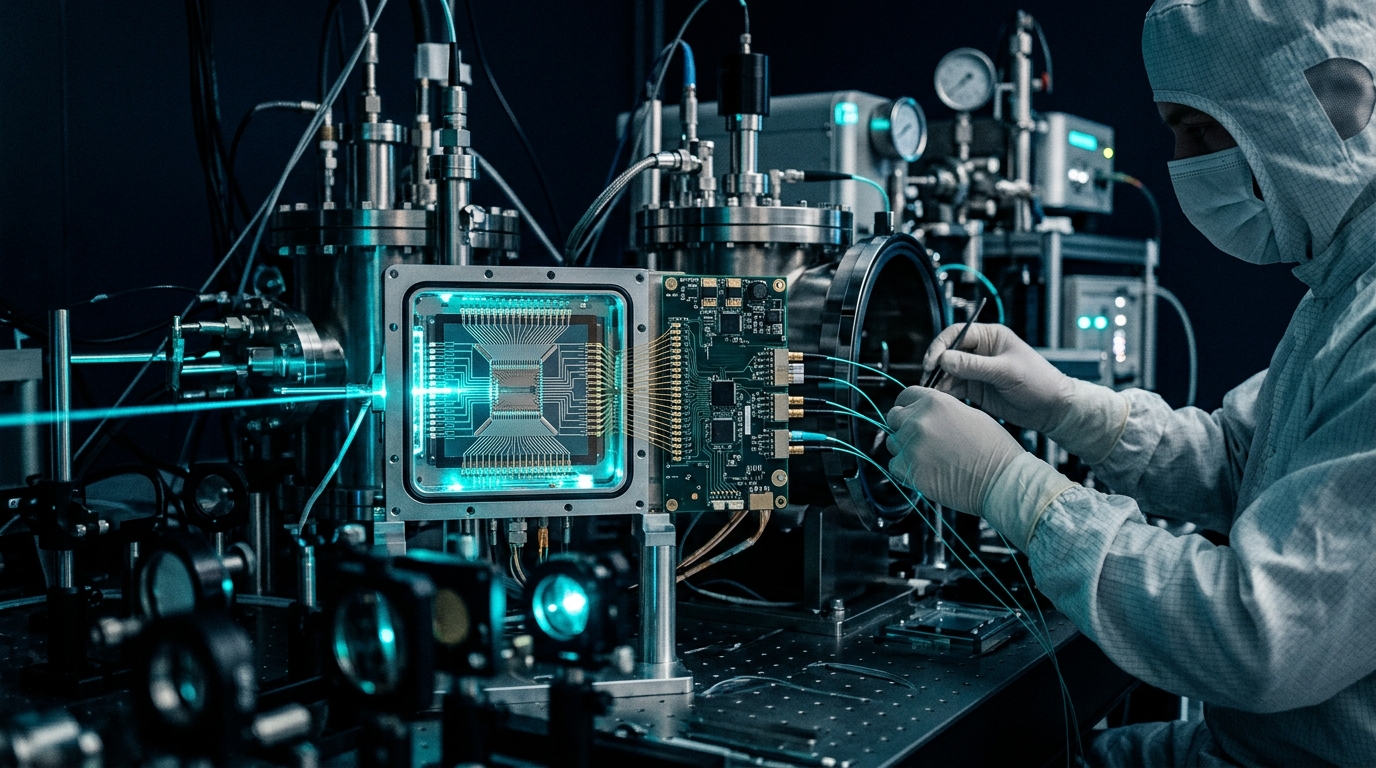
IonQ has secured final regulatory approval to complete its acquisition of SkyWater Technology, the largest exclusively U.S.-based semiconductor foundry. The green light, announced on July 28, 2026, removes the last obstacle to a deal that will fold SkyWater's Bloomington, Minnesota, fab and its trusted DoD supply lines directly into IonQ's hardware operations.
The transaction, first disclosed in January 2026, was structured as an all-stock buyout. IonQ framed the logic as straightforward: owning a domestic foundry would let it accelerate design cycles for the classical-control electronics, integrated photonics, and cryogenic CMOS chips that are critical to scaling trapped-ion quantum computers. With regulatory hurdles now cleared, the deal is expected to close within weeks.
What They're Actually Building
IonQ builds quantum computers using trapped-ion qubits—individual atoms suspended in electromagnetic fields and manipulated with lasers. This approach is known for high-fidelity gates and long coherence times, but it demands sophisticated classical infrastructure. Each qubit requires a chain of lasers, detectors, and analog control chips that must be tightly integrated and manufactured to exacting tolerances.
SkyWater brings a 200mm fabrication line and a catalog of custom process design kits already used by defense contractors and quantum hardware developers. By owning that capability, IonQ can co-design its next-generation control ASICs and photonic interposers with immediate feedback from the fab floor. The company has said the integration will "materially reduce" system cost and size per qubit, though it has not released updated technical roadmaps since the acquisition announcement.
IonQ's most recent public roadmap aimed at 100+ algorithmic qubits by 2028 using a modular, photonic-interconnect architecture. Competitors follow different trajectories: IBM targets 100,000 superconducting qubits by 2033, while Quantinuum, also a trapped-ion player, has demonstrated 56 high-fidelity qubits using a different trap geometry and a shuttling architecture. Owning a fab does not directly increase qubit counts, but it removes a common bottleneck—the custom control electronics that often lag behind qubit advancements.
Winners and Losers
The most obvious beneficiary is IonQ itself, which gains a captive supply chain for components that have been a persistent source of lead-time delays and design compromises. SkyWater shareholders receive a premium and liquidity, while the U.S. government sees a critical domestic foundry remain American-owned and operated—a priority under the CHIPS and Science Act, which has funneled billions into onshore semiconductor manufacturing.
For competitors, the picture is nuanced. SkyWater operates a merchant foundry model and has indicated it will continue to serve existing quantum and defense customers. However, a vertically integrated quantum competitor running the same fab inevitably raises concerns about design confidentiality and wafer allocation, particularly for startups developing novel cryo-CMOS or photonics circuits. QuTech spin-offs, small trapped-ion ventures, and even Quantinuum—which has used external fabs for control chips—may reassess their foundry strategies.
Cloud platforms and quantum-software companies are largely neutral on this deal. Their interest lies in the number, quality, and availability of qubits, regardless of who owns the fabrication line. If vertical integration helps IonQ deploy larger, more reliable systems faster, the entire ecosystem benefits from increased compute capacity.
The Bigger Picture
The acquisition fits a 2026 pattern of quantum hardware companies moving toward manufacturing self-sufficiency. In the superconducting domain, IBM fabricates its own transmon chips in-house, while Google Quantum AI uses dedicated cleanroom space. Trapped-ion players have traditionally relied on outsourced specialty components, from vacuum chambers to laser systems. IonQ's move to own a semiconductor fab—a layer deeper than most quantum startups—signals that the industry now sees control electronics not as a commodity, but as a differentiator.
The CHIPS Act, enacted in 2022, has underpinned much of this reshoring. SkyWater itself received $160 million in CHIPS funding to expand its Minnesota facility, making it an even more attractive asset. Defense applications loom large: trapped-ion computers are being evaluated for materials simulation and logistics optimization, and a trusted domestic supply chain is a prerequisite for classified workloads.
Other 2026 deals illustrate the trend. PsiQuantum secured $600 million in additional government and private backing for its photonic quantum data center, which will rely on a purpose-built silicon photonics fab. Meanwhile, Quantinuum spun off its Luminar photonic integration division as a separate entity, a counter-strategy that keeps the supply chain at arm's length. IonQ's path—full ownership—is the most capital-intensive but offers the tightest integration.
The Signal
Regulatory approval is a procedural milestone, not a technical breakthrough. The signal here is that IonQ is no longer just a quantum-computing startup; it is becoming a vertically integrated hardware manufacturer with physical factory assets, a unionized workforce, and direct exposure to defense procurement cycles. The real test will be whether owning a fab translates into faster iteration on control ASICs and photonics, and whether that, in turn, yields measurable improvements in system-level metrics—qubit fidelity, gate speed, and cost per qubit-hour. If IonQ's next-generation system, slated for 2027, shows a step-change in manufacturing quality and volume, the deal will be vindicated. If not, it will look like an expensive hedge against supply-chain risk that added complexity without accelerating performance.
"IonQ's acquisition of SkyWater turns quantum supply-chain risk into a potential competitive advantage by bringing control-electronics fabrication in-house for the first time."
In short: IonQ's vertical-integration play with SkyWater gives it direct control over the semiconductor components that often bottleneck trapped-ion scaling, but the hardware results will take years to materialize.
Frequently Asked Questions
What does IonQ do?
IonQ designs and builds quantum computers based on trapped-ion technology. Its systems use individual ytterbium or barium ions as qubits, manipulated by lasers in ultra-high-vacuum chambers. The company sells cloud access to its machines through Amazon Braket, Microsoft Azure, and Google Cloud, and has publicly traded on the NYSE under ticker IONQ since 2021.
How does trapped-ion computing compare to superconducting qubits?
Trapped-ion qubits offer longer coherence times and lower native gate errors than superconducting qubits, but they typically have slower gate speeds and face scaling challenges related to laser delivery and ion-chain control. Superconducting qubits switch faster and can leverage established semiconductor manufacturing, but require dilution refrigerators and struggle with crosstalk. Both are in the NISQ era, with logical error correction still experimental.
Is quantum computing ready for enterprise use?
Not yet. Large fault-tolerant computers capable of running commercially relevant algorithms remain years away. Current machines are used for algorithm exploration, error-mitigation research, and early proofs-of-concept in finance, chemistry, and logistics. Most enterprise engagement in 2026 is through co-development partnerships and access to cloud-based simulators and small-scale hardware.
What is IonQ's business model?
IonQ generates revenue from cloud access fees, professional services, and co-development contracts with enterprise and government customers. The company also sells hardware systems to research institutions. Margins remain negative as it invests heavily in R&D and manufacturing expansion. The SkyWater acquisition adds a for-hire foundry business that serves other chip designers, creating a second revenue stream unrelated to quantum computing.
What quantum computing milestones matter most in 2026?
Key metrics include the demonstration of logical qubits with error rates below the break-even threshold, scaling to hundreds of physical qubits with high two-qubit gate fidelity (above 99.9%), and deployment of modular architectures that link multiple traps or chips. Also important are reductions in the cost and energy consumption of control electronics, as well as progress on standardized benchmarking for noisy, intermediate-scale quantum processors.