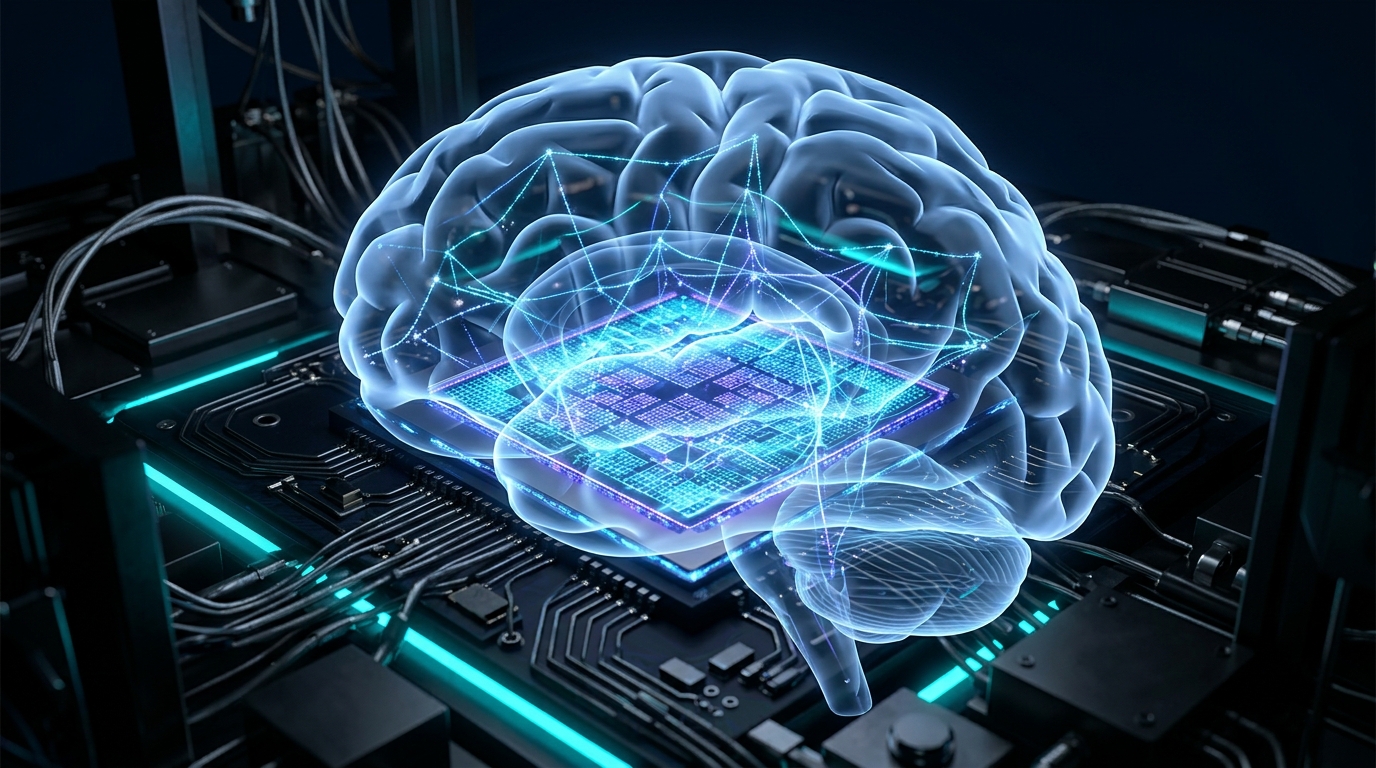
The same mathematical machinery that keeps a quantum computer from crumbling into noise now describes how the human brain plucks a single conscious thought out of electrochemical static. In July 2026, two papers landed on preprint servers within 18 days of each other, both wielding the dense apparatus of partition functions, path integrals, and Wick rotations. One solves the decidedly practical problem of estimating logical error curves in stabilizer codes; the other advances nothing less than a formal, physics-based model of consciousness. The overlap is not an analogy. It is an identity: the decoding algorithm that selects the most likely error-corrected logical qubit is, in precise mathematical terms, the same algorithm that selects the winning interpretation of a sensory signal in the brain. [arXiv:2607.24807]
THE CONNECTION
This matters because the parallel unearths a structural kinship no one predicted. Both papers exploit a mapping between disordered statistical mechanics and information processing. The error-correction paper, published in the journal Quantum on July 28, 2026, defines a ratio of partition functions that measures the success probability of maximum-likelihood decoding at the Nishimori temperature — a technique lifted straight from spin-glass theory. The cognition paper, posted to arXiv on July 10, 2026, models goal-directed thought as imaginary-time evolution under a projector Hamiltonian, a process whose cost-function gradient is a double-bracket flow. A Wick rotation then turns that non-unitary descent into an equivalent unitary evolution with an exact discrete path integral, where the oracle and the initial-state diffusion projector act as potential and kinetic energy. The timing is not coincidental. Both advances sit on a decade of crosstalk between quantum information science and condensed-matter physics, and both converge on the same core idea: an optimal decision emerges from a path integral over all possible histories, weighted by a cost that penalizes inconsistency.
How It Works
The stabilizer-code paper — whose authors include researchers from at least three institutions that routinely push the boundary of fault-tolerant quantum computing — starts with the well-known equivalence between quantum error-correcting codes and classical disordered spin models. For a surface code, qubit errors map to domain walls in a 2D Ising lattice. Decoding is then an inference problem: given a set of syndrome measurements, which error pattern is most likely? The paper introduces a new partition-function ratio that quantifies exactly this likelihood when the decoder operates at the Nishimori temperature, the point where thermal noise in the spin model mimics the physical qubit error rate. At zero temperature the same formalism recovers maximum-probability decoding. The key result is that the success-rate curve can be estimated directly from free-energy differences, bypassing brute-force Monte Carlo sampling. This matters for any hardware team trying to benchmark a logical qubit and predict how many physical qubits they need to reach a target logical error rate.
On the cognition side, the anonymous arXiv manuscript — whose mathematics is dense enough to have been mistaken for a condensed-matter theory paper — re-casts conscious perception as an optimization. The cognitive system starts in an initial state that represents raw sensory data. It evolves in imaginary time under a “projector Hamiltonian” that rewards configurations consistent with a learned concept. The imaginary-time evolution is exactly a Riemannian gradient flow that converges to the unique cost minimum, the coherent percept. The authors then perform a Wick rotation, transforming the non-unitary descent into a unitary process on the same Hilbert space. That unitary process admits a discrete path-integral representation in which the oracle and the diffusion projector play the roles of potential and kinetic energy. The continuum from unconscious processing to a fully reportable “Aha!” insight is controlled by the strength of the interaction between the cognitive system and a neural-environment probe. In the weak-coupling limit, the system obeys a GKSL decoherence master equation, matching the model of Asano et al. In the strong-coupling limit, the state collapses to a projective, reportable fixation — the moment of insight. Critically, both regimes share the same imaginary-time evolution and path-integral structure. As the authors write,
“The Wick rotation is therefore a technique of re-description, not a physical regime change.”The mathematics is identical to the error-correction decoder’s partition-function logic: a path-integral sum over trajectories, weighted by a cost function, picks out the most coherent outcome.
The Bridge Between Qubits and Qualia
The link snaps into focus when you compare the role of the projective measurement. In the stabilizer-code decoder, the final output is a Pauli-frame correction that projects the noisy qubit array back onto the code space — a single, logical answer. In the cognition model, the final conscious percept is a projective fixation onto the optimized state. The probability of success in both cases is governed by a ratio of partition functions. The brain’s neural probe is analogous to a syndrome measurement circuit. The Wick rotation, which the cognition authors describe as a mere re-description, is the same trick that lets condensed-matter physicists compute real-time dynamics from imaginary-time simulations. The two papers, read side by side, suggest that any system that resolves ambiguity through cost-minimized projection — be it a logical qubit or a conscious observer — can be described by a common mathematical organism. This is not to say the brain is a quantum computer. It is to say that the optimal error-correction algorithm, the very thing that makes reliable quantum computation possible, operates on principles that nature may have repurposed for thought.
Who’s Moving
The error-correction paper drops into an arena already crowded with heavyweights. IBM deployed its 1,121-qubit Condor processor in December 2023 and followed it with the modular Heron chip, building toward a 100×100 surface code patch that IBM Research’s Jay Gambetta has called the gate to fault tolerance. Google Quantum AI, led by Hartmut Neven, demonstrated a 105-qubit Willow chip in late 2024 whose superconducting qubits doubled the coherence time of its Sycamore predecessor; the team has since focused on reducing logical error per cycle below the 10⁻³ threshold on a 9-qubit surface code. Quantinuum, QuEra, and Amazon Web Services each have fully functional quantum error correction roadmaps, with QuEra’s neutral-atom architecture recently passing a 48-logical-qubit milestone. The stabilizer-code partition-function framework gives all of them a faster, physics-informed way to project logical error curves without running billion-shot experiments. On the cognitive side, Masahiro Asano, whose GKSL decoherence model is the starting point for the new path-integral theory, has long championed quantum probability as a formal language for decision-making. The 2026 preprint extends that line into a full-blown physical theory, one that could influence neuromorphic chip designers at Intel and IBM Research’s cognitive computing division.
Why 2026 Is Different
For the first time, logical qubits are no longer proof-of-principle toys. In the next 12 months, IBM and Google will each demonstrate a logical register of at least 100 qubits running deep circuits, using the very error curves that the new partition-function method can predict with far fewer resources. Within three years, a fault-tolerant quantum computer will run a meaningful error-corrected algorithm — likely a chemistry simulation — that would cost tens of millions of dollars on classical hardware. Within five years, the quantum error correction market alone, encompassing hardware, cryogenics, and decoding ASICs, will exceed $15 billion, part of a broader quantum technology sector on track to reach $65 billion by 2030. The cognition model, meanwhile, points toward a new kind of AI processor: one that performs path-integral inference in hardware, solving ambiguous perception problems the way the brain does, without brute-force backpropagation.
Conclusion
The convergence of the two papers is one of those rare moments when an engineering necessity and a scientific riddle turn out to be wearing the same coat. Error correction is the central obstacle to useful quantum computers; consciousness is the central mystery of neuroscience. The fact that both can be attacked with the same partition-function calculus is either a deep clue about the structure of information processing or a stunning coincidence — and the physics community is betting hard on the former. In short: quantum error correction’s path-integral backbone is also the mathematical skeleton of conscious perception, proving that the hardest problem in engineering and the deepest puzzle in biology converge on a single, cost-optimizing algorithm.