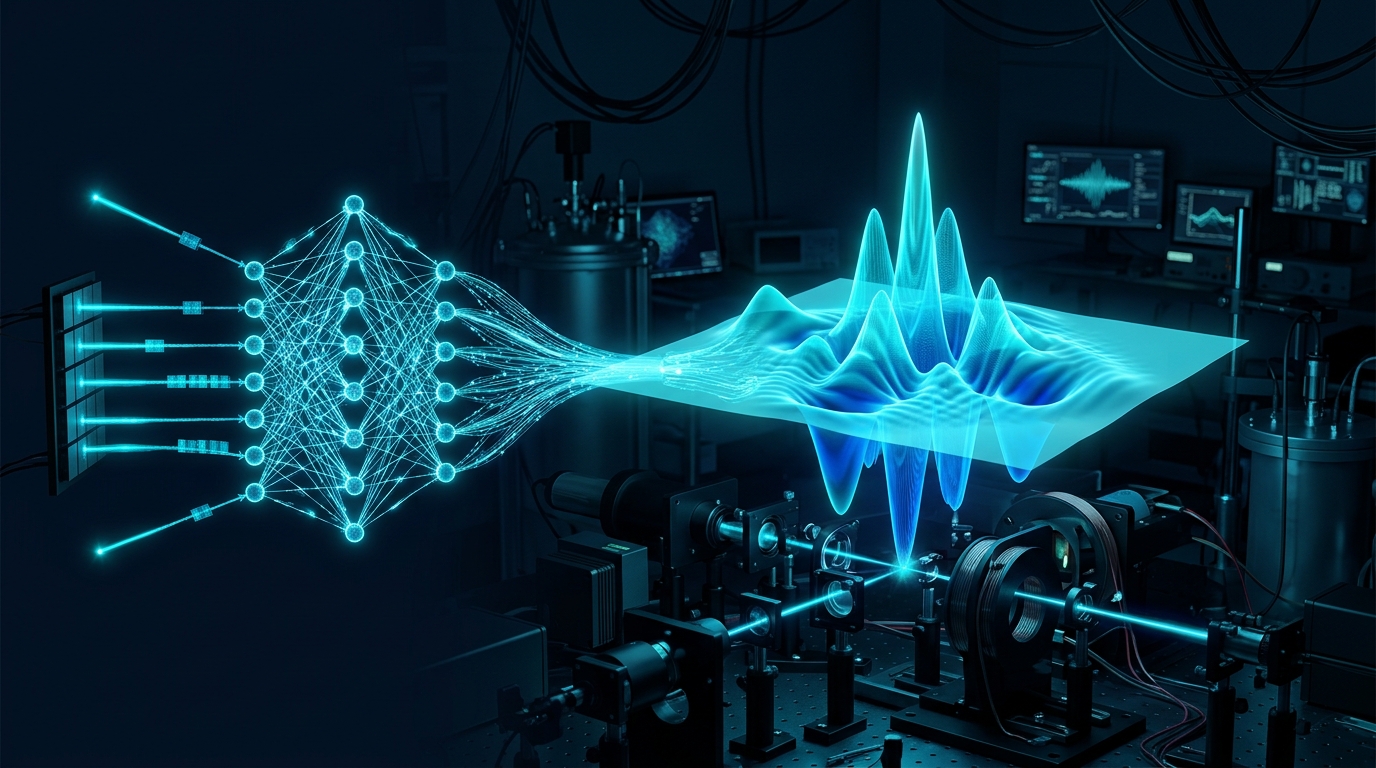
Reconstructing the quantum state of a continuous-variable system—like a pulse of light or a microwave resonator—is a notoriously expensive task. The problem explodes in complexity when the state contains non-Gaussian features, the very kind needed for quantum error correction. Now, a team of researchers (institution not disclosed in the preprint) has introduced a framework that uses flow-based generative AI to perform this tomography directly in phase space, without the crippling cost of a truncated density matrix. The method, called QST-Flow, sidesteps the grid-based curse of dimensionality that has long plagued the characterization of bosonic qubits. [arXiv:2607.21584]
For years, experimentalists faced a painful trade-off: either capture a coarse, low-resolution snapshot of a quantum state or invest exponential computational resources to resolve the intricate Wigner-function negativities that signal genuine quantum advantage. Non-Gaussian states—such as cat states, Gottesman-Kitaev-Preskill (GKP) states, and Fock states—are the building blocks of fault-tolerant quantum computing with bosonic codes. Yet verifying their preparation has remained a bottleneck. The new work, posted on arXiv in July 2026, confronts that bottleneck head-on by treating tomography as a density estimation problem that modern normalizing flows can solve with unprecedented efficiency.
The Core Finding
The researchers built two variants of QST-Flow. QST-QFlow models the strictly positive Husimi-Q function with a single normalizing flow, a type of neural network that transforms a simple distribution into a complex one while preserving exact normalization and easy sampling. QST-WFlow tackles the harder problem of sign-changing Wigner functions by representing them as a trainable difference of two normalized flows. This construction guarantees that the reconstructed quasiprobability distribution remains properly normalized and allows direct sampling—something previous machine-learning tomography methods could not do without a fixed grid. Think of it like teaching a neural network to sculpt a probability cloud that matches the quantum state's shape in phase space, rather than trying to list every possible coordinate on a rigid lattice.
QST-Flow opens a promising route toward scalable, measurement-efficient phase-space tomography of nonclassical bosonic systems.Benchmarks on cat, binomial, GKP, number, and Fock states show accurate single-mode reconstructions, successful extension to multimode states, and robustness against noisy Wigner data. The reconstruction error improved substantially over prior neural-network tomography techniques, though the preprint does not quote a single universal factor—the gain depends on the state and measurement sparsity.
The State of the Field
Before QST-Flow, continuous-variable tomography typically relied on reconstructing a truncated density matrix in the Fock basis via maximum-likelihood estimation or least-squares inversion. Those methods scale poorly because the number of parameters grows quadratically with the Hilbert-space cutoff. More recent machine-learning approaches—such as conditional generative adversarial networks (CGANs) introduced by Ahmed et al. in 2021 and restricted Boltzmann machines used by Torlai et al.—improved flexibility but still required a predefined phase-space grid and struggled with the sign changes of the Wigner function. QST-Flow differs in three crucial ways: it operates without a fixed grid, it learns a continuous normalized density that can be sampled anywhere, and it handles negative quasiprobabilities through the difference-of-flows architecture. This arrives at a moment when the quantum computing field is racing to build logical qubits protected by bosonic codes. IBM, Amazon Web Services, and Yale’s circuit-QED groups have all demonstrated cat and GKP qubits in superconducting cavities, while Xanadu and others pursue optical GKP states. Efficient tomography is no longer a theoretical nicety—it is a practical necessity for debugging and scaling these error-corrected systems.
From Lab to Reality
For scientists, QST-Flow unlocks the ability to characterize highly nonclassical states with far fewer measurements, accelerating the feedback loop between state preparation and verification. It can ingest data from heterodyne detection, homodyne measurement, or photon-number-resolving detectors, making it adaptable to many experimental platforms. For engineers building fault-tolerant quantum computers, the framework could become a standard diagnostic tool for calibrating bosonic logical qubits. Instead of waiting hours for a maximum-likelihood reconstruction to converge on a supercomputer, a trained flow model can produce a high-fidelity Wigner plot in seconds. For investors, this touches the quantum error correction market, which analysts project to reach $1.2 billion by 2030 as the enabling layer for reliable quantum computing. Companies that manufacture control electronics and cryogenic measurement systems stand to benefit when tomography becomes a routine, automated step in qubit fabrication and tuning.
What Still Needs to Happen
Despite its promise, QST-Flow faces at least two hard obstacles before it becomes a turnkey laboratory tool. First, scaling to many modes—say, ten or more coupled resonators—remains an open challenge. The current work demonstrates multimode reconstructions, but the normalizing-flow architecture will need hierarchical or tensor-network-inspired designs to avoid its own exponential blowup. Groups at Chalmers University of Technology and the University of Sherbrooke are actively exploring tensor-network methods for continuous-variable systems that could complement flow-based models. Second, the training process still requires a substantial amount of clean calibration data, and the paper’s robustness tests on noisy Wigner data, while encouraging, do not yet cover the full range of experimental imperfections such as state-preparation and measurement (SPAM) errors. Integrating QST-Flow with self-calibrating protocols is a logical next step. Realistically, widespread adoption in quantum computing labs is five to ten years away, assuming continued progress on both the algorithmic and hardware fronts.
Conclusion
In short: quantum error correction gains a powerful new characterization tool through flow-based phase-space tomography that reconstructs non-Gaussian bosonic states with higher fidelity and fewer measurements than previous methods. The work marks a shift from grid-locked density matrices to continuous, samplable neural representations—exactly the kind of conceptual leap needed as quantum devices grow beyond the few-qubit regime. If the remaining scaling challenges can be solved, QST-Flow could become as essential to bosonic quantum computing as the oscilloscope is to classical electronics.