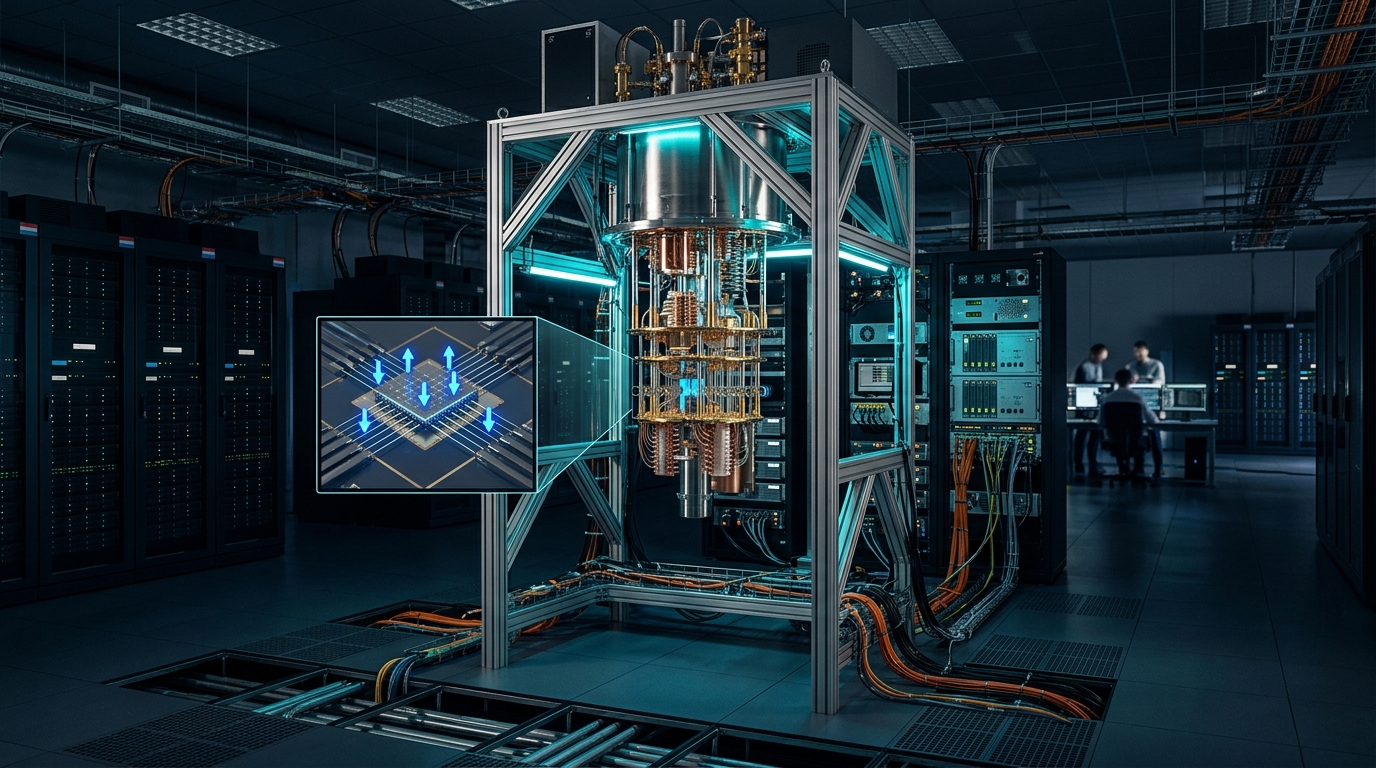
The European High Performance Computing Joint Undertaking (EuroHPC JU) on July 24, 2026 opened a procurement call for MeluXina-Q, a quantum computer to be integrated with Luxembourg’s existing MeluXina supercomputer. The system will be hosted by LuxProvide, the national HPC center, and is budgeted at up to €11.95 million ($13.6 million), split equally between EuroHPC JU and the Luxembourg government. The call specifies a minimum of 10 semiconductor spin qubits at deployment, with a contractual path to scale beyond 80 physical qubits. Once operational, MeluXina-Q will serve scientific, industrial, and public-sector users across Europe through hybrid classical-quantum workflows.
The procurement marks the latest node in EuroHPC’s plan to place at least six quantum computers across the continent by 2027. Unlike earlier EuroHPC quantum systems that opted for superconducting or trapped-ion architectures, MeluXina-Q explicitly targets spin qubits fabricated in silicon—a technology that promises high density and compatibility with existing semiconductor manufacturing but remains less mature in multi-qubit demonstrations.
What They’re Actually Building
Semiconductor spin qubits encode quantum information in the spin state of a single electron or hole confined in a silicon quantum dot. They are controlled by microwave pulses or electric fields and read out via charge sensing. The appeal is lithographic scalability: spin qubits are orders of magnitude smaller than superconducting qubits and can, in principle, be fabricated using modified CMOS processes. Intel, imec, and the Dutch QuTech center have invested heavily in this approach, though the largest publicly known spin-qubit arrays are still in the single-digit range for high-fidelity operation.
The MeluXina-Q call demands a system with at least 10 physical qubits at acceptance, with a roadmap to 80+ qubits during the contract period. That is a modest starting point compared to the 50–100+ qubit superconducting systems already deployed at EuroHPC sites in Germany (Euro-Q-Exa) and Finland (LUMI-Q). However, the requirement for a scaling path beyond 80 qubits signals that EuroHPC views this as a bet on spin qubits’ long-term density advantage, not an immediate performance play. The tender does not specify gate fidelities or coherence times publicly, but standard EuroHPC acceptance criteria typically demand two-qubit gate fidelities above 99% and coherence times sufficient for meaningful hybrid workloads.
Winners and Losers
The immediate beneficiary is LuxProvide, which gains a quantum division and a new service tier for its HPC users. The broader European quantum software ecosystem—companies like AQT, ParityQC, and Multiverse Computing—also wins, as each new hardware platform expands the addressable market for middleware and application development. The spin-qubit hardware vendor that ultimately wins the contract (the call is open until late 2026) will secure a reference customer inside an EU HPC center, a credential that matters for future procurements.
Superconducting and trapped-ion incumbents face no direct threat from a 10-qubit spin system in 2026, but the architecture choice does fragment the European quantum compute layer. IQM, which supplied the 50-qubit superconducting system for LUMI-Q, and AQT/ION-Q, which delivered trapped-ion machines for other EuroHPC sites, now see a competing modality enter the same program. For investors, the signal is that no single qubit technology has locked in the EuroHPC pipeline. The procurement also puts pressure on Intel’s spin-qubit program to either commercialize or risk losing European public-sector deals to a more agile startup or research spinoff.
The Bigger Picture
MeluXina-Q is the fifth EuroHPC quantum procurement since 2023, following systems in Germany, Finland, Italy, and Spain. The total EU public investment in on-premises quantum computers now exceeds €200 million, with co-funding from member states. This sits alongside the EU’s Quantum Flagship, which funds foundational research, and the European Chips Act, which supports semiconductor fabrication relevant to spin qubits. The Luxembourg government’s willingness to co-finance 50% of a €12 million system reflects a broader trend of small nations using quantum infrastructure to attract talent and industrial partnerships.
Comparable 2025–2026 deals include the UK’s £30 million investment in a superconducting quantum computer at the Hartree Centre and Japan’s deployment of a 64-qubit superconducting system at RIKEN. The MeluXina-Q budget is notably smaller, consistent with the earlier stage of spin-qubit technology and the expectation that the initial system is a development platform rather than a production-grade resource.
The Signal
The signal here is that EuroHPC is hedging its quantum architecture bets. By funding a spin-qubit system alongside superconducting and trapped-ion machines, the JU is creating a multi-platform testbed where users can benchmark real workloads across qubit modalities. That is a rational strategy given that no single qubit technology has demonstrated a clear path to fault tolerance at scale. The real test for MeluXina-Q will be whether the chosen vendor can deliver a system that achieves 80+ qubits with gate fidelities above 99.5% within the contract timeline—a milestone that would put spin qubits on a competitive footing with today’s superconducting devices. Until then, this procurement is a down payment on a technology that remains promising but unproven in multi-qubit operation.
In short: MeluXina-Q is a €11.95 million bet on semiconductor spin qubits, starting at 10 qubits and scaling to 80+, that diversifies Europe’s quantum computing infrastructure across qubit modalities.
FAQ
What is MeluXina-Q?
MeluXina-Q is a quantum computer procured by the EuroHPC Joint Undertaking to be hosted at LuxProvide in Luxembourg. It will use semiconductor spin qubits, starting with at least 10 physical qubits and scaling to more than 80. The system will integrate with the existing MeluXina supercomputer for hybrid classical-quantum workloads.
How do semiconductor spin qubits compare to superconducting qubits?
Spin qubits are much smaller—roughly 100 nanometers across—and can be fabricated using modified CMOS processes, offering a potential path to millions of qubits on a single chip. Superconducting qubits are larger, require millikelvin cooling, and have demonstrated higher gate fidelities and larger qubit counts to date. Spin qubits currently lag in multi-qubit demonstrations but promise better scalability and lower per-qubit cost if technical hurdles are overcome.
Is quantum computing ready for enterprise use in 2026?
No. Current quantum computers, including those in the EuroHPC network, are noisy intermediate-scale quantum (NISQ) systems. They can run small-scale experiments and hybrid algorithms for optimization, simulation, and machine learning, but they do not yet deliver a provable advantage over classical computers for commercially relevant problems. Enterprise adoption remains exploratory and R&D-focused.
What is the business model for MeluXina-Q?
MeluXina-Q will operate as a shared research infrastructure. Access will be allocated through EuroHPC’s peer-review process, with a portion reserved for Luxembourg-based users and industrial partners. LuxProvide may also offer commercial access to companies that want to test quantum algorithms on spin-qubit hardware without owning a system.
What quantum computing milestones matter most in 2026?
The key milestones are: demonstrating logical qubits with error rates below the physical qubit threshold (break-even error correction), scaling to hundreds of high-fidelity physical qubits, and achieving a quantum advantage on a practical problem. For spin qubits specifically, reaching 10+ qubits with two-qubit gate fidelities above 99.5% and a clear path to 100 qubits would be a significant step.