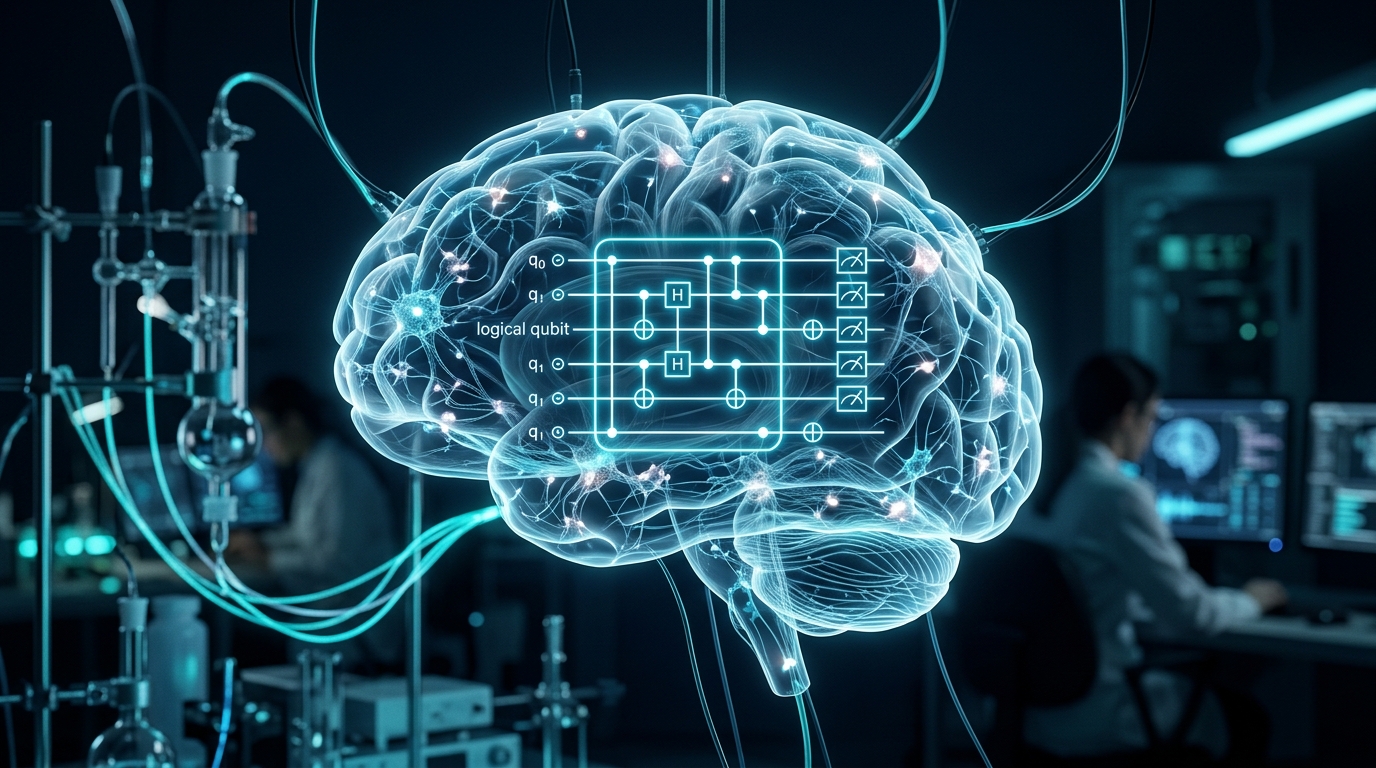
Nature solved fault-tolerant computation 500 million years before the first quantum processor. A new structural analogy between neural error correction and quantum error correction, published July 10 on arXiv, argues that the brain’s noise-reduction strategy can directly inspire the next generation of logical qubits.
This matters because the quantum industry is crossing a threshold: companies are promising operational logical qubits in systems of 50 or more within 18 months. On July 23, Infleqtion announced plans to deliver its Sqale neutral-atom quantum computer with more than 50 logical qubits to the Illinois Quantum & Microelectronics Park in 2027. The timing is not coincidental—the bio-inspired error-correction framework arrives just as engineers need practical ways to tame the overhead that has kept fault-tolerant quantum computing out of reach.
How It Works
Quantum error correction (QEC) encodes a single logical qubit into a protected subspace of a larger Hilbert space, using an entangled array of many physical qubits. Stabilizer circuits perform repeated parity checks that generate a syndrome without collapsing the logical information. “A set of commuting checks is repeatedly evaluated to produce an error syndrome that identifies which constraints were violated without directly revealing the logical state,” the abstract states. A classical decoder then maps that syndrome to a recovery operation, suppressing the logical error rate below a fault-tolerance threshold.
The arXiv paper ([arXiv:2607.20534]) draws an explicit parallel to how neural circuits handle noise. Neurons are stochastic, failure-prone units, yet ensembles of them produce reliable representations by distributing information across populations—a redundant encoding. The authors propose that the brain may operate on lower-dimensional manifolds, a biological codespace, where recurrent dynamics act like stabilizer-checks and mismatch signals act like syndromes, triggering fast corrective updates. Simplified numerical simulations pairing qubit and neuron models illustrate the analogy. Although the paper’s author list was not disclosed at posting time, its central claim holds that brain-inspired decoders can shrink the physical-qubit overhead that currently dominates QEC architectures.
The structural insight is that both systems use constraints to detect errors without measuring the protected information directly. In quantum hardware, that means faster, more efficient syndrome processing. In neural circuits, it hints at how the brain achieves robust computation from unreliable components—a principle that could be engineered into next-generation fault-tolerant machines.
Who’s Moving
Infleqtion, the Boulder, Colorado-based company that rebranded from ColdQuanta in 2023, is turning that principle into hardware. Led by CEO Scott Faris and Chief Scientist Benjamin Bloom, Infleqtion’s flagship platform, Sqale, is a neutral-atom quantum computer designed to host more than 50 logical qubits when it arrives at the Illinois Quantum and Microelectronics Park in 2027. The system integrates NVIDIA’s NVQLink (NVIDIA Corp., ticker NVDA) for ultra-low-latency communication and will be programmable through Superstaq, a cloud-native orchestration platform, via the National Quantum Algorithm Center.
The company also secured three Phase I U.S. Department of Energy Genesis Mission projects, partnering with Argonne National Laboratory, Brookhaven National Laboratory, and Lawrence Livermore National Laboratory. Those contracts target nuclear applications, deployable atomic sensing, and plasma dynamics simulations—areas that demand the very fault-tolerance that QEC provides. Meanwhile, Infleqtion is advancing America’s Quantum Space Initiative alongside Voyager Technologies, Armada, Monarch Quantum, and the University of Colorado Boulder, where physicist Ana Maria Rey bridges atomic-physics theory with QEC design.
Infleqtion raised $110 million in its 2022 funding round, fueling its transition from a supplier of cold-atom components to a full-stack quantum computing company. Competing platforms include IBM’s 1,121-qubit Condor processor and Google’s Willow chip, both superconducting, and Quantinuum’s H2 trapped-ion machine, which demonstrated high-fidelity logical qubits in 2025. Neutral atoms offer a different trade-off: long coherence times and highly parallel atom-shuffling operations that align with the bio-inspired approach’s need for rapid, collective syndrome checks.
Why 2026 Is Different
In 12 months, Infleqtion’s Sqale is scheduled for delivery, marking the first known deployment of a neutral-atom system with a logical qubit count in the dozens. By 2029, fault-tolerant machines with hundreds of logical qubits—fueled by codes that borrow from neural dynamics—will likely power early industrial applications in catalyst design, battery chemistry, and nuclear-stockpile stewardship. Five years out, in 2031, a 1,000-logical-qubit era becomes plausible if bio-mimetic decoding cuts the physical-to-logical qubit ratio from the current 1,000:1 toward 100:1. IDC forecasts global quantum computing spending to hit $8.6 billion in 2027, and a step-change in QEC efficiency directly determines how much of that value can be captured.
The bio-QEC connection also alters how researchers design error-correcting codes themselves. Instead of optimizing classical decoders in isolation, they now inject architectural constraints from neuroscience—distributed fault-tolerance, recurrent syndrome aggregation, and manifold-constrained inference—into surface code and LDPC-code pipelines. The result is a hardware–decoder co-design loop that accelerates the fault-tolerant roadmap.
In short: Quantum error correction, inspired by the brain’s distributed fault-tolerance, is enabling machines with 50 logical qubits by 2027—cutting the path to practical quantum advantage by years.