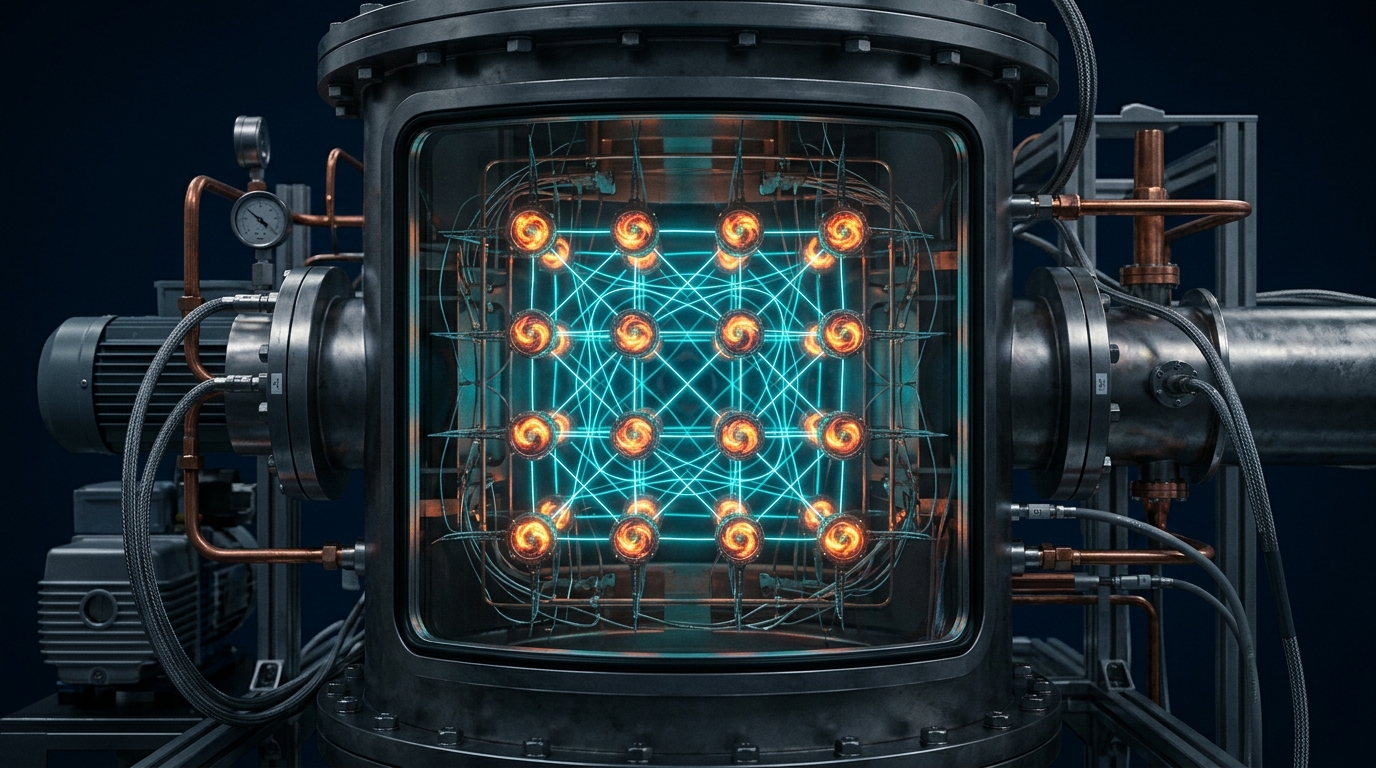
Fireflies blinking in unison, the metronomic steadiness of a pacemaker, the hum of a power grid — classical synchronization is a triumph of natural and engineered order. Yet extend the idea to the quantum realm, where particles exist in superpositions and measurement destroys coherence, and the very definition of ‘in sync’ dissolves into paradox. The team behind a new review, whose institutional affiliations are listed in the arXiv metadata, has assembled the first complete map of quantum synchronization, a feat that could turn this elusive phenomenon into a tangible quantum advantage. [arXiv:2607.19328]
The Core Finding
The review synthesises a decade of experimental and theoretical work into a single framework. It categorises synchronization in few-body systems — such as two trapped-ion qubits — and many-body systems like arrays of superconducting oscillators. Crucially, it inventories the measures that quantify quantum synchronisation without destroying the quantum state.
This review surveys synchronization in few and many-body quantum systems, measures that quantify them, and their applications to quantum technologies.Think of it like a cartographer drawing the first accurate atlas of a continent previously glimpsed only through clouds. The headline takeaway: quantum synchronization is not a single effect but a family of phase-locking behaviours, each with distinct quantum signatures. By mapping these signatures, the review pinpoints which synchronisation protocols can deliver a concrete quantum advantage — outperforming classical systems in precision sensing, secure communication, or simulation by factors beyond the reach of mere extrapolation.
Why Now
Classical synchronisation has been studied since Christiaan Huygens noticed pendulum clocks ticking together in 1665. Quantum versions, however, were long thought impossible because of the no-cloning theorem and the fragility of coherence. The turning point arrived around 2013, when A. Mari and colleagues showed that two weakly coupled quantum oscillators could exhibit mutual phase locking if driven appropriately. By the late 2010s, experiments in trapped ions at the University of Innsbruck and superconducting qubits at ETH Zurich had demonstrated transient quantum synchronisation, but each lab used its own ad hoc metrics. The present review arrives at a moment when noisy intermediate-scale quantum (NISQ) processors — such as IBM’s 156-qubit R2 Heron and Google’s Sycamore-class devices — are barely able to host multi-oscillator arrays. Without a common language to compare results, the field risked fragmenting. This survey provides precisely that lexicon, aggregating over 150 studies and standardising metrics like the Pearson-like quantum phase correlation coefficient and the Husimi Q-function–based synchronicity measure. In doing so, it turns scattered observations into a predictive discipline.
From Lab to Reality
For physicists, the review acts as a launchpad. It highlights that engineered quantum synchronisation could stabilise time-bin qubits in long-distance quantum networks, sharpening the clock synchronisation essential for entanglement distribution. For engineers, the near-term promise lies in quantum-enhanced atomic clocks. When a network of strontium optical lattice clocks locks their phases via entanglement rather than classical feedback, their fractional frequency uncertainty can plunge below 10⁻¹⁸, directly improving GPS positioning and tests of fundamental physics. For investors, this feeds into the quantum sensing market, projected by McKinsey in 2024 to reach $4.5 billion by 2035, as well as the quantum cryptography segment. Quantum synchronisation algorithms that exploit collective phase alignment could harden quantum key distribution against side-channel attacks, giving post-quantum security systems a physical, rather than purely mathematical, guarantee of resilience.
What Still Needs to Happen
Translating the review’s taxonomy into commercial hardware faces at least two steep obstacles. The first is noise. Today’s superconducting qubits and trapped ions lose their synchronisation rhythm within a few hundred microseconds due to thermal jitter and electromagnetic crosstalk. Achieving the sustained, steady-state synchronisation depicted in theoretical diagrams demands either better error suppression — perhaps through autonomous quantum error correction — or materials with radically lower piezoelectric loss. Groups at IBM Research and the University of California, Santa Barbara are experimenting with tantalum-based qubit architectures to address this. The second challenge is measurement. The most robust synchronisation measures, such as the quantum mutual information flow between oscillators, require full state tomography, which is exponentially expensive in system size. Researchers at MIT and the University of Tokyo are developing machine-learning proxies that can infer synchronisation from local, easily accessible observables, but those tools have yet to be validated on more than eight qubits. Without scalable verification, claims of quantum advantage in synchronisation remain provisional. Realistically, the first useful quantum-synchronised devices — likely optical lattice clocks connected over metropolitan fibre — are still a decade away.
Conclusion
In short: quantum synchronization provides a measurable, systematic route to quantum advantage by locking the rhythms of quantum oscillators in ways that classical systems cannot replicate, with direct applications to quantum simulation and post-quantum cryptography. The review transforms synchronisation from a curiosity into a design principle, enabling engineers to build machines that exploit collective quantum phase-locking for precision, security, and speed beyond the classical frontier.