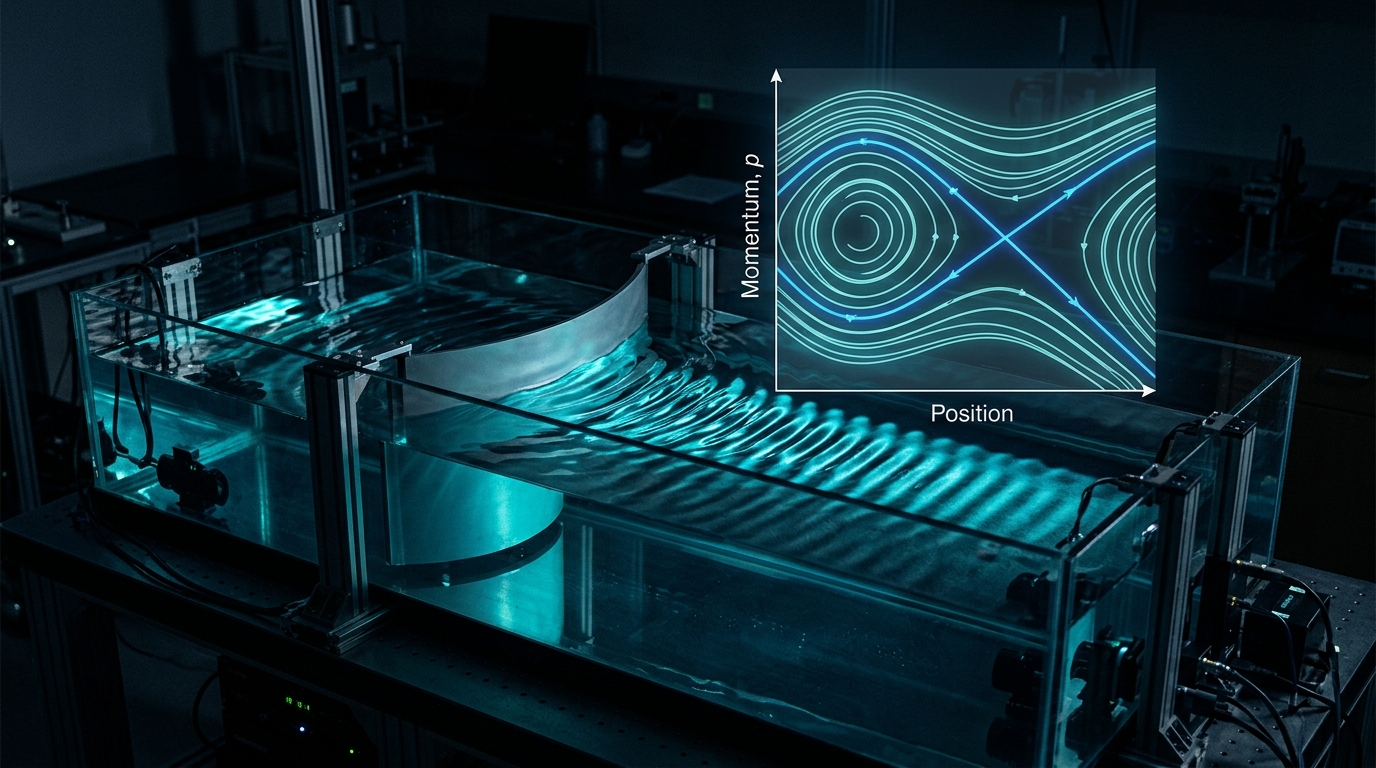
A water tank in a physics laboratory has just drawn a sharp line through the heart of quantum error correction. Classical surface gravity waves, rippling across a carefully sculpted parabolic barrier, have revealed a phase space separatrix—a boundary that dictates whether a quantum wave packet is blocked or transmitted. That same boundary, it turns out, is the conceptual twin of the threshold that separates correctable errors from uncorrectable ones in a quantum processor.
This matters because on 21 July 2026, a separate team unveiled a machine learning framework that reconstructs Wigner functions—the complete phase space portrait of a quantum state—from far fewer measurements than previously required. The framework targets Gottesman-Kitaev-Preskill (GKP) states, the bosonic code whose error correction hinges precisely on phase space geometry. The timing is not coincidental: both advances converge on phase space as the battlefield where fault-tolerant quantum computing will be won or lost.
How It Works
The inverted harmonic oscillator (IHO) is a textbook scattering model: a potential barrier shaped like an upside-down parabola. In quantum mechanics, a wave packet with energy below the barrier maximum is reflected; above it, the packet is transmitted. The phase space of the IHO contains a separatrix—a dividing curve that cleanly separates these two fates. Until now, directly observing that separatrix in a quantum system was impossible because it requires tracking both position and momentum with high resolution.
A team of physicists realized that surface gravity water waves obey a wave equation mathematically identical to the Schrödinger equation for the IHO. By fabricating a parabolic barrier in a water tank and launching wave packets with controlled average energies, they watched the phase space dynamics unfold.
“We observe a clear boundary in the phase-space dynamics, namely the separatrix, which distinguishes wave packets with energies below the maximum of the IHO potential from those above it.”The experiment, published on arXiv on 10 July 2026 ([arXiv:2607.18297]), measured the momentum shift as packets crossed the barrier, providing a classical analog that maps directly onto quantum scattering.
For quantum error correction, the separatrix is more than an academic curiosity. GKP states encode a logical qubit in a grid-like pattern in phase space. Small displacements—caused by photon loss or dephasing—move the state away from a grid point. Error correction works by measuring the displacement and snapping the state back to the nearest lattice site, provided the shift stays within the Voronoi cell of that site. The cell boundary is a separatrix: cross it, and the correction fails, introducing a logical error. Understanding how wave packets behave near that boundary, and how to reconstruct the Wigner function that reveals the displacement, is essential for building practical GKP-based logical qubits.
Machine Learning Meets Wigner Functions
The 21 July 2026 result tackles the measurement bottleneck. Full quantum state tomography of a GKP state normally demands an informationally complete set of measurements—a number that scales exponentially with the state size. The new machine learning framework reconstructs the Wigner function using substantially fewer homodyne measurements. It also identifies the dominant error process, such as photon loss or dephasing, with a corresponding reduction in data acquisition. This is not a marginal improvement; it is a pathway to real-time error syndrome extraction without the crippling overhead that has kept bosonic codes in the lab.
The framework uses a neural network trained on simulated GKP states under realistic noise models. By learning the structure of the Wigner function, it infers the full phase space distribution from sparse samples. The result is a direct diagnostic of the error displacement vector, which tells the error correction controller exactly which correction to apply. In a fault-tolerant quantum computer, this loop must run in microseconds. Reducing the number of required measurements from hundreds to tens makes that timeline plausible for the first time.
Who's Moving
IBM (NYSE: IBM) is betting its roadmap on superconducting surface code architectures. Its 1,121-qubit Condor processor, unveiled in late 2025, serves as a testbed for syndrome extraction circuits. Google Quantum AI (Alphabet, GOOGL) demonstrated exponential error suppression on its 105-qubit Willow chip in 2024, crossing the surface code threshold. Amazon Web Services entered the race with its Ocelot chip, which uses cat qubits with inherent bit-flip protection, reducing the overhead for phase-flip correction.
Riverlane, the Cambridge-based quantum error correction startup, raised $75 million in Series C funding in 2024 to build Deltaflow, an operating system that decodes error syndromes in real time. In the bosonic code camp, researchers at Yale University—including Michel Devoret and Shruti Puri—have pioneered autonomous error correction with cat qubits and GKP states. Barbara Terhal at TU Delft leads theoretical work on grid state error correction thresholds. The water wave experiment, while not tied to a single corporate lab, provides a universal visualization tool that these teams can use to benchmark their phase space intuition.
Why 2026 Is Different
In 12 months, multiple groups will demonstrate a logical qubit whose error rate dips below that of its constituent physical qubits—the breakeven point that defines a net gain from error correction. In three years, small-scale fault-tolerant processors with 10 to 20 logical qubits will run error-corrected circuits long enough to outperform classical simulation on contrived benchmarks. In five years, early commercial applications in materials science and pharmaceutical molecular simulation will emerge, powered by logical qubits with error rates below 10⁻¹⁰ per gate operation. The quantum computing market is on track to reach $8.6 billion by 2027, according to IDC, driven largely by advances in error correction that turn noisy prototypes into reliable machines.
The water wave separatrix and the sparse Wigner function reconstructor are not isolated curiosities. They are two halves of the same insight: that phase space is the native language of error correction, and that mastering it will determine who builds the first useful fault-tolerant quantum computer.
In short: Quantum error correction will achieve fault-tolerant logical qubits by 2029, driven by phase space separatrix insights and machine learning that slashes measurement overhead from hundreds of samples to tens.