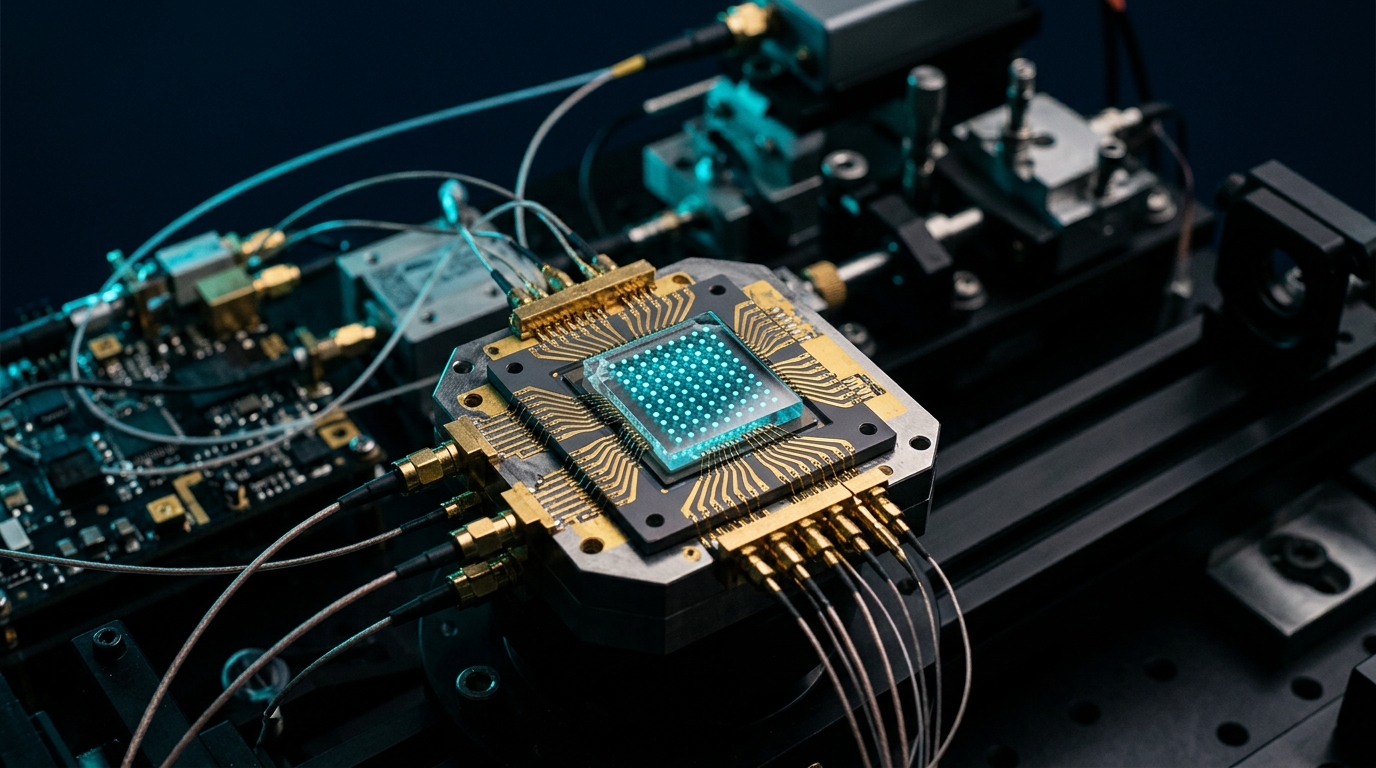
On July 22, 2026, German startup SAXON Q announced the commercial release of two diamond-based quantum processors: the SXQ128 with 128 qubits and the SXQ512 with 512 qubits. The systems, spun out of Leipzig University, operate at room temperature without cryogenic cooling or vacuum infrastructure—a stark departure from superconducting and trapped-ion platforms. No pricing, customer references, or independent performance data were provided.
What They're Actually Building
SAXON Q uses nitrogen-vacancy (NV) centers in diamond as qubits. NV centers are point defects where a nitrogen atom replaces a carbon atom adjacent to a lattice vacancy. The electron spin can be optically initialized and read out, with coherence times exceeding 1 millisecond at room temperature—roughly 10,000 times longer than typical superconducting qubits. This long coherence is a key advantage, but scaling NV centers into large, interconnected arrays has been a persistent challenge. The largest previously reported diamond quantum processor was a 5-qubit device from Quantum Brilliance in 2024, with two-qubit gate fidelities around 97%.
SAXON Q claims to have leapfrogged this by two orders of magnitude. The company's press release, as summarized by the Quantum Computing Report, states that the SXQ128 and SXQ512 are
“the first diamond-based nitrogen-vacancy (NV) center quantum processors to exceed ten physical qubits.”However, no details on qubit connectivity, gate fidelities, or error rates have been disclosed. In quantum computing, raw qubit count is a vanity metric without corresponding fidelity. A system with 512 qubits and 90% two-qubit gate fidelity is far less capable than a 50-qubit system with 99.9% fidelity. The absence of any published benchmark—such as randomized benchmarking, quantum volume, or even a simple Bell state fidelity—makes the announcement impossible to evaluate.
Typical single-qubit gate fidelities for NV centers exceed 99.9%, but two-qubit gates, which rely on dipolar coupling or photon-mediated interactions, have struggled to surpass 99%. For a 512-qubit system to be useful, two-qubit gate fidelities must be above 99.9%, and the system must support high connectivity. SAXON Q has not addressed these points. The company has not revealed how it achieved such scaling. Possibilities include a novel ion implantation technique to create precisely positioned NV centers, integrated photonic circuits for optical addressing, or a new entanglement scheme. However, without a peer-reviewed paper or technical preprint, these remain speculation. The diamond quantum computing community is small and tightly connected; a breakthrough of this magnitude would likely have been presented at major conferences like the APS March Meeting or QIP 2026. No such presentation has been reported.
Winners and Losers
If SAXON Q's claims are substantiated, the immediate loser would be Quantum Brilliance, the Australian startup that has led diamond NV quantum computing development since 2019. Quantum Brilliance raised $100 million in 2025 to build a 50-qubit diamond quantum accelerator by 2028; a 512-qubit room-temperature system would render that roadmap obsolete. More broadly, all cryogenic quantum computing companies—IBM, Google, IonQ, Quantinuum, Rigetti—would face a disruptive threat. Room-temperature operation eliminates the multi-million-dollar dilution refrigerators and complex cryogenic infrastructure that currently account for a significant portion of quantum computer cost and footprint.
Cloud quantum computing providers like AWS Braket and Microsoft Azure Quantum would benefit from easier deployment and lower operational costs. Quantum software startups, particularly those focused on error mitigation and hybrid algorithms, would gain a more accessible hardware platform. However, the lack of verifiable data means these scenarios remain speculative.
“Qubit count without fidelity is like a car's horsepower without a transmission,” says a quantum engineer familiar with diamond platforms.VCs should demand a live demonstration of a two-qubit gate on a 100+ qubit chip before considering investment.
The Bigger Picture
The 2026 quantum computing landscape is defined by a race toward error-corrected logical qubits. IBM targets a 100,000-qubit system by 2033; Google aims for a million physical qubits; PsiQuantum is building a photonic quantum computer with a similar room-temperature advantage but using photons, not matter qubits. Diamond NV centers have been a niche modality, valued for sensing and small-scale quantum information processing, but not considered a contender for large-scale computing. SAXON Q's announcement, if real, would reposition diamond as a leading platform.
Germany has invested heavily in quantum technologies through its €2 billion Quantum Technologies program and the EU Quantum Flagship. Leipzig University has a strong quantum optics group, and SAXON Q likely benefited from public grants. However, no venture funding details were disclosed, suggesting the company may still be pre-revenue or in stealth mode. In 2025, a Chinese team demonstrated a 10-qubit diamond quantum simulator, but that was a specialized device, not a universal quantum computer. SAXON Q's claim of 512 qubits is an order of magnitude beyond that. The field has seen steady progress since the first NV center qubit demonstrations in 2004, but scaling has been limited by fabrication challenges. A universal, gate-based 512-qubit processor would be a monumental leap—one that demands extraordinary evidence.
The Signal
The signal here is that room-temperature quantum computing is moving from a long-term research vision to a commercial narrative that can attract attention and capital. But the specific technical milestone that would validate SAXON Q's claim—a published two-qubit gate fidelity above 99% on a device with more than 100 qubits—is entirely missing. Until independent benchmarks are released, this announcement reads as a marketing move designed to stake a claim in a crowded market. Experienced quantum engineers will note that scaling NV centers to hundreds of qubits while maintaining high-fidelity control and readout is an unsolved problem in the field, with no peer-reviewed breakthroughs to support such a leap.
In short: SAXON Q's diamond-based quantum computers promise a massive qubit count at room temperature, but without error rates or third-party validation, the claim remains unproven.