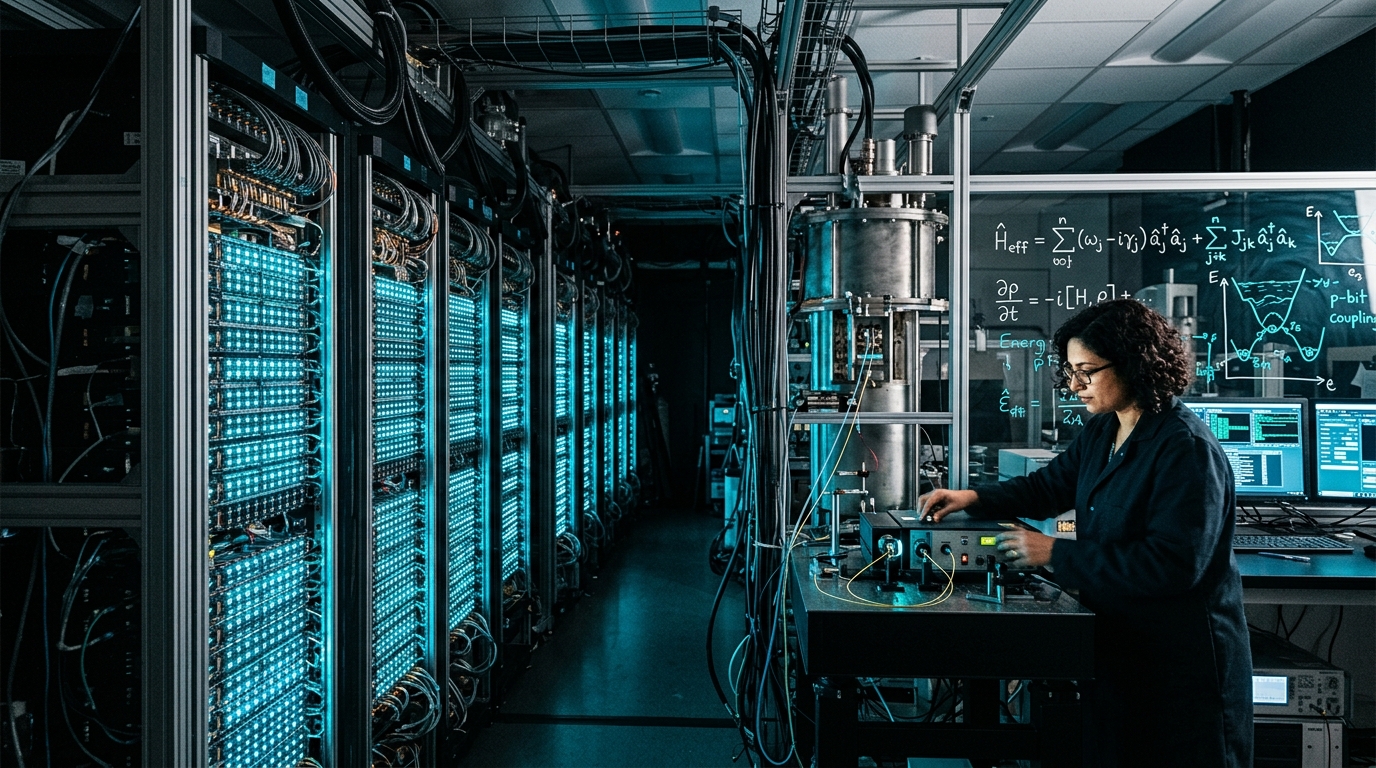
Quantum error correction has a noise problem it cannot solve alone. On July 17, 2026, a preprint on arXiv revealed that the same dissipation physicists fight in superconducting qubits can be turned into a precise control mechanism using non-Hermitian interference. The next day, a consortium led by Kerem Camsari at UC Santa Barbara announced the first probabilistic computer to cross 1 million p-bits—a scale where intrinsic noise must be managed or the entire architecture collapses. The timing is not coincidental.
This matters because probabilistic computing, which relies on noisy bits to sample complex probability distributions, has long been dismissed as a niche curiosity next to the fault tolerant quantum computing race. The arXiv paper provides the missing theoretical foundation to suppress errors without the overhead of syndrome measurement or surface code logical qubit encoding, while the million-p-bit machine proves that scale is achievable. The two developments together redraw the competitive landscape: quantum error correction no longer has a monopoly on taming noisy hardware.
How It Works
Non-Hermitian systems lose energy to their environment. In quantum computing, this decoherence destroys qubit fidelity and demands elaborate error-correction codes. The preprint—published as [arXiv:2607.15770]—shows that in a coupled non-Hermitian system, dissipation does more than degrade; it creates an interference pattern between two excitation pathways. One pathway is self-excitation, where a system element drives itself. The other is coupling-excitation, where one element drives its neighbor. When weak external driving is applied to two channels simultaneously, the ratio of those driving strengths determines which pathway dominates.
The researchers, who posted the work without named authors but with detailed numerical simulations, report that this interference produces "non-intrinsic outputs" that can be manipulated by adjusting the drive ratio. The result is a convergence effect in which a high-loss mode collapses towards a low-loss mode, effectively suppressing dissipation. Simultaneously, the resonant frequency undergoes a giant shift instead of the usual spectral Rabi splitting. The team discovered a Pythagorean relation linking the eigenlevel splitting, spectral Rabi splitting, and average total decay rate. That relation enables direct measurement of the coupling strength between modes—a parameter that until now was inferred indirectly in both quantum and classical coupled systems.
"dissipation in a non-Hermitian quantum coupled system induces interference between self-excitation and coupling-excitation spectral functions, giving rise to non-intrinsic outputs"
Probabilistic bits in Camsari's machine are stochastic magnetic tunnel junctions (sMTJs), inherently noisy devices that fluctuate between two states due to thermal agitation. When many p-bits are networked, they collectively realize a Boltzmann distribution that can solve optimization and inference problems. The challenge has always been that parasitic dissipation and uncontrolled coupling scramble the distribution, driving the system away from the correct solution. The non-Hermitian insight provides a prescription: apply a specific ratio of weak external drives to adjacent p-bits, and the high-loss fluctuations converge to the low-loss desired trajectory. In effect, error suppression becomes a physical consequence of tuning, not a computational overhead.
Who's Moving
Kerem Camsari and his group at the University of California, Santa Barbara, together with Supriyo Datta at Purdue University, have been scaling p-bit arrays since 2019. Their million-p-bit platform, fabricated on sMTJ wafers provided by Everspin Technologies (NASDAQ: MRAM), uses vertical rack-mounted chips with parallel read/write circuits. The team has not yet disclosed latency or energy figures, but the sheer count is a milestone. A DARPA grant worth $40 million, awarded in 2025 to a UC Santa Barbara-led consortium including Purdue and Tohoku University, funded the scale-up.
Meanwhile, the quantum error correction establishment continues its own march. IBM (NYSE: IBM) operates the 1,121-qubit Condor processor, which leverages a heavy-hexagonal surface code layout. Google Quantum AI, part of Alphabet (NASDAQ: GOOGL), demonstrated repetition-code logical qubit lifetimes exceeding physical qubit lifetimes in its Willow chip in late 2024. Both companies have invested billions in fault tolerant quantum computing. The non-Hermitian techniques could seep into their architectures too: the interference-based driving could be applied to tune couplers between transmons with less qubit fidelity loss, reducing the need for frequent syndrome measurement cycles. However, the immediate impact is in probabilistic hardware, where the physics is identical at room temperature.
Why 2026 Is Different
The next 12 months will see the first demonstrations of p-bit arrays using non-Hermitian convergence protocols to execute error-suppressed optimization tasks, such as maximum-cut graph problems on networks of hundreds of thousands of nodes. Within three years, probabilistic computing accelerators will appear as co-processors in data centers targeting Monte Carlo simulation workloads, a market that Yole Intelligence projects will reach $2.3 billion by 2028. In five years, the boundary between quantum error correction and probabilistic error control will blur, with hybrid machines combining logical qubits and massive p-bit clusters for sampling-based quantum advantage demonstrations. The quantum computing market, forecast by McKinsey to hit $15 billion by 2030, will absorb these techniques, not be replaced by them.
The Pythagorean relation reported in the arXiv paper gives engineers a new tool to precisely measure coupling strengths in any non-Hermitian platform, from nitrogen-vacancy centers to optomechanical arrays. That measurement capability alone accelerates the calibration and tuning of large-scale noisy systems at a time when qubit counts are climbing but individual qubit fidelity remains stubbornly below 99.99%.
The Error-Correction Landscape Expands
For a decade, quantum error correction meant surface code, cat codes, or bosonic codes, all requiring redundant physical qubits to build a single logical qubit. The overhead is enormous: a fault tolerant quantum computer needs roughly 1,000 physical qubits per logical qubit with current fidelities. Probabilistic computing, by contrast, treats noise as a feature, but uncontrolled noise is still destructive. The non-Hermitian driving technique corrects the output distribution without replicating the entire bit array. It is a form of physical error mitigation, not error correction in the algorithmic sense, but it achieves the same goal: output that is substantially more reliable than the raw hardware would allow.
This expansion matters because the race to practical computing no longer runs along a single track. Quantum error correction remains indispensable for applications like factoring large numbers or simulating quantum materials. Probabilistic machines, now embeddable with noise-management physics, will handle optimization, sampling, and machine-learning inference tasks sooner, with less cryogenic infrastructure. The two approaches will coexist, and increasingly, they will cross-pollinate.
In short: Quantum error correction no longer has a monopoly on taming noisy bits—non-Hermitian driving provides a complementary path to reliable computation at scale.