Two papers appearing 24 hours apart in July 2026 reveal a deep convergence between the physics of fermion parity detection and the mathematics of graph-state complexity—a convergence that directly shapes how future quantum algorithms will be compiled and executed. On 17 July, an experimental team demonstrated that the global fermion parity of a delocalized superconducting state can be read out locally via a nonlocal Josephson effect. The next day, theorists published a framework that characterizes the exact number of two-qubit Clifford gates needed to build any graph state, the scaffolding of measurement-based quantum computation. The timing is not coincidental. [arXiv:2607.15786]
This matters because fermion parity is the currency of topological qubits, the elusive hardware that promises error-protected quantum computation, while graph states are the substrate for fault-tolerant quantum logic. The near-simultaneous publication signals that hardware engineers and algorithm theorists are converging on a unified stack, where nonlocal measurements and Clifford-circuit complexity become two sides of the same coin. A quantum algorithm designed for a topological processor will require both perfect parity readout and minimal circuit depth—and these two papers provide the missing manuals.
How It Works
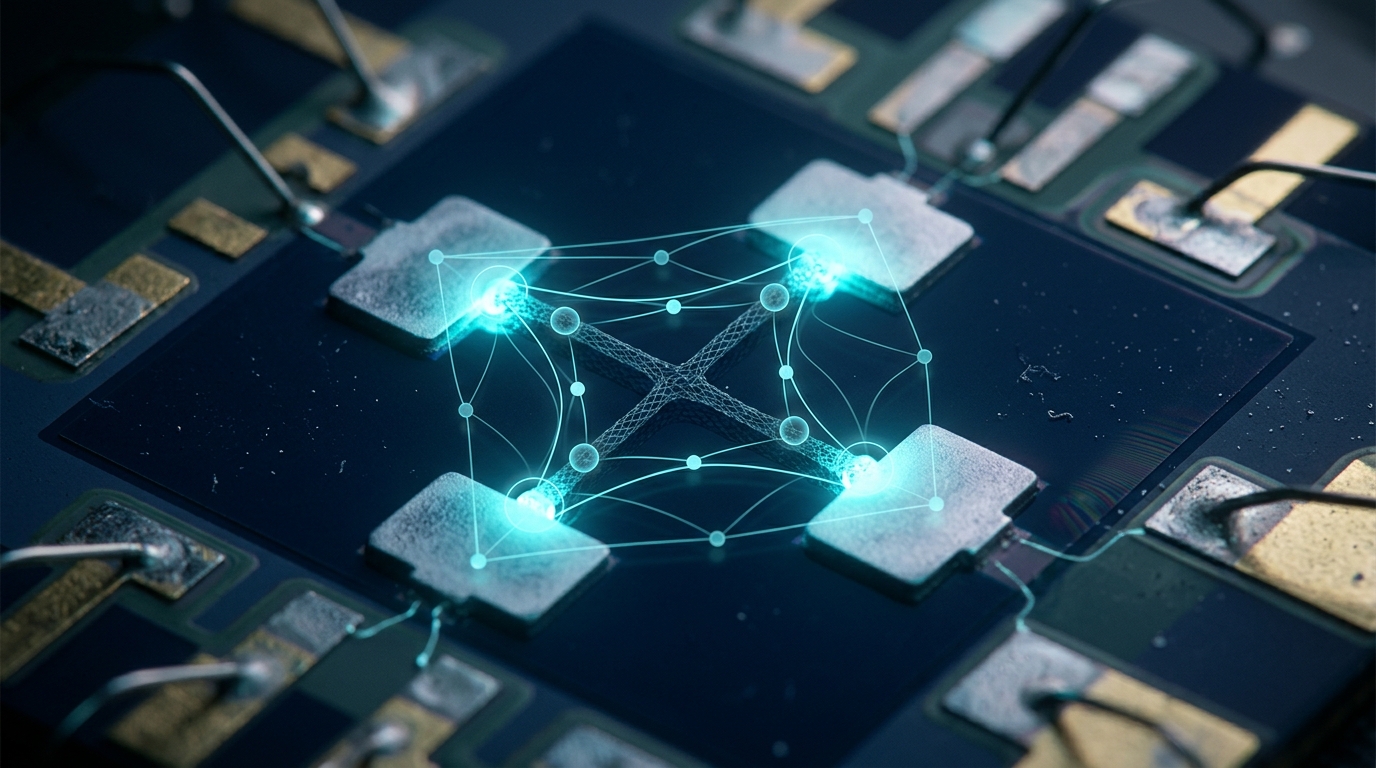
The experimental work, posted to arXiv on 17 July 2026, constructs an Andreev molecule—a single mesoscopic system formed by two coupled quantum-dot Josephson junctions fabricated on a carbon-nanotube platform. By injecting supercurrent through one junction and detecting a nonlocal Josephson response at the other, the team directly probes the global fermion parity of the shared many-body ground state. The key signature is unmistakable: “changes in the molecular ground-state parity manifest as characteristic π-phase shifts in the nonlocal response.” That phase flip transforms a fundamental quantum number into a macroscopically measurable signal, effectively building a parity-detector-in-a-device.
Meanwhile, the 18 July paper in the journal Quantum defines the CZ-complexity of an arbitrary graph state—the minimum number of controlled-Z (CZ) gates required to prepare it from a product state. The authors prove that this complexity measure is equivalent to the smallest number of vertex deletions, local complementations, and edge additions needed to transform one graph into another. Think of graph states as a tangle of entangled qubits; preparing them with as few two-qubit gates as possible is like untangling a knot with minimal moves. For any quantum algorithm that relies on cluster states or error-correcting surface codes, this combinatorial characterization immediately translates into a guaranteed upper bound on circuit depth.
The connection between the two breakthroughs lies in Clifford operations. The graph-state preparation paper explicitly allows all single- and two-qubit Clifford gates, while the parity-detection scheme inherently relies on Josephson physics that, when embedded in a topological qubit, yields Pauli measurements—Clifford by nature. Together, they map a direct path from physical parity detection to algorithmic overhead reduction in the same operational language.
Who's Moving
Every major quantum computing effort is watching. Microsoft, which has staked its roadmap on topological qubits via InAs-Al nanowires and Majorana zero modes, requires exactly the kind of local parity-readout demonstrated in the Andreev molecule paper. Leo Kouwenhoven’s group at TU Delft and Charles M. Marcus at the University of Copenhagen, both long-time Microsoft collaborators, have pursued parity-to-charge conversion; the new nonlocal Josephson method offers a simpler, all-superconducting alternative. Across the Atlantic, John M. Martinis, who led Google’s 2019 quantum supremacy experiment and now drives silicon-based qubits at Silicon Quantum Computing, notes that parity checks are the heartbeat of error correction, regardless of platform.
On the software side, Quantinuum’s trapped-ion H2 processor already runs graph-state circuits with record fidelity, and the new complexity measure gives compiler teams a precise target for gate-count optimization. IBM’s 1,121-qubit Condor processor, while still a noisy beast, can now be reconfigured as a graph-state generator; knowing the exact CZ-cost of a target state lets the Qiskit runtime prune unnecessary operations before a job hits the hardware. In 2024, Quantinuum raised $300 million in equity funding, and that capital is now flowing into middleware that will embed combinatorial graph optimizations directly into the quantum software stack.
Why 2026 Is Different
In 2026, the quantum computing market surpasses $3 billion in annual spending, and McKinsey’s latest forecast puts the industry at $65 billion by 2030. The NISQ era is fading; logical qubits are no longer a paper promise. IBM plans to deliver a fully error-corrected machine by 2029, and Google Quantum AI’s Willow processor already stores a logical qubit with lifetime exceeding the break-even point. The two papers land precisely when the community needs them: a hardware demonstration that parity can be read without destroying coherence, and a theory framework that guarantees minimal circuit depth for the cluster states that will form the logical fabric of those machines. Within 12 months, multiple groups will replicate the nonlocal parity measurement on different materials. In three years, a topological qubit with integrated parity readout will execute a variational circuit with verifiable quantum speedup. In five years, graph-state-based quantum algorithms running on logical qubits will reach circuit depths once thought impossible for early fault-tolerant devices.
The hybrid quantum-classical feedback loop—where a classical optimizer adjusts measurement angles on a quantum device—now has a rigorous complexity backbone. Every variational circuit can be mapped to a graph state, and every graph state has a known CZ-complexity. That ends the guesswork in compiling hybrid quantum-classical workloads, cutting months from experimental iteration cycles.
In short: The marriage of graph-state complexity theory and nonlocal parity detection gives quantum algorithms a physical metric for circuit depth, enabling optimal compilation on future fault-tolerant machines.
Frequently Asked Questions
What is fermion parity in quantum computing?
Fermion parity refers to whether the total number of electrons in a superconducting island or a many-body state is even or odd. In topological qubits built from Majorana zero modes, quantum information is stored in the parity of shared fermion states, protected from local noise. Reading out that parity without disturbing the qubit is the central measurement challenge. The 2026 Andreev molecule experiment translates global parity into a π-phase shift of a nonlocal supercurrent, providing a clean, single-shot detection mechanism.
How does graph-state complexity compare to traditional quantum circuit compilation?
Traditional compilation maps a quantum algorithm to a sequence of one- and two-qubit gates, often using heuristics that minimize total gate count. Graph-state complexity instead characterizes the entanglement structure directly: it defines the absolute minimum number of CZ gates needed to generate a given graph state from unentangled qubits. Because measurement-based quantum computing and many error-correcting codes use graph states as their native resource, this combinatorial metric gives compilers a provable lower bound on circuit depth, eliminating wasteful over-compilation.
When will nonlocal Josephson effect detectors be commercially available?
Nonlocal Josephson detectors are still laboratory prototypes, but the 2026 demonstration shifts the technology from proof-of-concept to engineering optimization. Expect pilot integration with research-scale topological qubit chips within 18 months. Commercial availability in cloud-accessible quantum processors—likely through Microsoft Azure Quantum—is plausible by 2029, once the readout fidelity exceeds 99.9% and multi-qubit arrays are demonstrated.
Which companies are leading in fermion parity-based quantum computing?
Microsoft is the most prominent company pursuing topological qubits, with extensive partnerships at TU Delft, the University of Copenhagen, and Station Q Santa Barbara. IBM and Google focus on superconducting transmons and surface codes, where parity checks are also fundamental for error correction. Quantinuum uses trapped-ion qubits and graph-state measurement-based protocols, directly benefiting from the new complexity framework. PsiQuantum’s photonic approach similarly relies on graph states, making the CZ-complexity metric a key tool for their compiler team.
What are the biggest obstacles to using graph states in quantum algorithms?
The largest obstacle is generating large-scale, high-fidelity graph states fast enough to beat decoherence. Each added CZ gate increases circuit depth and introduces noise; the complexity paper shows that some states inherently require many gates. Fabrication imperfections in solid-state platforms and photon loss in optical systems further erode fidelity. Integrating parity-based readout that verifies graph edges without collapsing the entanglement remains a hardware challenge, but the 2026 advances close the feedback loop between theory and experiment.