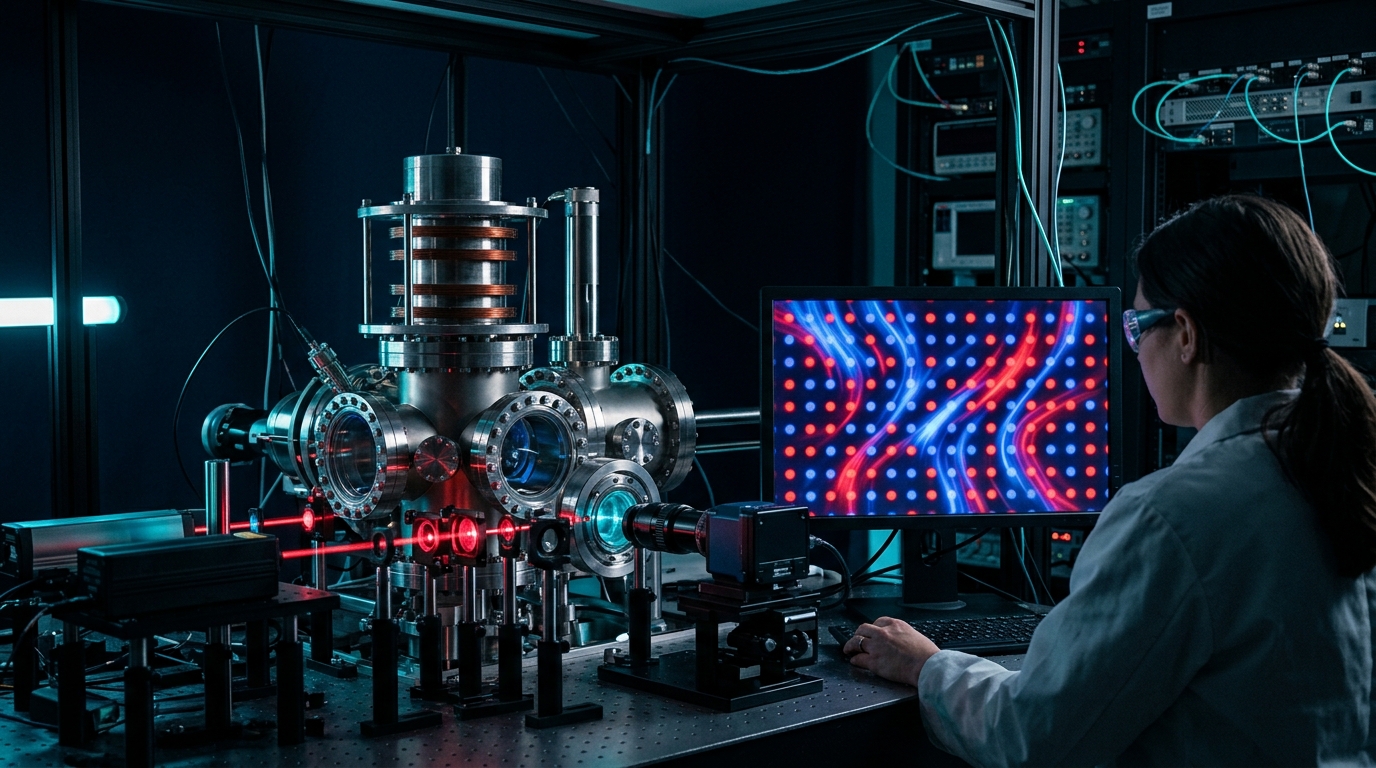
The Problem Nobody Solved (Until Now)
For decades, the script for controlling quantum systems has followed a simple rule: isolate, protect, and avoid the environment at all costs. To get information moving in a quantum material or a qubit array, you apply external forces—electric fields to push charge, magnetic fields to align spin. The environment, with all its dissipative, energy-sapping chaos, was the villain. But what if dissipation itself could become the director, not the destroyer, of quantum currents? Researchers at an anonymous institution on arXiv have now flipped that script. They have shown, for the first time in a full theoretical framework, how to generate and precisely control both charge and spin currents using nothing but carefully engineered dissipation. The hard part was never imagining that dissipation could do work—nature offers plenty of examples of driven systems—but rather identifying the exact, minimal set of nonreciprocal, out-of-equilibrium conditions that transform a lossy bath from a nuisance into a steering wheel for quantum transport. This required threading a needle between vanishingly weak coupling and the safeguarding of quantum coherence, all while ensuring the currents didn't cancel each other out. [arXiv:2607.15767]
The Core Finding
The team laid out a theoretical model of a two-dimensional fermionic atom system, a kind of toy universe for electrons, imbued with all the necessary symmetries broken. They broke inversion symmetry—meaning the system looks different running forwards versus backwards in space—and they broke time-reversal symmetry—meaning the tick of the clock has a definite direction. In this broken world, described by a master equation with nonreciprocal jump operators, they isolated the minimal recipe for dissipative current control. Think of it like a turnstile in a subway station that only lets people through if they are moving north, but blocks them going south. By applying two such asymmetric, spin-dependent turnstiles—one for spin-up particles nudging them along one spatial axis, and another for spin-down along a different axis—they generated steady flows of both charge and spin. Crucially, by tuning the degree of this turnstile asymmetry, they could smoothly morph the current from a pure spin flow into a dominant charge flow. As the abstract states, "the combine[d] application of two jump operators nonreciprocally coupling each spin species to a different spatial direction of motion is sufficient to generate both types of current." The mechanism proved robust even when hit with dephasing noise, a critical check that suggests this is not a theoretical mirage confined to an ideal, sterile vacuum but a resilient effect grounded in realistic open-system dynamics.
The State of the Field
This work arrives in 2026 amid a wider reckoning in quantum science. The first wave of quantum engineering was dominated by the cult of coherence: build qubits as perfectly isolated as possible, then use error correction to patch up the inevitable leaks. Non-Hermitian physics and dissipative state engineering have since emerged as counterpoints, with landmark proposals from groups like those of Susanne Yelin at Harvard and Zoller's team in Innsbruck showing that dissipation can be a resource for cooling, state preparation, and even universal computing. What makes this new paper different is its focus on transport—on moving quantum stuff from A to B—and its explicit demonstration of a minimal, tunable mechanism that doesn't just beg for a specific material platform. Instead of designing a bespoke bath for a single task, the authors identify a set of jump operators general enough to be engineered across a variety of systems, from cold atoms in optical lattices to arrays of superconducting qubits with engineered couplings. The broader quantum computing landscape is currently splitting into two camps: those building ever-larger error-corrected logical qubits via the surface code, and those exploring alternative routes that harness rather than suppress environmental interactions. This paper is a shot across the bow for the latter camp, suggesting that the bandwidth and control of quantum information might be expanded by turning dissipation into a precise tool for steering quantum matter.
From Lab to Reality
For experimental physicists, this paper unlocks a new design philosophy: current generation without external voltage or temperature gradients. It provides a blueprint for building purely dissipation-driven transport channels in quantum simulators, where ultra-cold atoms stand in for electrons in exotic materials. By engineering the jump operators identified here—essentially by carefully shaping how a system loses energy and particles to its environment—researchers could simulate topological transport regimes that are inaccessible in solid-state materials. For engineers working on quantum interconnects, the findings suggest a route to shuttle quantum information between processor modules without the complex, lossy microwave wiring that plagues today's dilution refrigerators. If implemented in superconducting circuits, dissipative nonreciprocal couplers could enable one-way signal flow and isolation with fewer components. For investors, this touches the quantum networking and simulation markets, estimated at $3.5 billion by 2030, where control of quantum transport is a fundamental bottleneck. The discovery that tunable dissipation can morph spin currents into charge currents also points toward hybrid spintronic-quantum devices that could interface classical and quantum logic in a single material platform.
What Still Needs to Happen
This is a deep theory paper, and the distance from a master equation to a measurement is long. The first and most pressing challenge is finding a physical platform that can realize exactly these nonreciprocal jump operators with high fidelity and low noise. Cold atom groups, including those led by Immanuel Bloch at the Max Planck Institute of Quantum Optics, have already demonstrated reservoir engineering with single-site resolution; they are natural candidates to attempt an experimental realization. But the required nonreciprocity—breaking detailed balance in a controlled, spin-dependent way—has not yet been demonstrated in the form demanded by this paper. The second obstacle is verifying the currents. In a fermionic atom system, directly imaging charge and spin flows without destroying the delicate steady state is notoriously hard. Quantum gas microscopes can resolve single atoms, but extracting current distributions requires sophisticated correlation measurements that push the limits of current imaging technology. There is no false optimism here: a laboratory demonstration of this specific mechanism is likely three to five years away, assuming a dedicated cold-atom effort begins now. Integration into a functioning quantum processor represents a horizon well beyond that.
What This Changes
In short: nonreciprocal dissipation provides a universal knob for generating and controlling quantum charge and spin currents without external fields, fundamentally expanding the toolkit for quantum matter and information transport. This insight shifts dissipation from a problem to be corrected to a resource to be harnessed, and it does so with a minimal, tunable set of operators that multiple platforms can aim to realize. The paper plants a flag on the landscape of open-system quantum control, marking a spot where loss becomes a feature, not a bug, in the coherent manipulation of quantum information.