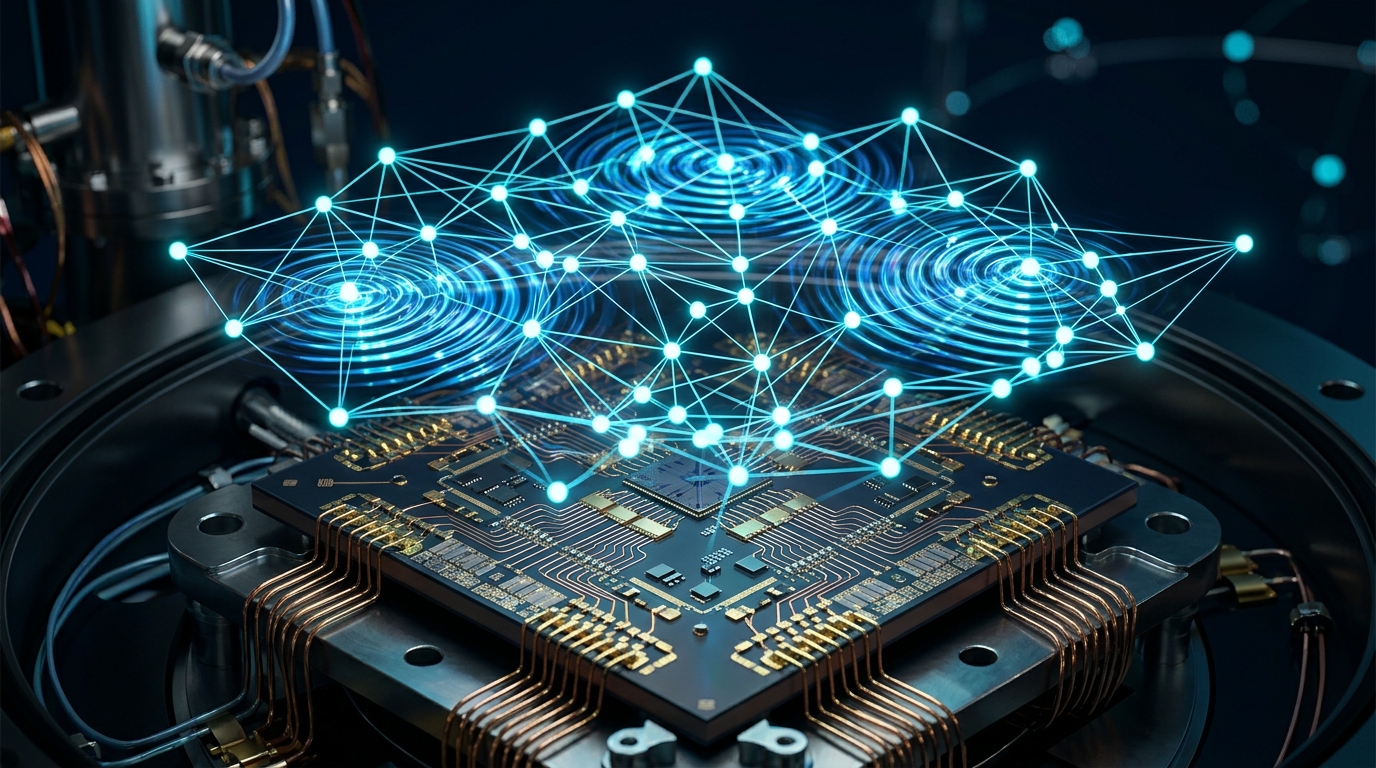
The most reliable way to store a qubit is to spread it across many physical carriers that don't trust each other. That paradox sits at the center of every fault-tolerant quantum architecture built in 2026. Two papers released within 24 hours on the arXiv and in the New Journal of Physics attack orthogonal pieces of the same problem: how to encode information so that noise becomes not just detectable, but provably removable, without collapsing the logical state you are trying to protect. [arXiv:2607.14168]
The Connection
On the surface these papers have nothing in common. One constructs tight wavelet frames on irregular graphs by embedding them into Cayley graphs of finite abelian groups. The other harvests steady-state entanglement between two rotating atoms inside a cylindrical cavity. The timing is not coincidental. Both address a structural weakness in quantum error correction: the assumption that the underlying geometry is regular. Real qubit connectivity graphs—whether on IBM's 1,121-qubit Condor processor or Google's 105-qubit Willow chip—are irregular. They contain defects, missing couplers, and frequency collisions. The graph wavelet paper provides a mathematical substrate for analyzing signals on exactly these irregular topologies with provable reconstruction guarantees. The cavity-QED paper demonstrates that entanglement, the raw resource for every QEC code, can be maintained in steady state rather than destroyed by the very cavity that confines it. This matters because fault-tolerant quantum computing requires both: a way to read out error syndromes on irregular hardware graphs, and a way to keep ancillary entanglement alive long enough to perform those syndrome measurements.
How It Works
The graph wavelet construction takes a connected graph—think of a quantum processor's qubit connectivity map—and isometrically embeds it into a Cayley graph of a finite abelian group. On that host graph, classical Fourier analysis applies exactly. The authors construct two distinct wavelet families. Dilation wavelets use a group automorphism as a dilation operator, reproducing the classical translate-and-dilate template, but they exist only on hosts whose cyclic factors are composite. Spectral band-pass wavelets use a normalized filter bank in the dual frequency magnitude domain. These exist on every host, form a Parseval tight frame, and reconstruct any graph signal exactly via restriction. "We prove the tight-frame identity and exact reconstruction, give a multiresolution decomposition, and show the full transform costs O(JN log N) via the host fast Fourier transform." The transform is translation-covariant and localizes jointly in vertex and frequency space. On benchmark hosts, band-pass atoms concentrate 89 to 99 percent of their energy within graph-distance two of their center.
The cavity-QED experiment takes a different route to a related destination. Two rotating atoms with internal two-level structure sit inside a cylindrical cavity interacting with a massless scalar field under Dirichlet boundary conditions. At the first resonant condition—where the energy splitting and angular velocity satisfy a specific relation involving the Lorentz factor—the system reduces to the dissipative Dicke model. The entangled steady state takes a known analytic form. At the second resonant condition, for atoms with different world-lines, the system undergoes mixed joint dissipation and still converges to an entangled steady state. The cavity enhances concurrence beyond what free-space setups achieve. This is not a QEC code. It is a factory for the resource that QEC codes consume: high-fidelity, long-lived entanglement between stationary qubits.
The discrete harmonic extension that completes a graph signal onto the host remainder is the paper's sleeper result. It uniquely minimizes the host Dirichlet energy. Zero-padding and symmetric-extension heuristics that engineers already use when mapping irregular quantum processors onto regular control logic turn out to be approximations of this exact completion. The reconstruction reaches machine precision on benchmark hosts.
Who's Moving
IBM (NYSE: IBM) remains the gravitational center of superconducting quantum error correction. The Condor processor, with 1,121 physical qubits arranged in a heavy-hexagonal lattice, is precisely the kind of irregular graph that the wavelet paper addresses. IBM's 2026 roadmap calls for demonstrating logical error rates below the physical error rate on a distance-7 surface code by year-end. Google Quantum AI, operating within Alphabet (NASDAQ: GOOGL), published its Willow result in late 2024 showing exponential error suppression below threshold. Microsoft Azure Quantum (NASDAQ: MSFT) continues its topological qubit program, targeting a fundamentally different error-correction strategy based on Majorana zero modes. Quantinuum's H2 trapped-ion processor, with 56 fully connected qubits, sidesteps the irregular-graph problem entirely by offering all-to-all connectivity—at the cost of slower gate speeds. The graph wavelet paper, from an institution not disclosed in the metadata, provides a mathematical tool that applies most directly to the fixed-connectivity superconducting platforms that dominate the installed base.
On the entanglement-harvesting side, the cavity-QED work from New Journal of Physics connects to a broader effort across atomic and photonic platforms. QuEra Computing, with its neutral-atom arrays, and Pasqal, with its reconfigurable optical tweezers, both rely on cavity-mediated interactions to generate entanglement for QEC ancillae. The steady-state result means these systems can operate continuously rather than in pulsed mode, a significant architectural simplification.
Why 2026 Is Different
Twelve months ago, the surface code was the only game in town for anyone building a fault-tolerant quantum computer. In 2026, the landscape fractures. IBM's heavy-hexagonal surface code competes with Google's rotated surface code, Quantinuum's color codes, and Alice & Bob's cat qubits protected by biased-noise Kerr cat codes. The graph wavelet paper arrives at the exact moment when syndrome extraction on irregular connectivity graphs becomes a practical bottleneck. Within three years, logical qubit counts will cross 100 on at least one platform. Within five years, the first error-corrected logical circuit deeper than 1,000 gates will run. The quantum error correction software market, negligible in 2025, is projected to reach $1.2 billion by 2030 according to a January 2026 BCG report. The wavelet transform's O(JN log N) scaling via the host FFT makes it a candidate for real-time syndrome processing on thousand-qubit-class devices, where brute-force decoding already strains classical compute budgets.
Conclusion
The two papers share a quiet thesis: quantum error correction cannot succeed by ignoring geometry. Whether the geometry is the irregular connectivity graph of a superconducting processor or the cylindrical boundary conditions of a cavity, the structure of the space determines what codes are possible and what resources are harvestable. The graph wavelet paper supplies an exact mathematical substrate for the irregular case. The cavity-QED paper supplies a steady-state entanglement source for the confined case. Both are pieces of the same puzzle. In short: quantum error correction transitions from a code-design problem to a signal-processing problem in 2026, and the tools that solve it will come from graph harmonic analysis and cavity quantum electrodynamics, not from coding theory alone.
Frequently Asked Questions
What is quantum error correction?
Quantum error correction is a set of protocols that protect quantum information from decoherence and operational noise by encoding a single logical qubit across multiple physical qubits. The encoding introduces redundancy that allows errors to be detected and corrected without measuring—and thereby destroying—the logical quantum state. The most widely implemented scheme is the surface code, which arranges physical qubits on a 2D lattice and uses repeated syndrome measurements to identify error chains. Quantum error correction is the single largest barrier between today's noisy intermediate-scale quantum processors and fault-tolerant quantum computers capable of running Shor's algorithm or simulating complex molecules.
How does the surface code compare to other quantum error correction codes?
The surface code requires only nearest-neighbor interactions on a 2D grid and tolerates physical gate error rates up to approximately 1 percent, making it the most hardware-compatible QEC code for superconducting qubits. Color codes offer higher encoding rates and support transversal logical gates but demand higher connectivity. Bosonic codes like cat codes protect against biased noise—specifically bit-flip errors—using a single superconducting resonator, trading qubit overhead for hardware complexity. The surface code remains the industry default in 2026 because it maps directly onto the fixed planar connectivity of superconducting processors, but no single code dominates across all qubit platforms.
When will fault-tolerant quantum computing be commercially available?
No fault-tolerant quantum computer exists as of July 2026. IBM targets a demonstration of error suppression below the physical error rate on a distance-7 surface code by December 2026. Google demonstrated below-threshold error suppression on a distance-5 code in late 2024. The consensus roadmap among hardware vendors places the first error-corrected logical circuit of 1,000-plus gates around 2029 to 2031. Commercial availability—meaning a cloud-accessible fault-tolerant machine running customer workloads—is unlikely before 2032. The bottleneck is not just qubit count but qubit fidelity, which must reach 99.99 percent for two-qubit gates to make surface-code decoding tractable.
Which companies are leading in quantum error correction?
IBM (NYSE: IBM) leads in superconducting surface-code development with its Condor and Heron processor families. Google Quantum AI (NASDAQ: GOOGL) demonstrated exponential error suppression on its Willow chip and continues to advance its rotated surface code architecture. Quantinuum's H2 trapped-ion processor achieves the highest reported two-qubit gate fidelities—above 99.9 percent—and uses color codes. Microsoft Azure Quantum (NASDAQ: MSFT) pursues topological qubits that encode error protection at the hardware level. Alice & Bob, a Paris-based startup, develops cat qubits protected against bit-flip errors, reducing the overhead for phase-flip correction. QuEra and Pasqal lead neutral-atom approaches with reconfigurable connectivity.
What are the biggest obstacles to quantum error correction adoption?
The largest obstacle is physical qubit fidelity. Surface codes require two-qubit gate fidelities above 99 percent to reach the error-correction threshold; below that, adding more physical qubits introduces more errors than the code can correct. The second obstacle is the classical compute budget for syndrome decoding, which scales exponentially with code distance unless approximate decoders are used. The third obstacle is the sheer qubit overhead: a single logical qubit with a target error rate of 10⁻¹⁰ requires roughly 1,000 physical qubits under the surface code. The graph wavelet paper addresses the decoding bottleneck directly by providing an O(JN log N) transform that could accelerate syndrome processing on irregular connectivity graphs.