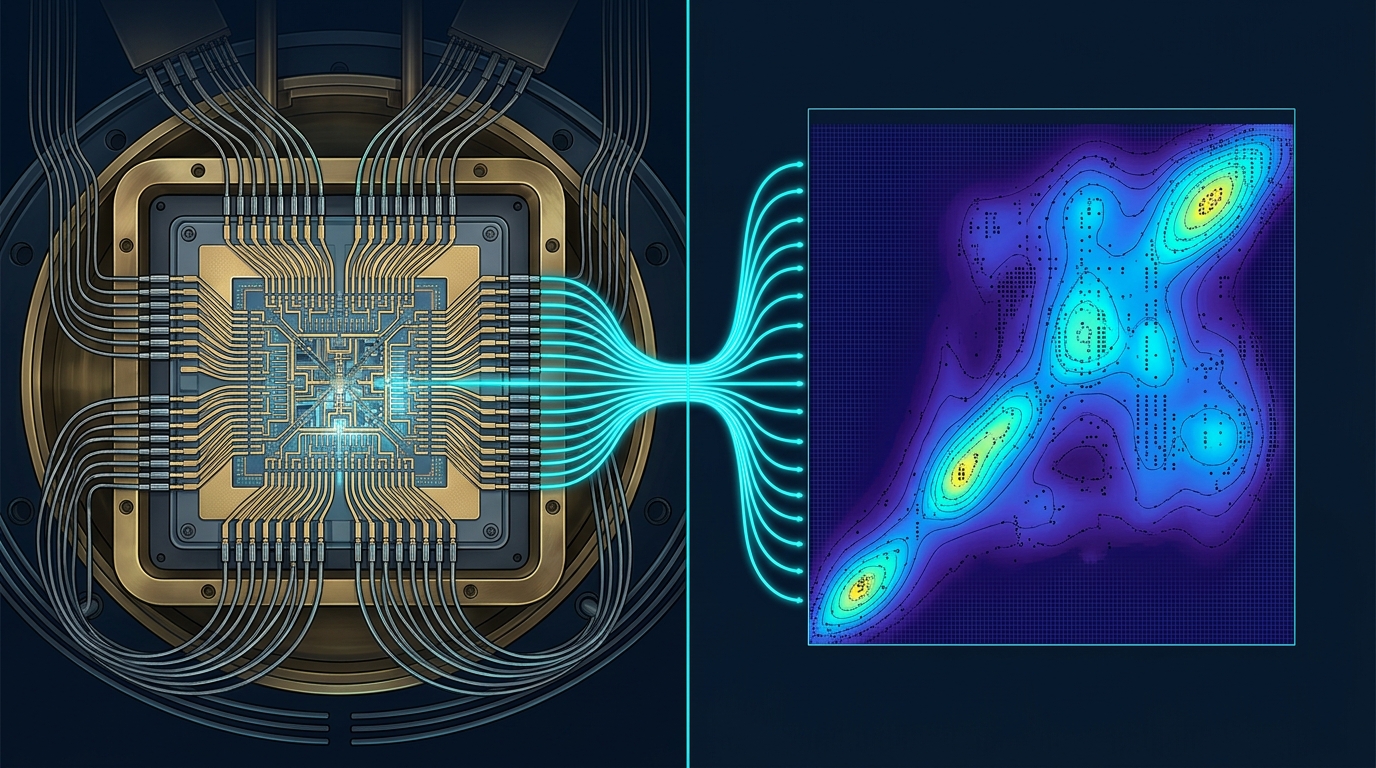
Every quantum computer today is noisy. That is not news. The news is that until now, nobody could tell you how noisy in a way that actually predicted whether your specific quantum algorithm would work. A team of researchers has just published a framework that answers a question the field has dodged for years: given ten different quantum backends, which one will give you a reliable answer for your chemistry simulation, and under what conditions does it fail catastrophically? [arXiv:2607.14392]
The problem has always been that benchmarking quantum computers is like judging chefs by how well they boil water. Standard metrics — gate fidelity, T1 coherence times, quantum volume — tell you something about the hardware. They do not tell you whether a variational quantum eigensolver will find the ground state of a lithium hydride molecule on a Tuesday afternoon when the calibration has drifted by half a percent. The paper, posted to arXiv in July 2026, builds a statistical pipeline that finally connects backend noise characteristics to application-level reliability.
The Core Finding
The researchers constructed a unified uncertainty quantification framework that subjects two radically different quantum algorithm classes to the same statistical scrutiny. On one side sit variational quantum algorithms, the workhorses of the NISQ era: parameterized circuits optimized classically to solve problems in chemistry, optimization, and linear algebra. On the other side sits Quantum Singular Value Transformation, a more recent and theoretically elegant approach that reconstructs Green's functions from block-encoded real-time propagators — a technique central to simulating materials. The framework does not simply report which backend achieved the lowest energy or the sharpest spectral peak. It identifies robust parameter regions, residual gaps to ideal behavior, backend-specific failure modes, and calibration-sensitive uncertainty. As the abstract states: "Instead of reporting only one best parameter vector, the framework identifies robust parameter regions, residual gaps to ideal behavior, backend specific failure modes, and calibration sensitive uncertainty."
Think of it like testing cars not by their top speed on a pristine track, but by how consistently they handle potholes, rain, and a driver who occasionally steers slightly wrong. The framework uses Bayesian optimization to explore parameter landscapes, then refines posterior distributions to show not just where the algorithm works, but how wide the working region is. A narrow spike of good performance surrounded by cliffs of failure is far less useful than a broad plateau of acceptable results. The framework quantifies that difference explicitly, producing what amounts to a reliability score rather than a performance score.
The State of the Field
Quantum benchmarking has been stuck in a hardware-centric rut. IBM's quantum volume metric, introduced in 2019, measures the largest random circuit a device can run successfully. IonQ and Quantinuum publish algorithmic benchmarks showing their trapped-ion and quantum charge-coupled device architectures outperforming superconducting rivals on specific tasks. The problem is fragmentation: every vendor benchmarks differently, and none of those benchmarks capture the sensitivity of real algorithms to the specific noise spectra that plague each platform. A 2023 review by researchers at the University of Innsbruck catalogued over forty distinct benchmarking protocols, none of which provided uncertainty quantification at the application level.
What makes this new framework different is its agnosticism about the algorithm class. Variational quantum algorithms and QSVT operate on fundamentally different principles. VQAs use classical optimizers to tune quantum circuit parameters, making them sensitive to optimization landscapes that can be barren or riddled with local minima. QSVT uses polynomial transformations of block-encoded matrices, making it sensitive to approximation errors in the encoding step. By running both through the same statistical pipeline — Bayesian optimization, posterior refinement, sensitivity analysis, robust parameter density estimation, backend ranking, noise correlation, and resource estimation — the framework creates a common language for reliability that transcends algorithmic architecture.
The broader landscape makes this work timely. Quantum computing is transitioning from physics experiments to engineering systems. IBM's 1,121-qubit Condor processor debuted in late 2023. Google's Willow chip demonstrated below-threshold error correction in late 2024. But raw qubit counts mean nothing if the software stack cannot predict which algorithms will actually work on which hardware. This framework addresses that gap directly.
From Lab to Reality
For computational chemists and materials scientists, this framework unlocks something immediately practical: the ability to select a quantum backend based on the specific molecule or material being simulated, with quantified confidence bounds. A researcher studying lithium-ion battery electrolytes could determine, before spending expensive cloud computing credits, whether IBM's Heron processor or Quantinuum's H2 system is more likely to resolve the spectral peaks they need. The framework's Green's function reconstruction benchmark is particularly relevant here, as Green's functions encode the electronic structure information that determines material properties from conductivity to catalytic activity.
For quantum software engineers, the framework provides a regression testing tool. When a hardware vendor updates their calibration routines or installs new control electronics, the framework can detect whether application-level reliability improved or degraded — even if standard gate fidelity metrics stayed flat. This matters because calibration drift is a known failure mode in deployed quantum systems. A 2025 study from Rigetti Computing documented cases where two-qubit gate fidelity remained above 99 percent while algorithmic success probability dropped by half due to correlated noise that fidelity benchmarks missed.
For investors watching the quantum error correction market, projected by McKinsey to reach $2.3 billion by 2030, this framework signals a maturation of the software-hardware interface. Companies that can demonstrate not just high-fidelity gates but broad, robust algorithmic performance will capture the early adopters in pharmaceuticals and materials science who are already spending on quantum cloud access. The framework's resource estimation analysis also feeds directly into roadmapping: it tells you how many physical qubits and how much error suppression you need to close the residual gap to ideal behavior for a given application.
What Still Needs to Happen
The framework is a measurement tool, not a fix. It tells you that a backend fails under certain noise conditions; it does not make the backend better. Closing the residual gaps it identifies will require advances in quantum error mitigation and, ultimately, full fault tolerance. The ten VQA benchmark families span an impressive range — chemistry, optimization, simulation, compiling, linear solving, partial differential equations, metrology, error correction, tomography, and channel fidelity estimation — but they are still synthetic benchmarks. Real-world quantum advantage will require running actual industrial problems, not representative proxies.
Two specific technical challenges remain. First, the Bayesian optimization at the heart of the framework scales poorly with parameter count. For variational circuits with hundreds of parameters, the posterior refinement step becomes computationally expensive, potentially requiring more classical compute time than the quantum job itself. Researchers at ETH Zurich and the Flatiron Institute are developing scalable Bayesian methods for high-dimensional quantum landscapes, but integration remains future work. Second, the framework currently treats each backend as a static noise source. Real quantum computers exhibit time-dependent noise that drifts on timescales from minutes to hours. Capturing that temporal dimension in uncertainty quantification is an open problem being tackled by groups at the University of Sydney and IBM Research.
The timeline to commercial relevance is uneven. For cloud quantum computing providers, the framework could inform backend selection engines within two years. For end users in drug discovery, the framework's Green's function benchmarks will become directly useful when quantum processors can simulate systems beyond classical reach — likely five to seven years for industrially relevant molecules. The framework does not accelerate that timeline, but it makes the wait more productive by ensuring that when the hardware arrives, we will know exactly how to use it.
Conclusion
In short: this quantum algorithm benchmarking framework replaces single-number performance scores with statistically rigorous uncertainty quantification, revealing which noisy backends produce reliable results and under what conditions they fail. It is the difference between knowing a car's top speed and knowing whether it will start on a cold morning. For a field that has spent a decade chasing quantum advantage demonstrations, that shift from peak performance to robust reliability may be the most important metric yet.
"Instead of reporting only one best parameter vector, the framework identifies robust parameter regions, residual gaps to ideal behavior, backend specific failure modes, and calibration sensitive uncertainty."