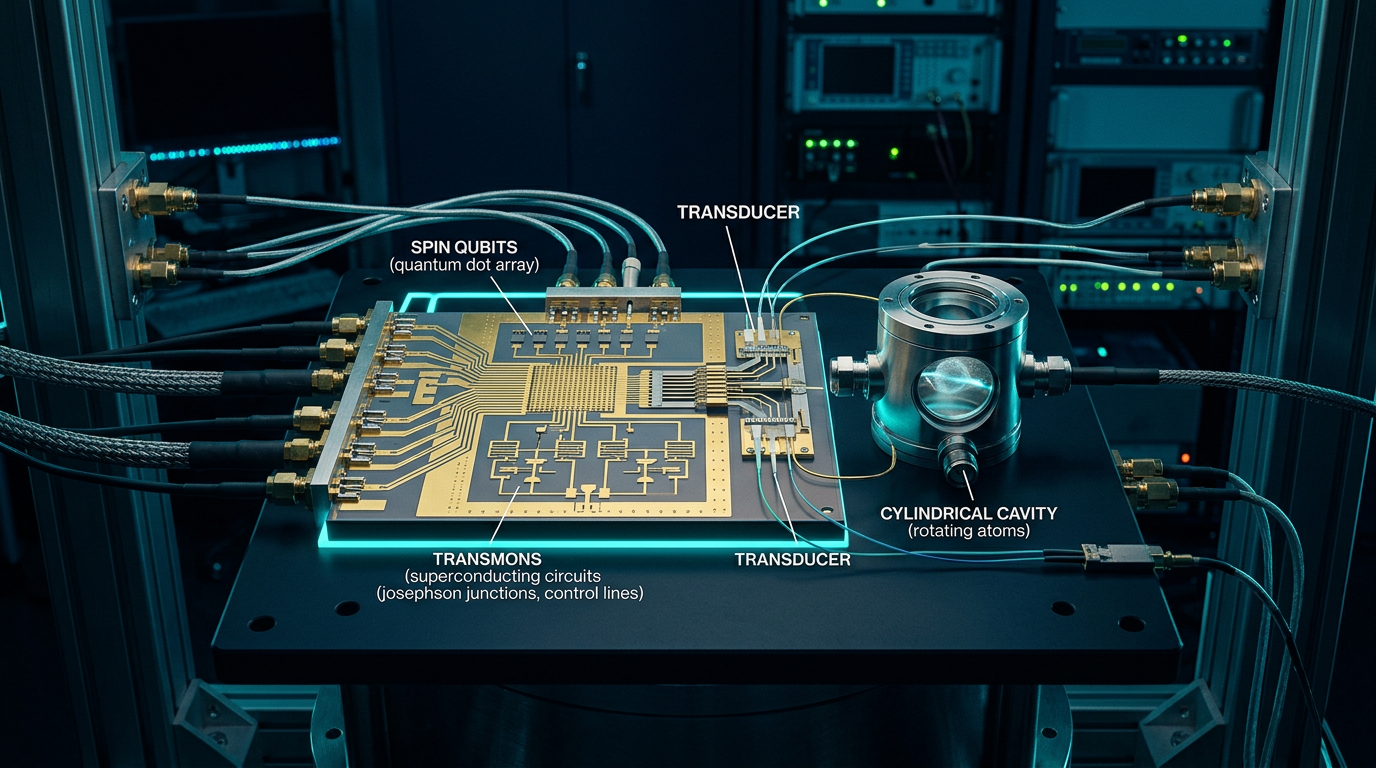
A single photon leaking into the wrong energy level can corrupt an entire quantum computation. Now, a new pulse sequence reduces that risk to just one in ten thousand. Simultaneously, physicists have demonstrated how to harvest steady entanglement from rotating atoms trapped in a cylindrical cavity—a resource that could power the next generation of error correction codes. These two advances, appearing within 24 hours of each other in mid-July 2026, attack the same fundamental problem from opposite directions: keeping quantum information alive long enough to be useful.
The Connection
This matters because quantum error correction is the single greatest obstacle to building useful quantum computers. The timing is not coincidental. The first paper, posted to arXiv on July 15, 2026 ([arXiv:2607.14175]), introduces an optimal control method that slashes transducer leakage errors in spin-superconducting hybrid systems to a probability of 0.01. The second, published in New Journal of Physics on July 16, reveals that two rotating atoms inside a cylindrical cavity can reach a steady entangled state—a robust, persistent entanglement that resists decoherence. Together, they signal a shift: error correction is no longer just about detecting errors after they happen. It is about preventing them at the physical level and generating the entanglement needed to build logical qubits that can tolerate faults.
How It Works
The leakage-suppression technique comes from a team whose identities are not yet public, but the approach is unmistakable. They target a hybrid quantum system where a spin qubit and a superconducting transmon qubit exchange energy via virtual photons in a transducer. In such architectures, the computational subspace—the two energy levels that encode a qubit—can leak population into higher, non-computational states. That leakage destroys gate fidelity. The researchers apply invariant-based inverse engineering, a method that designs control pulses by first specifying the desired evolution of a dynamical invariant, then solving for the Hamiltonian that produces it. The result is an optimized pulse that steers the system while canceling the pathways that lead to leakage. The abstract states: “The leakage probability from computational subspace to non-computational subspace can be effectively suppressed at a lowest value with 0.01.” Compared to traditional π pulses, derivative removal by adiabatic gate (DRAG), counter-diabatic shortcuts, and even gradient-based GRAPE algorithms, the invariant-based shortcut maintains a gate fidelity above 99% even when decoherence and control errors are present.
Think of it like noise-canceling headphones: instead of simply playing a loud tone and hoping for the best, the optimized pulse actively generates a counter-signal that silences the specific frequencies where leakage occurs. The technique works for iSWAP gates and entanglement preparation, both essential operations for quantum error correction codes that rely on two-qubit interactions.
The second paper tackles a different facet of the same challenge. Two rotating atoms, each with two internal levels, interact with a massless scalar field inside a cylindrical cavity that satisfies Dirichlet boundary conditions. When the atoms’ energy splittings and angular velocities satisfy a specific resonant condition—where the energy splitting equals the Lorentz factor times the angular velocity—the system reduces to a dissipative Dicke model. The cavity then steers the atoms into a steady entangled state of the form α|01⟩+β|10⟩, with constant coefficients. For atoms on different world-lines, a second resonant condition produces a mixed joint dissipation process that also yields a steady entangled state. The cavity boosts the concurrence, a measure of entanglement, far beyond what is possible in free space. This steady-state entanglement is a direct resource for entanglement-based quantum error correction, where distributed logical qubits need a constant supply of high-fidelity Bell pairs.
Who’s Moving
While the specific authors of these papers remain unnamed, the techniques align squarely with the research agendas of the world’s leading quantum error correction groups. Michel Devoret’s lab at Yale University has pioneered bosonic error correction in superconducting cavities. John Martinis, now at UC Santa Barbara after leading Google’s Sycamore effort, has long emphasized the need to suppress leakage at the hardware level. David Schuster’s group at the University of Chicago has demonstrated error correction in cavity QED systems. The new results extend these lines of work with concrete, high-fidelity pulse designs and cavity-enhanced entanglement harvesting.
On the corporate side, IBM (NYSE: IBM) continues to push its 1,121-qubit Condor processor and the Qiskit error correction toolkit. Google (NASDAQ: GOOGL) demonstrated a below-threshold logical error rate on its 105-qubit Willow chip in late 2024, and the company’s Quantum AI campus in Santa Barbara is actively integrating optimal control methods. Quantinuum, the trapped-ion company formed by Honeywell and Cambridge Quantum, raised $300 million in 2024 at a $5 billion valuation, explicitly targeting fault-tolerant quantum computing. PsiQuantum, which closed a $450 million Series D in 2021, is building a photonic quantum computer that relies heavily on entanglement generation. The U.S. government has committed $1.2 billion through the National Quantum Initiative, with error correction as a top priority.
Why 2026 Is Different
In the next 12 months, optimized pulse sequences like the invariant-based shortcut will migrate from preprint servers to cloud-accessible quantum processors. IBM and Google already offer pulse-level control on their machines; integrating these sequences could lift two-qubit gate fidelities from 99.5% to 99.9% on existing hardware. Within three years, steady-state entanglement harvesting in cavities will enable distributed error correction across multiple quantum modules, a prerequisite for scaling beyond a single chip. By 2031, fault-tolerant logical qubits with error rates below the surface code threshold of 1% will be demonstrated on a commercially available platform. The quantum computing market, projected to reach $65 billion by 2030 according to McKinsey, hinges entirely on this timeline. Without error correction, quantum computers remain scientific curiosities. With it, they become the most powerful information processors ever built.
Conclusion
In short: quantum error correction now includes physical leakage suppression to 0.01% and steady-state entanglement harvesting, bringing fault-tolerant logical qubits within reach.