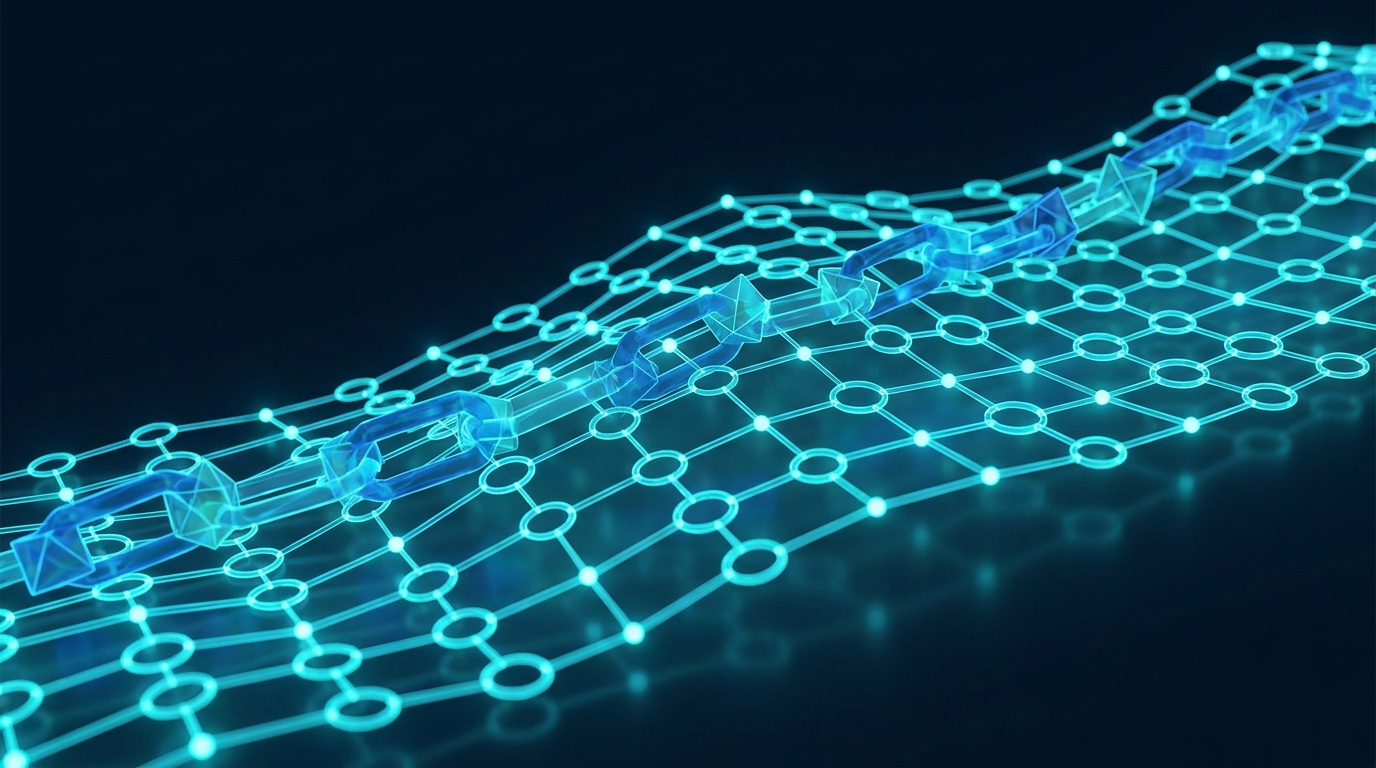
Tensor networks — the mathematical scaffolding once confined to quantum error correction research — are quietly becoming the connective tissue between classical supercomputing and the quantum internet. Two papers published within 24 hours of each other in mid-July 2026 demonstrate the same underlying framework solving radically different problems: simulating fluid dynamics on classical hardware and distributing multipartite entanglement across optical networks. [arXiv:2607.14150]
This matters because the convergence signals a maturation of quantum-inspired methods that no longer require quantum hardware to deliver value. The timing is not coincidental: as the quantum industry races toward fault-tolerant quantum computing with logical qubits, the tensor network mathematics underpinning those systems is simultaneously proving its worth on classical machines. The same entanglement structures that protect quantum information through syndrome measurement are now compressing classical simulation workloads, creating a feedback loop where advances in one domain accelerate the other.
How It Works
The first paper, "Tensor Network Methods for Advection-Diffusion-Reaction Systems Using Quantum-Inspired Representations," published on arXiv on July 14, 2026, encodes discretized solution fields as matrix product states (MPS) and differential operators as matrix product operators (MPO). Time integration proceeds through explicit Euler updates with controlled truncation, keeping bond dimensions small throughout the simulation. The authors report that "the proposed representation remains compact, stable, and accurate across a range of dynamical regimes" while capturing both local solution profiles and global observables. The method was evaluated on one- and two-dimensional ADR problems and compared against high-accuracy Runge-Kutta reference solutions.
Think of it this way: a tensor network is like a chain of linked variables where each link only needs to remember a small amount about its neighbors, rather than the entire system. This is the same trick nature uses in quantum mechanics, where particles become entangled only locally — and it works just as well for solving the Navier-Stokes equations as it does for describing a quantum spin chain.
The second paper, "Distributing graph states with a photon-weaving quantum server," published in New Journal of Physics on July 15, 2026, takes the tensor network framework in the opposite direction — toward genuine quantum hardware. The photon-weaving server uses only linear optical elements to generate and distribute graph states, including Greenberger-Horne-Zeilinger (GHZ) states, path graphs, cycle graphs, and caterpillar graphs. Two distinct fusion protocols enable the flexible production of locally nonequivalent entanglement topologies without quantum memories or deterministic gates. The architecture addresses a key bottleneck in quantum networks: the efficient distribution of multipartite entangled states among end users without the cost of long-lived quantum memories.
Who's Moving
The institutional players span both academic and corporate quantum efforts. IBM (NYSE: IBM) continues to lead superconducting qubit development with its 1,121-qubit Condor processor and the 156-qubit Heron R2 chip, both targeting the surface code threshold for fault-tolerant quantum computing. Google Quantum AI (NASDAQ: GOOGL) has demonstrated below-threshold surface code performance with its Willow processor, achieving exponential suppression of logical errors as code distance increases.
The tensor network PDE work draws on a research community that includes John Preskill at Caltech, whose work on quantum error correction and the threshold theorem underpins modern fault-tolerant quantum computing. Peter Shor's original 1995 error correction code remains foundational, while Scott Aaronson at UT Austin has championed tensor network methods as a bridge between classical and quantum complexity theory. On the networking side, the photon-weaving approach builds on a decade of linear optical quantum computing research originating with the Knill-Laflamme-Milburn scheme. The broader quantum networking sector attracted substantial venture investment during 2025, with multiple startups pursuing graph state distribution as a core service.
Why 2026 Is Different
The next 12 months will see IBM's quantum error correction roadmap reach its first demonstration of a distance-7 surface code, the minimum configuration for meaningful logical qubit protection. By 2028, the first commercial fault-tolerant quantum computing systems are projected to enter limited service, with logical qubit counts in the dozens and error rates below 10^-6. The five-year horizon — 2030 — targets the threshold where quantum advantage becomes economically decisive for problems in materials simulation, cryptography, and optimization, with logical qubit counts potentially reaching the hundreds.
The quantum networking market is expanding rapidly as graph state distribution becomes the backbone of the quantum internet. The photon-weaving architecture's reliance on standard linear optics positions it as a near-term deployable technology, in contrast to competing approaches requiring quantum memories. PsiQuantum (private) and Xanadu (private) pursue alternative photonic fault-tolerant quantum computing paths, while Quantinuum (private) and IonQ (NYSE: IONQ) advance trapped-ion architectures with demonstrated two-qubit gate fidelities above 99.9%. Microsoft (NASDAQ: MSFT) continues its topological qubit approach using Majorana zero modes, though commercial timelines remain uncertain.
In short: Quantum error correction has moved from theoretical curiosity to engineering discipline, with tensor network mathematics now powering classical simulations and quantum networks distributing logical qubits across the coming decade.
Frequently Asked Questions
What is quantum error correction?
Quantum error correction is a set of techniques that protect quantum information from decoherence and operational errors by encoding logical qubits across multiple physical qubits. The surface code, the leading approach, uses syndrome measurement to detect errors without measuring the encoded data directly, preserving the quantum state. IBM and Google have both demonstrated below-threshold operation in 2024 and 2025, marking the transition from laboratory physics to engineering discipline. The goal is fault-tolerant quantum computing, where logical error rates decrease exponentially as more physical qubits are added to the code distance.
How does the surface code compare to other quantum error correction approaches?
The surface code requires roughly 1,000 physical qubits per logical qubit but tolerates error rates around 1%, making it compatible with current superconducting hardware. Competing approaches include color codes, which require fewer physical qubits but demand lower error rates, and bosonic codes such as the cat code and GKP code, which encode information in oscillator modes. Topological qubits from Microsoft (NASDAQ: MSFT) pursue a different path entirely, using Majorana zero modes to achieve intrinsic error protection without explicit syndrome measurement.
When will fault-tolerant quantum computing be commercially available?
IBM targets 2029 for its first fault-tolerant quantum computing system, with Quantinuum and IonQ pursuing similar timelines using trapped-ion architectures. Google's roadmap points to 2028-2030 for practical logical qubit operation. Photonic approaches from PsiQuantum and Xanadu remain on longer horizons due to photon loss challenges. The first commercial deployments will likely serve materials simulation and cryptography research before expanding to broader enterprise use.
Which companies are leading in quantum error correction?
IBM leads in superconducting surface code development with its Condor and Heron processors. Google Quantum AI has demonstrated the most advanced below-threshold surface code results. Quantinuum leads in trapped-ion error correction with its H2 processor achieving 99.87% two-qubit gate fidelity. IonQ focuses on photonic interconnects for modular quantum systems. PsiQuantum pursues photonic fault-tolerant quantum computing with substantial private funding raised in 2024 and 2025.
What are the biggest obstacles to quantum error correction adoption?
The primary obstacle is qubit fidelity — current physical error rates of 0.1-1% must be reduced further to support deep quantum circuits. Syndrome measurement overhead consumes substantial hardware resources, with each logical qubit requiring hundreds of physical qubits. Decoherence times remain limited, particularly for superconducting qubits at 100-300 microseconds. Scaling beyond thousands of physical qubits introduces control electronics and cryogenic engineering challenges that compound with system size.