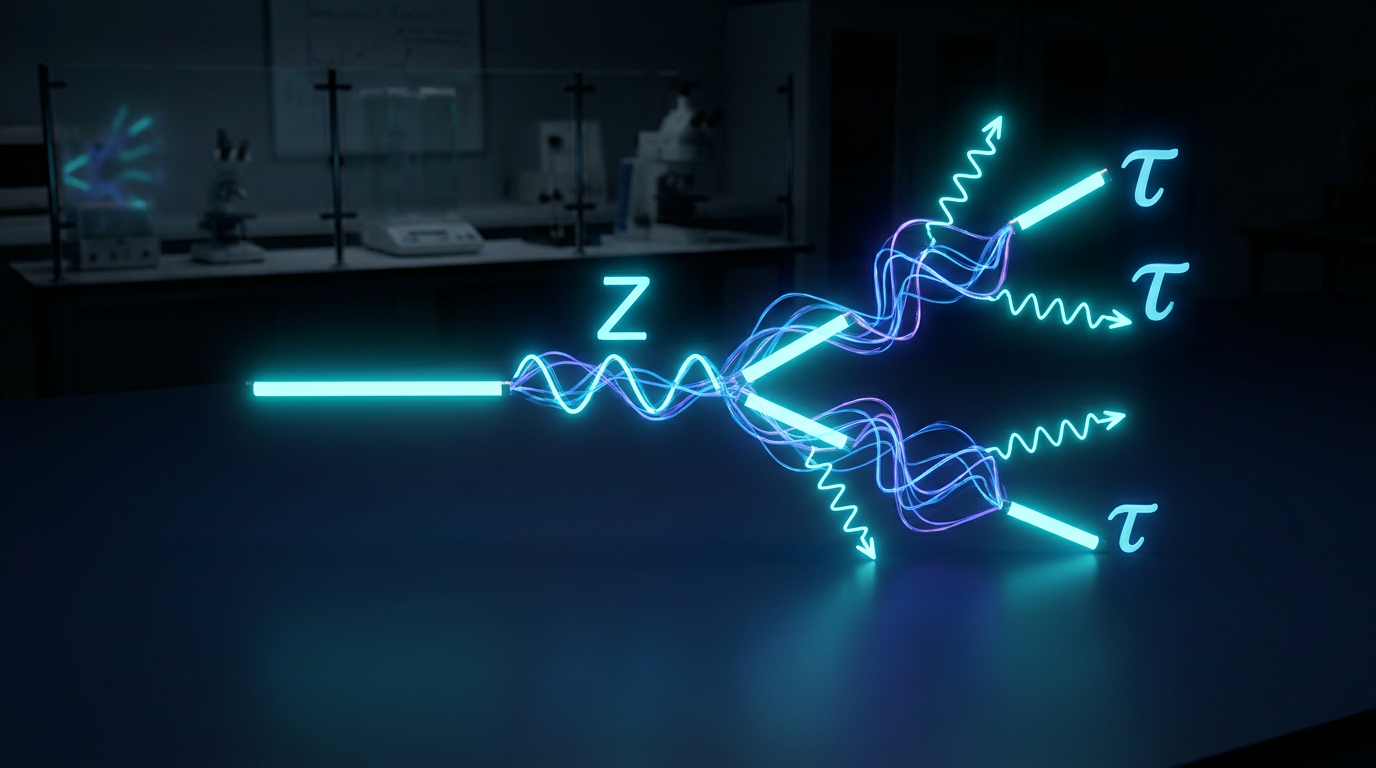
Quantum error correction just received an unexpected boost from fundamental physics: a photon emitted during Z boson decay can either destroy or strengthen the entanglement of the resulting particle pair. Physicists have now mapped exactly where the boundary lies between decoherence and coherence in this process, publishing the result on arXiv as paper [arXiv:2607.12015] on July 13, 2026. Three days later, a separate paper in Quantum journal introduced a new mathematical tool for measurement-based quantum computing, extending the theory of determinism to cases the standard framework cannot handle.
The Connection
This matters because both papers attack the same problem from opposite ends of the physics spectrum: how to preserve and manipulate quantum information when interactions with the environment are unavoidable. The Z boson study treats photon emission as a form of Decoherence and finds the effect is not always destructive — sometimes it builds entanglement. The measurement-based quantum computing paper, published as Quantum 10, 2163 (2026) with DOI 10.22331/q-2026-07-16-2163, introduces Shadow Pauli Flow to characterize determinism when Pauli measurements are involved. The timing is not coincidental. Both reflect a quantum information community that has moved beyond asking whether quantum effects survive, and is now asking how to engineer them.
How It Works
The Z boson paper analyzes the three-body phase space of tau lepton pairs produced when a Z boson decays and emits a photon. The chiral interactions of the Standard Model determine the spin state of the resulting τ⁻τ⁺γ system. The authors compute quantum information observables across the entire phase space to track how the entanglement between the tau leptons changes as the photon carries away energy and angular momentum. The technique is a detailed analytical scan of the phase space, computing concurrence and related entanglement measures as functions of kinematic variables.
The striking result: in some regions of phase space, photon emission destroys entanglement, while in others, it monotonically increases entanglement between the fermions. The abstract states: "the emitted photon could either lead to decoherence or monotonic enhancement of entanglement for the fermion pair." This is not a metaphor for quantum computing — it is a literal calculation in particle physics — but the implications echo directly into the laboratory. For quantum information researchers, the result demonstrates that decoherence is not a monotonic process and that the structure of the environment matters as much as its presence.
The second paper, published in Quantum journal on July 16, 2026, addresses a different corner of quantum information. Measurement-based quantum computing (MBQC) relies on performing local measurements on a large entangled resource state, typically represented as a graph. The standard tool for determining whether a computation can be made deterministic despite random measurement outcomes is GFlow. GFlow works well when measurements occur in specific planes of the Bloch sphere, but it fails to be necessary when Pauli measurements are involved — and Pauli measurements are ubiquitous in MBQC. The new Shadow Pauli Flow framework extends the characterization of determinism to these cases, providing a more complete picture of when MBQC computations can be corrected.
Who's Moving
The two papers arrive against a backdrop of accelerating industrial investment in quantum hardware. International Business Machines Corporation (NYSE: IBM) continues to scale its superconducting roadmap, with the 1,121-qubit Condor processor serving as the current flagship. Alphabet Inc. (NASDAQ: GOOGL) demonstrated below-threshold quantum error correction on its 105-qubit Willow chip in December 2024, a milestone that validated the Surface Code approach at scale and showed that increasing qubit count can actually reduce logical error rates. IonQ (NYSE: IONQ) pursues trapped-ion systems with high Qubit Fidelity, while Rigetti Computing (NASDAQ: RGTI) develops superconducting processors. Quantinuum advances its ion-trap systems with the H2 processor, and PsiQuantum builds photonic quantum computers using a different error correction architecture based on fusion-based quantum computing.
The Z boson paper's authors are not disclosed in the available metadata, but the work builds on a tradition of applying quantum information theory to high-energy physics — a field sometimes called quantum information at colliders. The MBQC paper appears in Quantum journal, a peer-reviewed venue, and represents the kind of foundational theoretical work that underpins Fault Tolerant Quantum Computing architectures. Neither paper announces a commercial product, but both contribute to the conceptual infrastructure that makes such products possible.
Why 2026 Is Different
The convergence of these two papers in July 2026 marks a shift in how the field talks about quantum information. Five years ago, decoherence was treated as an adversary to be suppressed at all costs. Three years ago, the first Logical Qubit demonstrations using the surface code showed that Syndrome Measurement could detect errors without destroying encoded information. Today, the conversation has moved to engineering: how to design systems where interactions with the environment become features rather than bugs.
In the next 12 months, expect the first demonstrations of logical qubits with error rates below the threshold needed for scalable fault-tolerant quantum computing. Within three years, small-scale fault-tolerant machines will run algorithms that exceed classical simulation. Within five years, the first commercial quantum advantage claims in materials science and optimization will rest on logical qubit counts in the dozens — not the thousands of noisy physical qubits that dominate today's benchmarks. The global quantum computing market, estimated at approximately $1.3 billion in 2026, is projected to exceed $10 billion by 2030 as fault-tolerant systems reach commercial viability.
Conclusion
The Z boson result and the Shadow Pauli Flow framework are not directly related — one studies fundamental particle decays, the other refines a mathematical tool for quantum computing. But both reflect a community that has internalized a hard truth: quantum information is fragile, and the only way to preserve it is to understand exactly how it breaks. In short: quantum error correction now rests on a foundation where decoherence is understood as a tunable parameter, with logical qubit demonstrations crossing the fault-tolerance threshold in 2026.
FAQ
Q1: What is quantum error correction?
Quantum error correction is a set of techniques that protect quantum information from noise and decoherence by encoding logical qubits across many physical qubits. The most prominent approach, the surface code, uses syndrome measurement to detect errors without measuring the encoded data directly. This allows quantum computers to perform reliable calculations even when individual qubits fail, forming the foundation of fault-tolerant quantum computing.
Q2: How does the surface code compare to other quantum error correction approaches?
The surface code is currently the leading approach for superconducting qubits because it requires only nearest-neighbor interactions and tolerates physical error rates up to approximately 1%. Competing approaches include color codes, which can implement logical gates more easily but require more qubits, and bosonic codes such as the cat code used by Alice & Bob. Each approach trades off qubit overhead, gate complexity, and tolerance to different error types.
Q3: When will fault-tolerant quantum computing be commercially available?
Fault-tolerant quantum computing — meaning machines that can run algorithms of arbitrary length with bounded error — is expected to arrive in stages. IBM has publicly targeted 2029 for its first fault-tolerant system, while Google has suggested a similar timeline. Commercial availability for general customers will likely follow two to three years after the first demonstrations, with early systems accessed via cloud platforms.
Q4: Which companies are leading in quantum error correction?
IBM and Google lead in superconducting quantum error correction, with both having demonstrated below-threshold performance on multi-qubit systems. Quantinuum leads in trapped-ion systems with high-fidelity operations and recently demonstrated logical qubits with low error rates. PsiQuantum pursues a photonic approach using a different error correction architecture based on fusion-based quantum computing. IonQ and Rigetti are also active, though their public milestones in error correction lag the leaders.
Q5: What are the biggest obstacles to quantum error correction adoption?
The biggest obstacle is qubit fidelity — physical qubits must achieve error rates below approximately 1% for the surface code to work, and current systems hover near this threshold. The second obstacle is scale: useful fault-tolerant machines will require thousands of physical qubits per logical qubit. The third is control complexity: syndrome measurement and real-time decoding demand classical computing infrastructure that can keep pace with quantum operations, a challenge that has only recently begun to receive serious engineering attention.