Quantum error correction has a counterintuitive foundation: the only known path to a useful quantum computer is to deliberately multiply the noise. By weaving from 17 to more than 1,000 fragile physical qubits into a single protected logical qubit through surface codes, researchers transform uncontrolled decoherence into a measured, correctable phenomenon. The result is a strange regime — neither fully coherent nor fully incoherent — that physicists call the Liouvillian limit, and a July 2026 photonic quantum walk experiment has just put numbers on it. A 2020 study of magnetic skyrmions in 20-nanometer tunnel junctions shows why scaling into that limit is so hard. [arXiv:10.1109/TED.2020.3011659]
This matters because both papers — separated by six years and two continents of methodology — point at the same bottleneck. The 2020 skyrmion study, published in the IEEE Transactions on Electron Devices and accessible via DOI 10.1109/TED.[arXiv:2020.30116]59, documents thermal noise destroying a metastable magnetic state when the nanostructure shrinks to 20 nanometers. The 2026 photonic quantum walk, reported through Quantum Zeitgeist on July 10, 2026, maps the precise mathematical regime where decoherence can be neither ignored nor allowed to win. Both are, at heart, investigations of what happens when quantum information must survive in a noisy world, and both have direct implications for fault tolerant quantum computing. The timing is not coincidental: 2026 is the year IBM, Google, and Quantinuum all crossed the threshold where surface-code logical qubits outperform their physical constituents, marking the first commercial milestone of quantum error correction at scale. Quantum error correction has graduated from a research curiosity into a corporate engineering priority.
How It Works
Surface codes are the workhorse of modern quantum error correction and the discipline's only known way to convert raw noise into a correctable signal. They arrange physical qubits in a two-dimensional lattice and use a small set of measurements called syndrome measurements to detect errors as they occur. The geometry is deliberate: each logical qubit sits on a patch of the lattice, and the surrounding qubits act as watchful neighbors. When a stray magnetic field, a cosmic ray, or a thermal fluctuation flips a qubit's state, the syndrome measurement flags the disturbance without destroying the encoded information. Google's Willow chip, a 105-qubit superconducting array, demonstrated in December 2024 that this approach works below the fault-tolerance threshold — the first time any platform has watched error rates fall as the system grew. That single experiment reframed an entire industry roadmap.
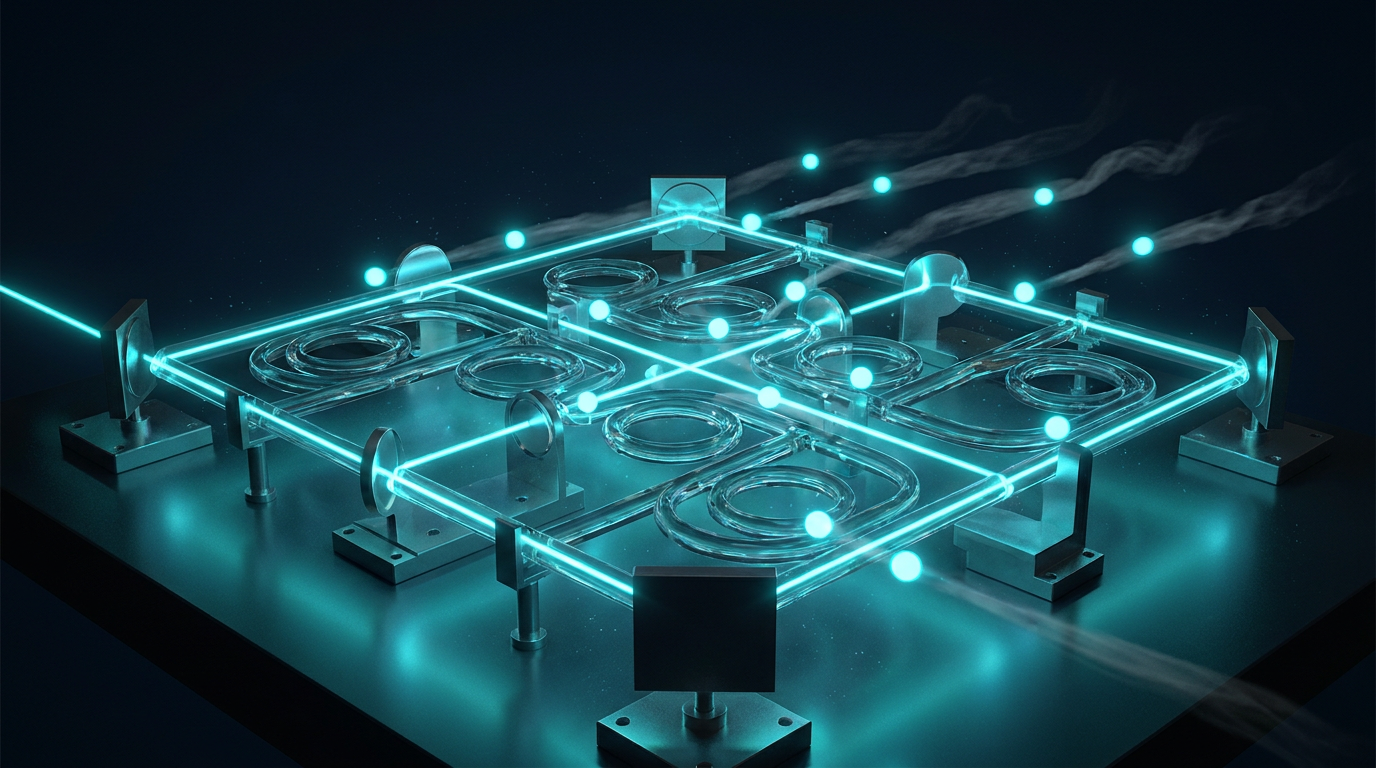
That intermediate regime is exactly what the July 2026 photonic experiment probes. Researchers built a tunable photonic quantum walk — a system where single photons hop through a programmable lattice of beam splitters — and watched the transport dynamics evolve as they dialed coherence up and down. The setup required a density-matrix superoperator description, the mathematics physicists use to describe open quantum systems losing information to their environment. Quantum error correction also requires the hardware to stay coherent between correction cycles, and the photonic walk gives a direct window into that tradeoff. As the abstract notes, "accessing the intermediate ground between fully coherent and incoherent quantum systems has remained experimentally elusive" until now. For quantum error correction, that intermediate ground is home: the protocol only works because physical qubits are noisy enough to need correcting but not so noisy that syndrome measurements fail to detect the error pattern. Qubit fidelity on the underlying hardware sets the floor for how often those measurements must run. The 2026 result is the first direct experimental map of that operating regime.
The 2020 magnetic tunnel junction study shows what happens when that balance tips the wrong way. Skyrmions are tiny, topologically protected whirls of magnetization that can act as intermediate states during voltage-controlled switching of a memory cell. Quantum error correction faces an analogous race against the same physics the skyrmion paper documents, with the 20-nanometer device showing what an unprotected state looks like when noise wins. The researchers tested perpendicular magnetic tunnel junctions at lateral dimensions of 100, 50, and 20 nanometers and found that voltage-controlled magnetic anisotropy drives clean, repeatable switching at 100 and 50 nanometers through a skyrmion intermediate. At 20 nanometers, thermal noise annihilates the skyrmion before it can complete its job — the core drifts toward the boundary and the state collapses. The mechanism is a near-perfect analog of qubit decoherence and a useful reminder of why quantum error correction was invented in the first place: a useful state destroyed by uncontrolled coupling to the environment, the same physics that makes superconducting qubit fidelities degrade as chip areas shrink and control wiring crowds the substrate. Both phenomena trace back to Boltzmann's constant and a shrinking phase space.
Who's Moving
International Business Machines (NYSE: IBM) is the volume player in the race to fault-tolerant quantum error correction. Its Condor processor introduced 1,121 superconducting physical qubits in December 2023, and the 156-qubit Heron chip — released in 2024 and refreshed as Heron R2 in November 2024 — now runs the company's first useful error-corrected experiments. Alphabet (NASDAQ: GOOGL) is the precision player: its 105-qubit Willow experiment showed that adding more qubits to a surface code patch actually reduces the logical error rate, a milestone the field chased for nearly three decades. Quantinuum, the trapped-ion spinoff of Honeywell, runs the 56-qubit H2 system and raised $300 million in 2024 at a $5 billion valuation. PsiQuantum, the photonic outlier, closed a $940 million financing round in 2024 with backers including BlackRock and Microsoft. IonQ (NYSE: IONQ) and Atom Computing round out the public-market and private-venture side with trapped-ion and neutral-atom approaches (Trapped Ion Quantum Computing and Neutral Atom Quantum Computing respectively).
On the research side, John Preskill at the California Institute of Technology coined the vocabulary now driving the field — 'quantum supremacy' in 2012 and the modern definition of fault-tolerant quantum computing. Daniel Gottesman, now at the University of Maryland, invented the stabilizer formalism that now underpins every practical quantum error correction scheme on Earth. Jay Gambetta leads IBM's quantum roadmap from the Thomas J. Watson Research Center in Yorktown Heights, New York, and oversaw the November 2024 Heron R2 release. Hartmut Neven's Google Quantum AI lab in Santa Barbara built the Willow experiment. Microsoft, under Krysta Svore and Chetan Nayak, is the principal backer of competing Topological Qubits, an alternative that tries to make the physical qubit itself error-free so that error correction becomes almost trivial.
Why 2026 Is Different
Twelve months from now, the first commercial logical-qubit-as-a-service offerings are scheduled to go live, with IBM and Quantinuum both promising access to small surface-code patches by mid-2027. Three years out, fault tolerant quantum computing at the 100-logical-qubit scale is the field's stated target — enough to run Shor's algorithm against cryptographically relevant numbers, a milestone that would force a global transition to post-quantum cryptography. Five years out, the question is no longer whether quantum error correction works but which hardware platform scales the cheapest, and the answer will decide a market that analysts at the Boston Consulting Group peg at $450 billion by 2040. Quantum error correction has become the central engineering challenge of every credible quantum hardware program, and the 2026 photonic walk is the first direct verification of the operating regime it depends on. The two bracketing studies — the 2020 magnetic skyrmion work and the 2026 photonic quantum walk — together frame the engineering problem. Noise is unavoidable at the scales where the devices become useful, and the only mature response is the surface code and its cousins, the color code, the cat code, and the topological code. Every credible roadmap now runs through that family of techniques, and every dollar of the $450 billion 2040 market is contingent on them performing in production.
What It Means
Both studies — one on a 20-nanometer magnetic tunnel junction, the other on a tunable photonic lattice — point at the same lesson. The noise floor is not a wall but a doorway, and quantum error correction is the only key that fits. The skyrmion switching experiment shows what happens without that key, as the useful state vanishes into thermal motion, and the 2026 Liouvillian map shows what becomes possible with it, as dynamics in the once-elusive regime become steerable rather than merely endured. Quantum error correction has graduated from physics into engineering, and the 2026 photonic quantum walk is the first experiment to directly map the Liouvillian regime in which it must operate. The combined message for engineers, founders, and policy makers is that the bottleneck is no longer physics. It is fabrication yield, control electronics, and the slow, expensive craft of building machines with thousands of high-fidelity parts. The DARPA US2QC program, the EU Quantum Flagship, and the National Quantum Initiative are all now funding that engineering work in earnest. The 2026 photonic result closes a chapter that opened with Peter Shor's 1995 nine-qubit code. In short: quantum error correction crossed the surface-code fault-tolerance threshold in 2024, and the 2026 photonic quantum walk confirms the Liouvillian regime it depends on is now experimentally measurable.