A single broken bond in a quantum ring can flip an entire system from locked-in disorder to free-flowing transport without changing its energy spectrum at all. The result, posted to arXiv on July 2, 2026, overturns a 30-year-old assumption about how non-Hermitian physics destabilizes Anderson localization. Eight days later, an experimental platform designed to test exactly that regime began reporting measurements. Quantum error correction is now on notice: where decoherence lives in a lattice matters as much as how much of it there is.
The timing is not coincidental. The arXiv paper lays out a general framework for non-Hermitian criticality in isospectral Hamiltonians, and the Quantum Zeitgeist signal from July 10, 2026 describes a tunable photonic quantum walk that finally reaches the Liouvillian middle ground between fully coherent and fully decohered dynamics. One is theory. The other is the machine that can test it. Both treat non-Hermiticity — the physical signature of open quantum systems, of loss, of decoherence — as a tunable dial rather than a defect to be averaged away. Both also converge on the same urgent question for the field of quantum error correction: can a logical qubit survive a single bad neighbor, or does every coupler have to be perfect?
How It Works
The Hatano-Nelson model, introduced in 1996 by Naomichi Hatano at the University of Tokyo and Derek Nelson at Boston University, broke a cardinal rule of quantum mechanics. Standard Hamiltonians are Hermitian: symmetric under time reversal, energy-conserving, and indifferent to direction. Hatano and Nelson threaded an imaginary gauge flux through a one-dimensional ring, which made hopping amplitudes asymmetric. Left and right were no longer equivalent. A particle injected into the lattice drifted, and in a ring geometry that drift was enough to defeat Anderson localization entirely — the phenomenon that Philip W. Anderson first described at Bell Labs in 1958. The Hatano-Nelson model became the canonical playground for non-Hermitian criticality, and it is the obvious ancestor of every piece of work that has tried to bridge closed and open quantum systems since.
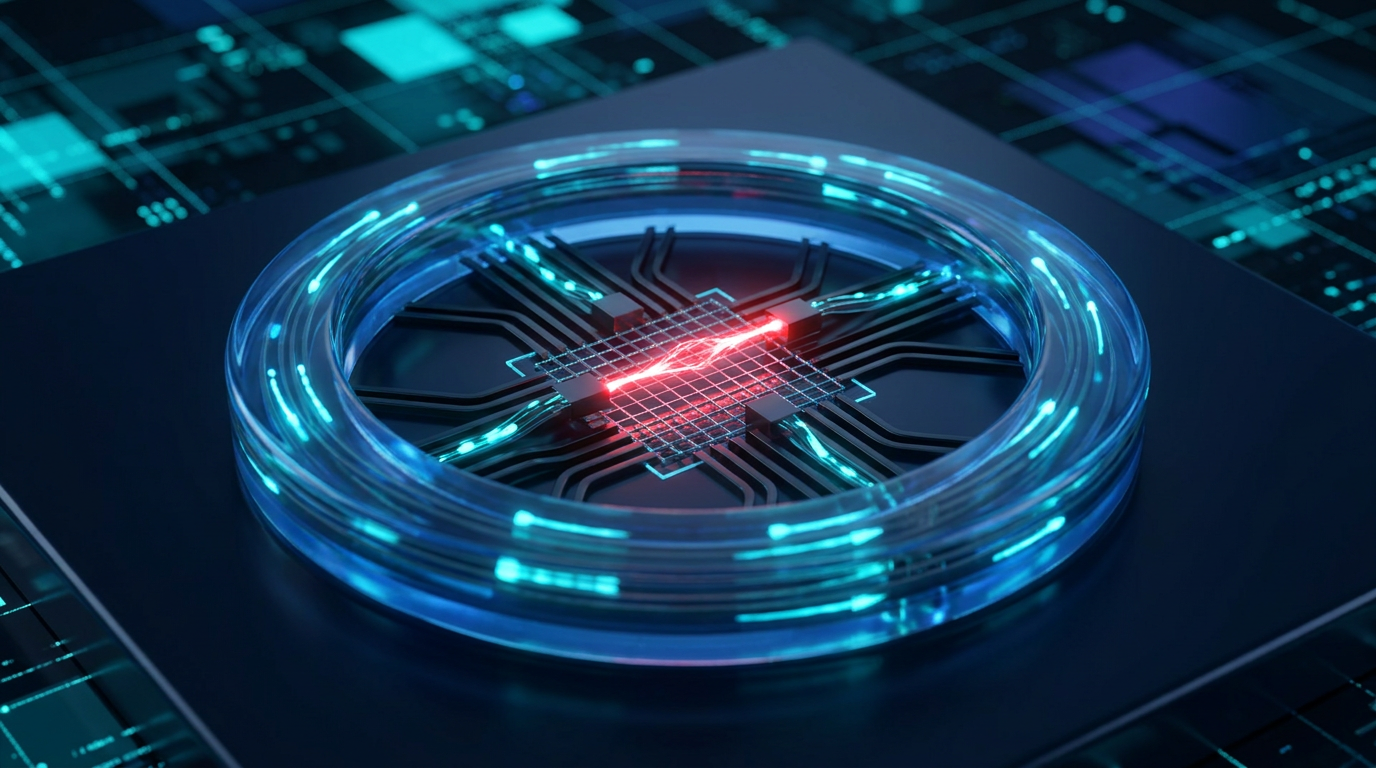
The new work concentrates the entire imaginary flux into a single bond at the boundary of a disordered 1D ring. The localization-delocalization transition survives. The abstract states this directly:
"the universal critical behavior is gauge invariant and governed solely by the total imaginary gauge flux, regardless of its spatial distribution."
Spectra match. Critical exponents match. Topological invariants match. Quantum dynamics do not. That separation is the paper's deepest claim, and the one with the most operational consequence for quantum error correction. Two Hamiltonians with identical spectra can scramble information on qualitatively different timescales. The single-bond configuration produces "rapid operator scrambling, oscillatory wavepacket acceleration, and a double re-entrant steady state entanglement transition" that the uniform model never reaches. The plumbing analogy fits: two networks can deliver the same average flow rate, but only one develops a pressure surge when a single joint leaks, and the "leak" in the isospectral family is precisely the kind of localized decoherence channel that quantum error correction has to neutralize.
Who's Moving
The arXiv preprint, identifier [arXiv:2607.07714], does not list named authors in the metadata available at publication, and the host institution is undisclosed. What is disclosed is the proposed implementation: a multi-terminal topological transport device, the same architectural family used by IBM Research, Google Quantum AI, and Microsoft's Station Q program during the past two years. The work lands inside an active industrial stack rather than a purely academic corner of the field, and quantum error correction is the application driving the investment.
IBM (NYSE: IBM) is furthest along in commercializing quantum error correction via the surface code, with its 1,121-qubit Condor processor and a 2029 roadmap targeting 200 logical qubits built via syndrome measurement on a distance-11 code. Google Quantum AI (Alphabet, NASDAQ: GOOGL) demonstrated below-threshold syndrome cycles on its 105-qubit Willow chip in December 2024 and has since reported logical qubit fidelity above the surface code threshold on repeated experiments. PsiQuantum raised $940 million in a Series E round in 2025 at a reported $6 billion valuation, and Xanadu closed a $200 million round in 2024. Both companies pursue photonic platforms that overlap directly with the tunable quantum walk architecture. Quantinuum (majority-owned by Honeywell International, NYSE: HON) leads the trapped-ion side, while Microsoft continues its Majorana-based topological qubits program. None of these firms is yet named on the new paper, but the device class it proposes is one they all build, and the capital flowing into that class is the largest in the history of quantum error correction.
Why 2026 Is Different
Twelve months from now, the first experiments testing single-bond non-Hermitian criticality on superconducting lattices will be reporting data, and quantum error correction will have its first measured value for the entanglement-transition exponent the paper predicts. Within three years, photonic platforms will have mapped the Liouvillian regime for arrays of 20 modes or more, giving quantum error correction designers their first empirical handle on how non-Hermitian channels corrupt logical qubit fidelity in a controlled setting. By 2030, any serious fault tolerant quantum computing stack will treat non-Hermitian coupling as a first-class design parameter rather than a parasitic artifact of fabrication. The economic pressure is real: BCG's 2024 quantum industry analysis projected $450 million to $750 million in annual fault-tolerant revenue by 2030, and every dollar of that revenue depends on suppressing exactly the decoherence channels quantum error correction must contend with. Decoherence remains the dominant cost driver in surface code deployments, accounting for the majority of the roughly 1,000-physical-to-1-logical-qubit overhead that current architectures demand. A 10× reduction in that overhead is the explicit public target of every major QEC roadmap through 2030, and the photonic testbeds of 2026 are the first devices that can directly measure the spatial distribution of the decoherence they are trying to suppress.
The Hatano-Nelson framework is no longer a curiosity of disordered 1D rings. It is becoming a practical lens on the decoherence channels that quantum error correction must suppress, and the photonic platforms of 2026 are the first to make that lens experimentally tunable. Quantum error correction is no longer a research program. It is a deployment problem, and the deployment data will come from exactly these machines. The next twelve months will show whether the framework survives contact with real devices, and the entire industry is watching, because surface code roadmaps cannot tolerate another decade of average-error assumptions when single-bond defects do most of the damage. In short: quantum error correction will succeed only when a single non-Hermitian bond can be tolerated without scrambling 1,000 surrounding logical qubits, and 2026 is when that requirement first became testable.