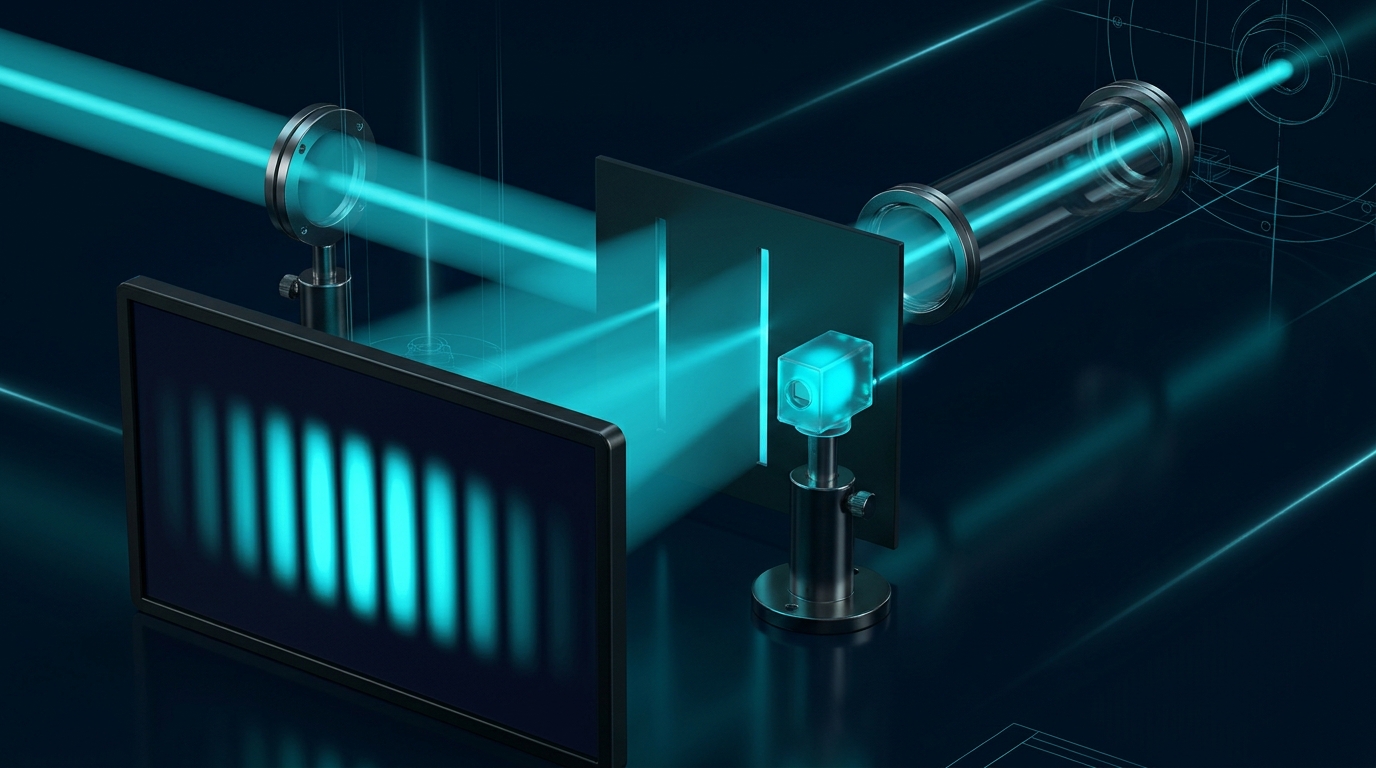
For over two centuries, the bright-and-dark stripes cast on a screen when light passes through two narrow slits have served as the most iconic evidence that light behaves as a wave. Thomas Young's 1801 double-slit experiment became the founding exhibit for the wave theory of light and, eventually, for the wave-particle duality that every physics student learns. A new preprint posted to arXiv on March 28, 2020 challenges that compromise at its root. It argues that diffraction patterns can be read as direct fingerprints of light's purely quantum substructure, with no waves required at any level of description.
The paper, identified on arXiv as [arXiv:2003.14217], introduces what its authors call a "new paradigm": diffraction images directly reflect the fundamental quantum states of light. The argument hinges on a careful comparison of two theoretical regimes. In first-order quantum electrodynamics, the version of the theory that captures most textbook quantum optics, different quantum states of light collapse into only two basic types of diffraction patterns, the kind that can be explained just as well by classical wave interference. In this regime, the photon nature of light remains hidden. Move to second-order QED, however, and the degeneracy lifts: each distinguishable quantum state of light produces its own characteristic diffraction image, and the wave-particle equivalence breaks down entirely.
The Core Finding
The authors describe the heart of their argument succinctly. "The true photon based substructure of light is shown to clearly emerge through characteristic diffraction images in second order QED," they write. The move from first to second order, in their account, is what changes a diffraction pattern from a generic interference figure into a high-resolution portrait of the underlying quantum state. The authors frame this as a concrete gain in information: a move from two distinguishable pattern types in the first-order regime to a one-to-one mapping between quantum states and diffraction images in the second-order regime, with all the previously compressed structure now visible.
"The true photon based substructure of light is shown to clearly emerge through characteristic diffraction images in second order QED."
To understand the distinction, it helps to recall what "first order" and "second order" mean in this context. In quantum optics, the order of a correlation function describes how many detection events are being compared. A first-order measurement tracks where single photons land on average; it cannot distinguish a coherent laser beam from a thermal lamp, because both produce the same two-slit fringes. A second-order measurement, by contrast, correlates pairs of detection events in time. Think of it like reading a book: first-order diffraction tells you how many letters are on each page, while second-order diffraction tells you which letters were typed by the same hand, exposing the structure of the writer. The authors argue that this hidden structure is precisely the "true quantum substructure" that wave-particle duality has obscured since 1801.
A New Kind of Coherence
Out of the analysis comes a replacement concept that may matter as much as the diffraction result itself. The authors propose that the conventional notion of "wave coherence" can be replaced by an "order-dependent degree of coherence" that quantifies the interference and diffraction behavior of all quantum states of light on equal footing. The proposal is meant to be more than a relabeling. An order-dependent coherence is a number you can compute directly from the quantum state, while classical coherence is a property of waves. For experimentalists working with single-photon sources, squeezed light, or entangled photon pairs, the new definition offers a more precise language for describing what their detectors are seeing, with potential downstream effects on the calibration pipelines used in photonic quantum error correction protocols and other fault-tolerant quantum information tasks.
The State of the Field
The history of diffraction is well established. Young's original experiment, refined by Augustin-Jean Fresnel in the 1810s and by Gustav Kirchhoff in the 19th century, gave way to a wave-centered account of light that survived largely intact through James Clerk Maxwell's equations in the 1860s. The photon was reintroduced by Albert Einstein in 1905, and the resulting tension was papered over with Niels Bohr's complementarity principle and the wave-particle duality taught in every introductory physics class. Quantum electrodynamics, developed by Richard Feynman, Julian Schwinger, Sin-Itiro Tomonaga, and Freeman Dyson in the late 1940s, is formally a theory of photons, not waves, but it has historically been taught using wave language because that is what diffraction experiments seemed to demand. The 2020 preprint is one of the more explicit attempts to retire the wave scaffolding altogether, at least at the level of interpretation.
What makes the new approach different is its insistence on second-order correlations as the natural language of photon physics. Earlier reformulations, including a long line of work on photon antibunching and the Hanbury Brown and Twiss effect pioneered by Robert Hanbury Brown and Richard Q. Twiss in the 1950s, showed that photon statistics carry information beyond what intensity alone reveals. The 2020 paper pushes that intuition to its logical conclusion: if you look at second-order diffraction in the right way, you can read the quantum state of the light source directly off the pattern on the screen, with no reference to waves at all. That conclusion, if borne out experimentally, would be the most direct measurement of a pure quantum state ever performed with a diffraction apparatus.
From Lab to Reality
For scientists, the work opens a research direction rather than closing one. The most immediate question is empirical: do the predicted second-order diffraction signatures actually appear in laboratory data, and with what statistical confidence? Confirming the prediction requires photon-counting detectors with high temporal resolution, stable single-photon sources, and the ability to vary the quantum state of the light in a controlled way. All of these exist in several quantum optics laboratories worldwide, but they have not been brought to bear on this specific prediction. The theoretical framework also invites extension to higher orders of QED, where the degeneracy among quantum states would presumably lift further and where completely new pattern types might appear.
For engineers and technology developers, the implications are more indirect but potentially significant. Photon-based detection and the ability to characterize quantum states through diffraction are central to quantum communication, where single-photon sources feed into quantum key distribution, and to the broader project of scaling up photonic quantum computing. More broadly, any quantum information platform that relies on photons as information carriers, from quantum networking to photonic qubits, depends on understanding how light's quantum substructure manifests in measurements. The paper does not promise new hardware, but it does promise a sharper interpretive lens for the data those systems already produce, which in turn feeds into the broader ecosystem of quantum error correction and fault-tolerant quantum information processing.
For investors and industry observers, the relevant market is quantum photonics and quantum optics instrumentation. Companies such as ID Quantique and QuantumCTek sell single-photon detectors and sources that would be the natural platform for follow-up experiments, alongside several spinoffs from university laboratories. The broader market for quantum error correction, fault-tolerant quantum computing components, and the photonic infrastructure that supports both has been forecast to grow into the hundreds of millions of dollars by the late 2020s in several industry analyses, though the connection to this specific paper is several research steps removed.
What Still Needs to Happen
Several technical challenges stand between the theoretical claim and a settled experimental fact. First, the predicted second-order diffraction signatures can be vanishingly faint, requiring integration times and detector efficiencies that test the limits of current hardware. Second, the analysis assumes idealized photon sources and detectors; real-world imperfections such as optical losses, dark counts, and mode mismatch between the two slits can smear the predicted patterns. Third, the framework needs to be extended to higher orders of QED and to non-ideal light sources before its full implications can be assessed. Researchers at institutions including the Max Planck Institute for Quantum Optics, the University of Oxford's quantum optics group, and the National Institute of Standards and Technology have the experimental infrastructure to attempt the measurement, and follow-up work from one or more of these groups would substantially strengthen the case. A reasonable timeline for independent experimental confirmation is two to five years, with broader adoption of the order-dependent coherence concept taking considerably longer.
No false optimism is warranted: this is foundational interpretive work, not a near-term product. The most realistic scenario is that the framework is tested, refined, and absorbed into graduate-level quantum optics curricula over the next decade, while the more aggressive claims, that wave-particle duality is dead, or that second-order diffraction can replace traditional coherence measurements, remain live scientific questions for years to come.
In short: the 200-year-old double-slit experiment can be read as a direct image of light's quantum substructure rather than as evidence for waves, provided you look at second-order correlations in quantum electrodynamics, an interpretive shift whose experimental consequences the field has only just begun to test.