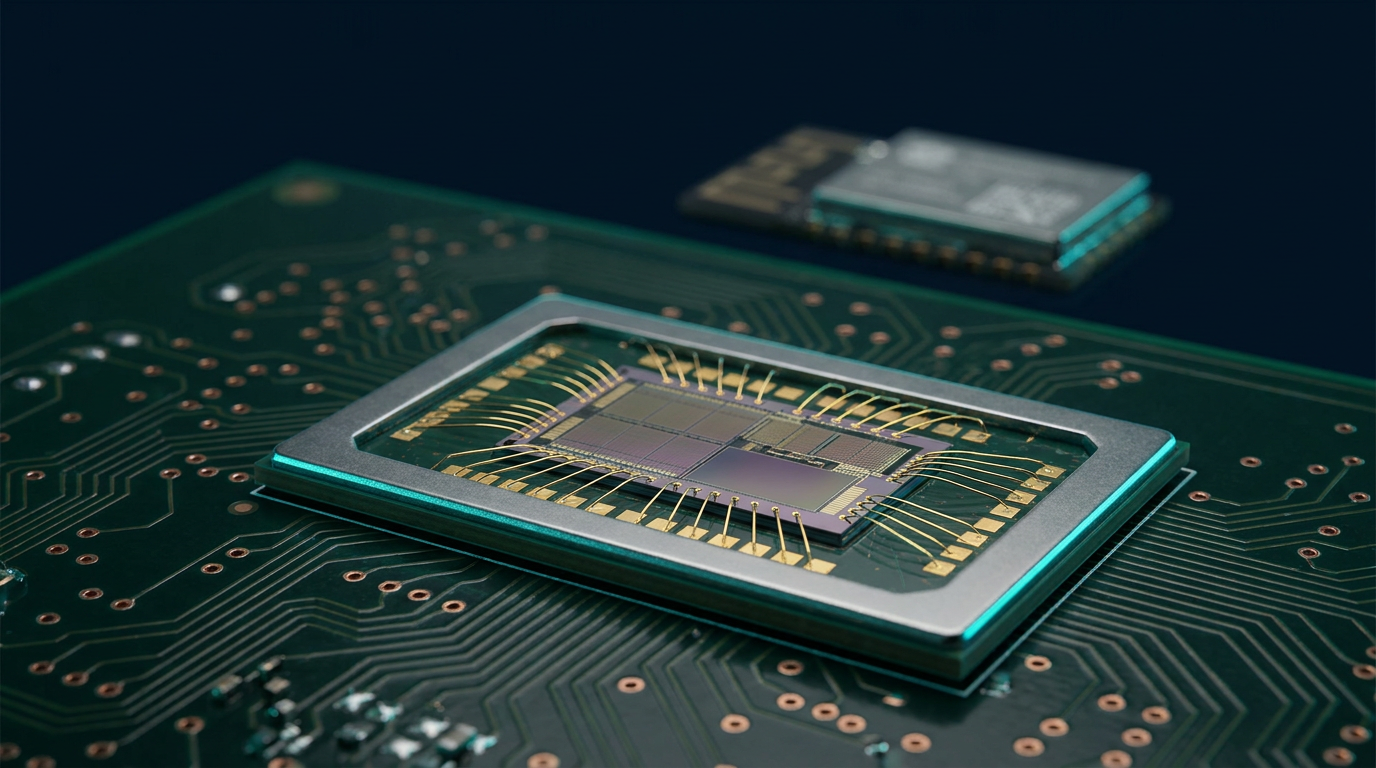
BTQ Technologies and South Korea's ICTK have completed the design of their next-generation QCIM-PUF security chip, with test silicon scheduled to ship to customers by the end of 2026, the companies said on July 11, 2026. The platform merges BTQ's QCIM cryptographic accelerator with ICTK's VIA Physical Unclonable Function (PUF) technology and is backed by a €13.9 million development agreement signed in 2025.
What They're Actually Building
The QCIM-PUF chip is a hardware security module, not a quantum computer. It pairs two distinct primitives on a single die: BTQ's QCIM, a post-quantum cryptographic accelerator designed to run lattice-based and hash-based signature schemes including the NIST-standardized ML-DSA (FIPS 204) and SLH-DSA (FIPS 205), and ICTK's VIA PUF, which derives a unique cryptographic fingerprint from manufacturing-time variations in on-chip structures.
PUFs are not new. Intrinsic ID has shipped PUF-based roots-of-trust since 2010, and Rambus, Microchip, and NXP all market hardware security ICs with silicon fingerprinting. The technical question for the BTQ-ICTK combination is whether integrating a post-quantum accelerator on the same die as a PUF-derived key store reduces the attack surface enough to justify a custom part versus buying both functions separately.
BTQ has not disclosed silicon area, power, or throughput targets for QCIM. The company has previously described QCIM as a "cryptographic identification module" rather than a general-purpose PQC engine, suggesting it is tuned for authentication flows rather than bulk encryption. ICTK's published VIA PUF claims stability across temperature and voltage variations, a known pain point for SRAM-based PUFs, but independent third-party characterization at the 2026 process node is not yet public.
Winners and Losers
The most direct competitive pressure falls on standalone PUF IP vendors and post-quantum software-stack suppliers targeting embedded devices. Intrinsic ID, which has historically dominated the PUF IP licensing market, faces a competitor offering a more integrated solution at the chip level. PQShield, which raised $37M in 2024 to push PQC into IoT, now competes against a part that bakes PQC acceleration into silicon rather than relying on a general-purpose MCU.
BTQ shareholders benefit from the deal's revenue visibility through 2026, though €13.9M spread over a multi-year development agreement is small relative to the company's market capitalization and prior capital raises. ICTK gains a foothold in the post-quantum segment without having to develop the cryptographic IP internally, a sensible trade given the 18-month gap between NIST's August 2024 PQC standards and the August 2024 publication of FIPS 203, 204, and 205.
Adjacent markets are largely unaffected. Cloud quantum computing providers (IBM, IonQ, Quantinuum) and quantum hardware manufacturers are not in the same product category; QCIM-PUF is a classical-silicon security part, not a qubit controller. The deal does, however, validate the emerging market for quantum-resistant edge devices, which matters for the broader PQC migration thesis that VCs have been underwriting since 2023.
The Bigger Picture
The 2026 quantum security market sits at the intersection of two forces: the NIST PQC mandate timeline, which began forcing federal suppliers toward ML-KEM and ML-DSA in 2025, and the slow-motion "harvest now, decrypt later" threat that has pushed banks and defense primes to plan for cryptographic transitions well before a cryptographically relevant quantum computer exists.
Comparable deals calibrate the BTQ-ICTK announcement. SEALSQ announced a €25M investment in a PQC semiconductor facility in France in March 2026. Crypto4A secured a Tier 1 automotive design win for its HSM-on-chip platform in late 2025. ID Quantique acquired a PUF IP portfolio in Q1 2026. Each of these is a chip-level quantum-security play, and the BTQ-ICTK partnership is the first design-completion announcement tied to a Korean partnership of this scale.
Korea's quantum security spending is anchored by government programs including the 2023 K-Quantum Strategy, which committed approximately 1.2 trillion won (~$900M) over ten years. The €13.9M BTQ-ICTK deal is a small fraction of that envelope but positions both companies to bid on follow-on procurement from Korean telecom and industrial OEMs.
The Signal
The signal here is a partnership milestone, not a product launch. A design completion announcement is one step removed from working silicon in customers' hands, and the history of PQC chip startups is littered with parts that taped out on schedule and missed their throughput, power, or certification targets. What would validate this announcement is independent test data showing QCIM's post-quantum signature verification latency on a representative IoT-class microcontroller, plus a published Common Criteria or FIPS 140-3 certification roadmap. Absent those, this is a Korean-market positioning move dressed in technical clothing.
FAQ
Q: What does BTQ Technologies do?
BTQ Technologies is a Vancouver-based company developing post-quantum cryptography hardware and software, with its QCIM product line targeting cryptographic acceleration for embedded and edge devices. The company is not a quantum computer maker; it sells classical-silicon security primitives designed to resist attacks from future quantum machines.
Q: How does QCIM-PUF compare to existing PUF-based security chips from Intrinsic ID or Rambus?
QCIM-PUF bundles a post-quantum accelerator with a PUF on a single die, whereas most competing parts pair a PUF with classical AES or ECC engines. The advantage is a smaller hardware footprint for PQC-mandated applications; the risk is a less mature silicon stack and no public third-party benchmark data as of July 2026.
Q: Is quantum-secure hardware ready for enterprise deployment?
For IoT, automotive, and industrial control systems, yes: NIST finalized three PQC standards in August 2024 and CISA has mandated federal PQC transitions through 2035. For cryptographic workloads that depend on fault-tolerant quantum computers rather than PQC migration, the timeline remains uncertain, with most analysts targeting 2030 or later.
Q: What is BTQ's business model?
BTQ generates revenue through IP licensing, reference design sales, and custom silicon partnerships with regional manufacturers such as ICTK in Korea. The €13.9M ICTK agreement represents milestone-based development funding rather than volume production revenue.
Q: What quantum security milestones matter most in 2026?
Three concrete checkpoints: NIST PQC conformance certification of production chips (not just software), the first FIPS 140-3 validated PQC module shipping in volume, and the first public cryptanalysis of a production PUF-PQC combo under physical attack. Any of those would materially change the competitive map.