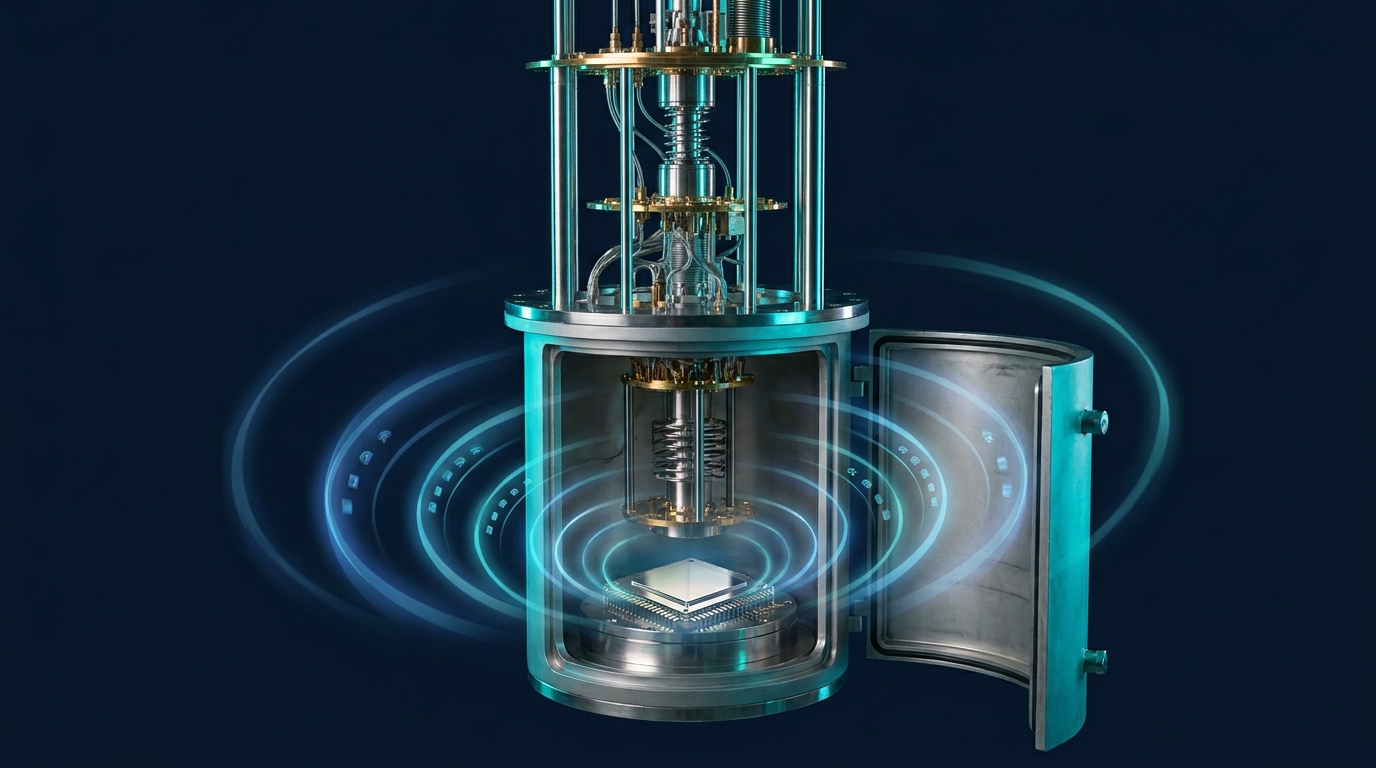
The 6 GHz band, freshly opened for unlicensed Wi-Fi 6E in the United States, now hosts more than just consumer routers. New simulations and new thermometry theory, both published in the summer of 2026, show that quantum hardware and Wi-Fi coexistence are colliding in the same slice of spectrum — and the result reshapes how quantum error correction is engineered. [arXiv:2606.13711]
This matters because quantum error correction does not operate in a vacuum. The same engineering instinct that asks how a 36 dBm standard-power access point coexists with a 30 dBm low-power indoor access point is now asked of quantum hardware: how do delicate quantum states survive a noisy RF environment? The timing is not coincidental. Wi-Fi 6E rollout accelerated through 2025 and 2026, and quantum hardware scaled into the regime where every additional physical qubit, every additional logical qubit block, and every cryogenic cable acts as a new potential noise source. Two research signals from June and July 2026 frame the same problem from opposite sides of the same physical layer.
How It Works
Quantum error correction is the discipline of protecting fragile quantum states from Decoherence, the slow leakage of quantum information into the environment. The leading approach is the Surface Code, a topological scheme that scatters one Logical Qubit across a grid of physical qubits — typically hundreds to thousands. The grid continuously measures stabilizer operators and extracts a syndrome, a fingerprint of where errors have occurred. Classical software then corrects those errors in real time, without ever measuring the protected quantum data directly. Increasing the code distance — the lattice size — suppresses logical error rates exponentially, but only if physical qubit fidelity stays high.
That last clause is where the 6 GHz band becomes a problem. Qubit control pulses, microwave drives, and dispersive readout tones live in the microwave regime, and many of their harmonics spill into the lower-gigahertz range that overlaps with Wi-Fi 6E channels. A research team at Morocco's Abdelmalek Essaadi University published new thermometric scaling laws in July 2026 that quantify how a quantum probe's spectrum determines its measurement precision. A finite-spectrum quantum probe scales its temperature sensitivity as the fourth power of temperature, T⁻⁴, while an unbounded-spectrum probe falls more slowly, at T⁻². "A temperature-sensing performance that decays as the fourth power of temperature, T⁻⁴, distinguishes finite-spectrum quantum probes from those with unbounded spectra," the team reported.
The mirror image of that result appears in a separate June 2026 paper on 6 GHz Wi-Fi self-coexistence. The authors built an ns-3 Wi-Fi 6E simulation to study how a 36 dBm standard-power (SP) access point degrades the throughput of a 30 dBm low-power indoor (LPI) access point in the same building. The finding is direct: "channel bandwidth is a key factor in determining the extent of SP-to-LPI impact, with the degradation being most severe at 20 MHz and partially alleviated at 160 MHz." In Wi-Fi terms, more spectrum dilutes the interference. In quantum terms, the same logic applies — broader readout bandwidth, more spectral separation, more physical qubits encoding each logical qubit all raise the noise floor against which syndrome measurement must work.
Who's Moving
IBM (NYSE: IBM) operates the largest disclosed superconducting quantum fleet, anchored by its 1,121-qubit Condor processor unveiled in December 2023 and continued through its Heron and Flamingo modular chips. The company's published roadmap targets fault tolerant quantum computing systems that run quantum error correction at scales relevant to industrial problems. Google (Alphabet, NASDAQ: GOOGL) demonstrated below-threshold error suppression with its 105-qubit Willow chip in December 2024, meaning that adding more physical qubits reduced the logical error rate — a long-sought QEC milestone. Both companies push code distances upward, which forces them to manage RF environments inside dilution refrigerators and across control electronics with increasing precision. IBM has committed $3 billion over 10 years to quantum research and development, with portions directed at fault-tolerant QEC milestones.
Independent of the platform vendors, the simulation work published in arXiv in June 2026 gives the field a reproducible methodology. The ns-3 Wi-Fi 6E coexistence testbed, validated against the four FCC power regimes — SP at 36 dBm, LPI at 30 dBm, geofenced variable power at 24 dBm, very low power at 14 dBm — extends to study interference between Wi-Fi and cellular systems and, crucially, between unlicensed 6 GHz emitters and quantum measurement hardware. The Abdelmalek Essaadi University team complements this RF-side work by giving sensor designers a direct link between a quantum system's energy levels and its ability to measure temperature. Daniel Gottesman at the University of Maryland and Caltech's John Preskill established the theoretical scaffolding for stabilizer codes that underpin today's leading quantum error correction schemes.
Why 2026 Is Different
Three forces converged in 2026. First, the FCC's 6 GHz rules moved from policy paper to mass deployment: Wi-Fi 6E routers sold in the millions, and the regulatory question of how the four power regimes coexist became an engineering one. Second, quantum error correction crossed the threshold for below-threshold operation on more than one platform, with Google's Willow chip as the proof point and IBM's modular architectures providing industrial scale. Third, the theoretical tools for designing quantum probes — including the Abdelmalek Essaadi T⁻⁴ scaling law — matured to the point where sensor engineers choose finite- or unbounded-spectrum probes by design rather than by accident. Over the next 12 months, at least one quantum cloud provider publishes measured RF interference levels in deployed cryostats. Over the next three years, fault-tolerant logical-qubit benchmarks arrive with explicit RF environment specifications, and within five years quantum error correction stacks ship with built-in spectrum awareness as standard.
The deeper lesson from the 2026 literature is that quantum error correction is no longer a pure-mathematics problem. It is a physical-layer engineering problem that sits inside the same RF ecosystem as Wi-Fi 6E, 5G NR-U, and the next generation of unlicensed mid-band devices. Cryostat shielding, control-electronics filtering, and code-distance tuning are now joint design variables. In short: Quantum error correction's first fault-tolerant wins will be decided by how well the 6 GHz RF environment is managed, not just by code distance.