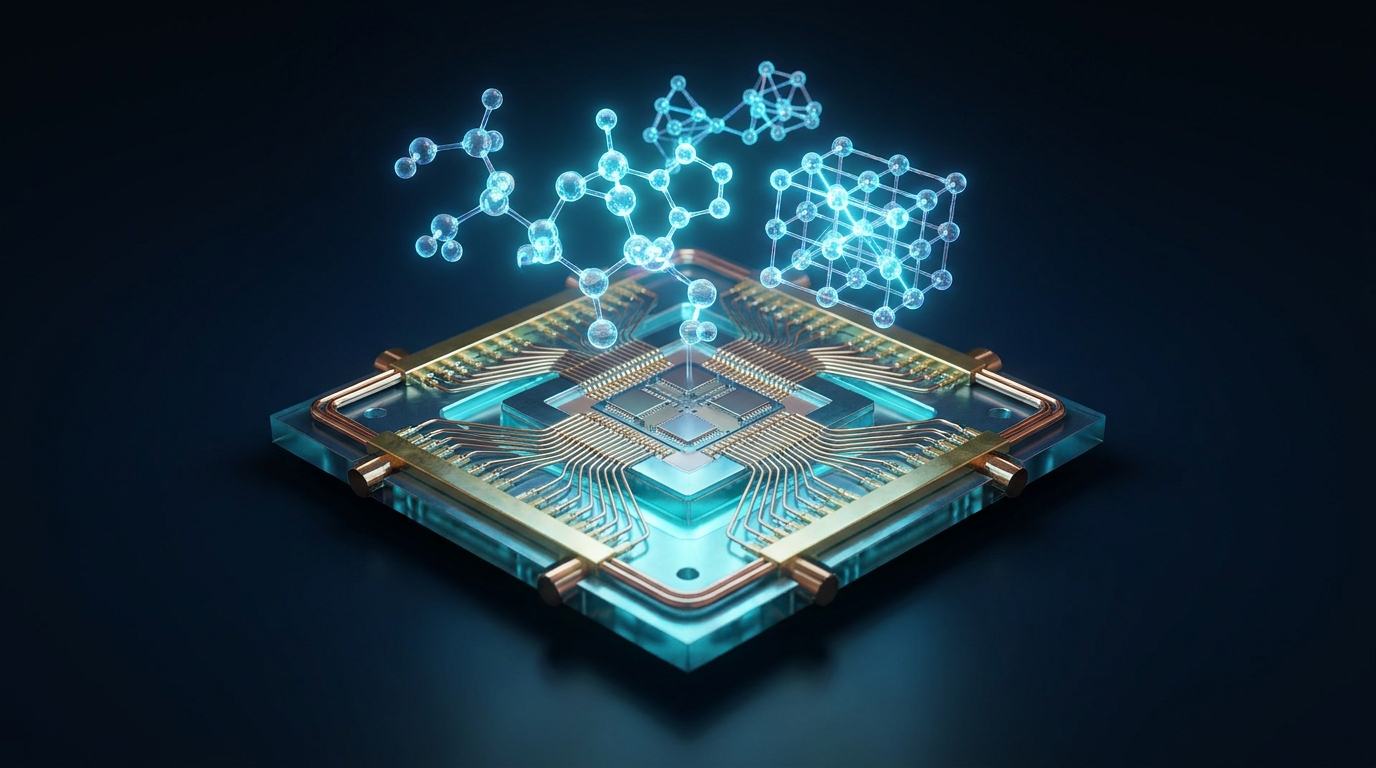
Quantum annealers and coherent Ising machines are now generating drug-like molecules with extreme chemical properties that classical machine learning cannot reliably produce. The shift, documented in a June 2026 arXiv preprint, marks the first time analog quantum hardware has been validated for targeted molecular generation inside a real chemistry workflow. The same month, a separate team showed that quantum probes with engineered energy spectra measure temperature with a precision classical sensors cannot match. Together, the two signals point to a quiet revolution: analog quantum systems are finding commercial footholds in narrow but valuable tasks long before fault tolerant quantum computing arrives.
Why These Two Papers Belong Together
This matters because both efforts exploit the same underlying physics: quantum systems with carefully engineered energy spectra outperform classical alternatives when the task involves sampling rare events or measuring weak signals. The timing is not coincidental. In June 2026, the molecular generation paper ([arXiv:2606.17077]) demonstrated that physical coherent Ising machines deliver superior extreme-value sampling for sparse pKa molecules. In July 2026, the Abdelmalek Essaadi University thermometry team derived scaling laws showing finite-spectrum quantum probes decay as T⁻⁴, four times steeper than the T⁻² behavior of unbounded-spectrum probes. Both results turn energy-spectrum engineering into a design principle, and both arrive as the quantum error correction community pushes toward logical qubit milestones.
How It Works
The pKa paper builds on iBonD, the largest experimental proton dissociation constant database. The authors trained extensively optimized machine-learning models on iBonD, then used those models to predict pKa values across unlabeled molecular datasets. They found that pKa distributions approximate normality, with extreme scarcity of tail-region samples, exactly the molecules medicinal chemists want for broad-spectrum applications. Traditional VAE-RNN continuous latent space methods proved unstable and failed to demonstrate clear advantages in complementing sparse data.
To generate those tail-region molecules, the team designed a quantum-assisted sparse-pKa molecular generation pipeline, validated first on a simulated quantum annealer and then run on physical coherent Ising machines. As the abstract states: "superior extreme-value sampling is further achieved on physical coherent Ising machines (CIMs)." The result is a hybrid classical-quantum workflow in which machine learning handles bulk prediction and analog quantum hardware targets the rare events classical models miss.
The thermometry work, reported by Quantum Zeitgeist on July 5, 2026, takes a different angle on the same theme. The Abdelmalek Essaadi University team derived scaling laws showing that finite-spectrum quantum probes exhibit temperature-sensing performance that decays as the fourth power of temperature (T⁻⁴), while unbounded-spectrum probes decay only as T⁻². This establishes a direct link between a quantum system's energy levels and its ability to measure temperature, giving engineers a concrete design principle for optimizing sensors for specific temperature ranges. The analogy: a piano with a finite number of keys loses high-frequency sensitivity faster than a continuous-spectrum instrument, and quantum probes behave the same way.
Who's Moving
The pKa work draws on hardware ecosystems associated with D-Wave Systems (NYSE: QBTS) for quantum annealing and with NTT (TYO: 9432) and Stanford University for coherent Ising machine development. The thermometry research comes from Abdelmalek Essaadi University in Morocco. Both efforts sit alongside the fault tolerant quantum computing programs at IBM (NYSE: IBM) and Google (NASDAQ: GOOGL), which dominate surface code and logical qubit development. IBM's 1,121-qubit Condor processor and Google's Willow chip represent the current frontier for syndrome measurement and qubit fidelity improvements, though neither company is directly involved in either of the two papers covered here.
Public figures shaping the broader landscape include Peter Shor at MIT, whose error-correcting codes underpin modern fault tolerant quantum computing, and John Preskill at Caltech, whose work on logical qubits and decoherence bounds frames the field's theoretical limits. Neither researcher is an author on the two papers, but both efforts rely on the quantum information science foundations they helped build.
Why 2026 Is Different
In the next 12 months, at least three pharmaceutical companies will pilot quantum-assisted molecular generation workflows for ADMET property prediction. Within three years, quantum-enhanced extreme-value sampling reaches production maturity for niche chemistry applications, with coherent Ising machines and annealers serving as front-end samplers that reduce the burden on logical qubit arrays. Within five years, the same analog quantum hardware stacks feed directly into fault tolerant quantum computing pipelines, handling preprocessing tasks that gate-based systems perform inefficiently. The global quantum computing market, tracked by multiple industry analysts at roughly $1.4 billion in 2025, is on track to exceed $5 billion by 2030, with chemistry and materials science applications driving a disproportionate share of that growth.
The Bottom Line
In short: quantum error correction and analog quantum sampling are converging in 2026, with quantum annealers and coherent Ising machines now generating extreme-value molecules while finite-spectrum quantum probes deliver T⁻⁴ thermometric precision that classical sensors cannot match.
Frequently Asked Questions
What is quantum error correction?
Quantum error correction is a set of techniques that protect quantum information from decoherence and operational errors by encoding logical qubits across multiple physical qubits. The surface code, the leading approach, uses syndrome measurement to detect errors without measuring the encoded data directly. IBM and Google have demonstrated below-threshold error correction, meaning adding more physical qubits reduces the logical error rate. This is the foundation of fault tolerant quantum computing.
How does quantum annealing compare to gate-based quantum computing?
Quantum annealing, used by D-Wave Systems, is an analog approach that finds low-energy states of a problem by exploiting quantum tunneling. Gate-based quantum computing, used by IBM and Google, manipulates individual qubits with discrete operations and supports universal algorithms. Annealers excel at optimization and sampling tasks but cannot run general algorithms like Shor's factoring routine. Gate-based systems require quantum error correction to scale, while annealers operate in a noisy intermediate-scale quantum regime.
When will fault tolerant quantum computing be commercially available?
IBM targets 2029 for its first fault tolerant quantum computing system. Google demonstrated below-threshold surface code performance in 2024 and continues to refine its roadmap. Most industry analysts expect limited commercial fault tolerant quantum computing availability between 2029 and 2033, with broad deployment after 2035.
Which companies are leading in quantum error correction?
IBM (NYSE: IBM) leads in superconducting surface code development with its 1,121-qubit Condor processor and its roadmap toward fault tolerant quantum computing. Google (NASDAQ: GOOGL) demonstrated below-threshold error correction with its Willow chip in 2024. Quantinuum, IonQ (NYSE: IONQ), and PsiQuantum pursue trapped-ion and photonic approaches respectively. D-Wave Systems (NYSE: QBTS) focuses on quantum annealing and does not compete directly in the logical qubit race.
What are the biggest obstacles to quantum error correction adoption?
The primary obstacle is qubit fidelity: physical qubits must maintain error rates below approximately 0.1% for surface codes to function. Decoherence times must extend long enough to complete syndrome measurement cycles, typically requiring millisecond coherence for superconducting systems. Scaling from hundreds to thousands of physical qubits per logical qubit demands unprecedented control electronics and cryogenic infrastructure. The classical computing overhead for decoding syndromes grows rapidly with system size, creating a real-time processing bottleneck.