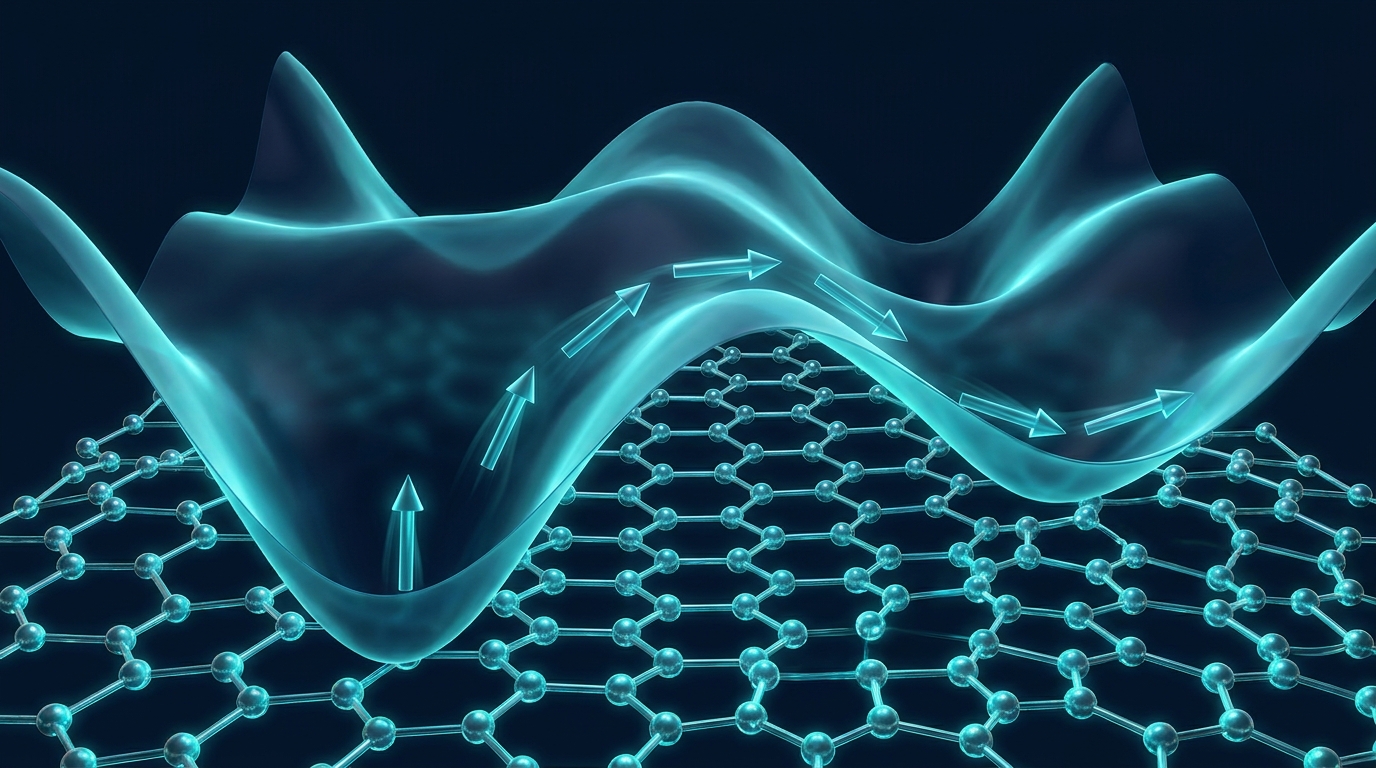
The quest for smaller, faster, and more energy-efficient data storage hinges on a single physical property: magnetic anisotropy. This is the energy barrier that prevents a magnetic bit from flipping its orientation spontaneously. In the realm of ultrathin films—layers only a few atoms thick—this barrier becomes notoriously unstable as temperatures fluctuate. For decades, physicists struggled to accurately predict how these films behave at varying temperatures because the energy landscapes are incredibly complex, often trapping standard simulations in local minima that obscure the true physical state. The challenge was not just seeing the magnetic state, but calculating the precise energy cost of moving between states across a continuous temperature gradient. [arXiv:10.1103/PhysRevB.100.174429]
The Core Finding
Researchers at the Budapest University of Technology and Economics have successfully applied metadynamics simulations to resolve the free energy landscape of ferromagnetic thin films. By utilizing a simple spin model alongside first-principles calculations, the team mapped the temperature dependence of magnetic anisotropy with unprecedented resolution. They specifically examined iron double layers deposited on gold and tungsten substrates, identifying the exact points where the magnetization flips from pointing out-of-plane to in-plane. Think of it like a compass needle that normally points north but suddenly decides to point straight up at the sky once the room reaches a certain temperature. The study successfully recovered the well-known power-law behavior of magnetic anisotropy energy against magnetization and provided a detailed analysis of these transitions. According to the abstract, the team performed simulations for Fe double layers where "our simulations display an out-of-plane to in-plane spin-reorientation transition in agreement with experiments."
The State of the Field
Before this breakthrough, the industry relied heavily on the Callen-Callen power law or standard Monte Carlo simulations to estimate magnetic stability. While these methods provided a rough approximation, they often failed to capture the nuances of spin-reorientation transitions (SRT) in complex environments like Fe2/W(110). Previous work by researchers such as Staunton and Gyorffy laid the groundwork for relativistic spin density functional theory, but the computational cost of exploring the full free energy surface remained prohibitive. This new approach integrates tensorial exchange interactions derived from first principles into a metadynamics framework. This shift is critical as the broader quantum and classical computing landscapes move toward "spintronics," where the spin of an electron, rather than just its charge, carries information. Understanding these transitions is the prerequisite for building fault-tolerant magnetic sensors and non-volatile memory that can survive the thermal stresses of modern processors.
From Lab to Reality
For the scientific community, this research unlocks a predictive toolset for designing new synthetic magnetic materials without the need for exhaustive trial-and-error fabrication. Engineers can now use these metadynamics models to stabilize the magnetic orientation of ultrathin films used in Magnetic Random Access Memory (MRAM). By knowing the exact temperature at which a bit becomes volatile, manufacturers can engineer heat sinks or material dopants to push the spin-reorientation transition far beyond the operating temperature of a standard data center. For investors, this research directly impacts the next-generation memory market, specifically the MRAM sector, which is projected to grow significantly as a replacement for aging Flash and SRAM technologies. The ability to guarantee data persistence at the atomic scale is the primary bottleneck for the $10 billion high-performance computing storage market.
What Still Needs to Happen
Despite the success of the metadynamics approach, two significant technical hurdles remain. First, the current model relies on a simplified spin Hamiltonian; while effective, it does not yet fully account for the long-range dipole-dipole interactions that can dominate in larger-scale device architectures. Second, the transition from iron bilayers on tungsten to more commercially viable substrates like silicon remains a challenge due to lattice mismatch and interface diffusion. Groups led by Riccardo Hertel in Strasbourg and others in the magnetism community are currently working on integrating these free-energy methods into micromagnetic solvers. We are likely five to ten years away from seeing these specific simulation results translated into consumer-grade hardware, as the industry must first perfect the deposition of these ultrathin layers at scale.
Conclusion
This study provides the first comprehensive free-energy map of temperature-induced spin flips in iron bilayers, proving that metadynamics can accurately predict the stability of atomic-scale magnets. In short: metadynamics simulations of magnetic anisotropy reveal that iron double layers undergo predictable spin-reorientation transitions, providing a blueprint for stabilizing ultrathin magnetic storage media.