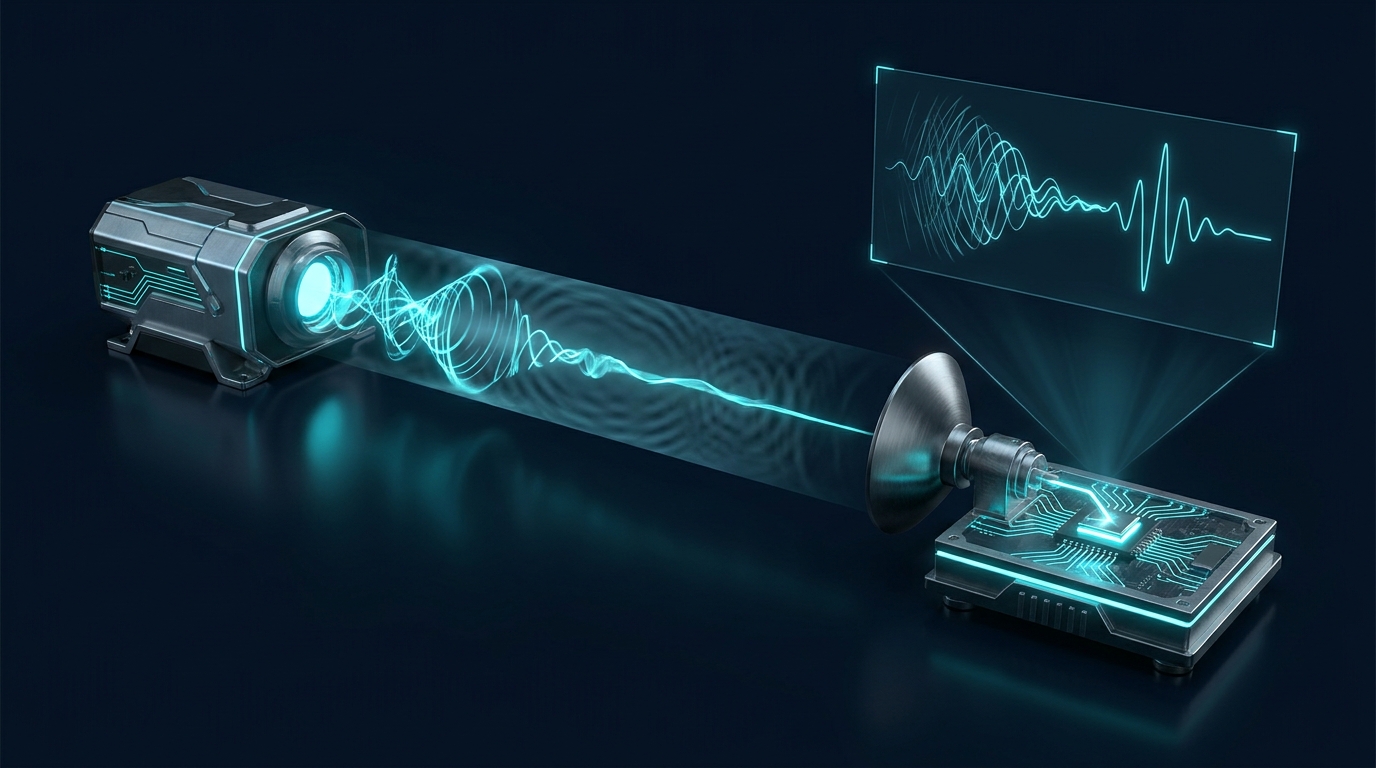
The quest for ultra-high-speed wireless communication often hits a physical wall: the complexity of the receiver. To transmit data at the terahertz (THz) frequencies required for the next generation of wireless networks, engineers typically rely on coherent detection. This process requires a continuous-wave local oscillator and a complex mixer circuit to decode the phase and amplitude of the signal. For years, the hardware overhead of these systems has made them bulky, expensive, and difficult to scale for widespread use. The problem was not just the frequency, but the mathematical difficulty of reconstructing a complex signal without a dedicated phase reference at the receiver end. [arXiv:10.1038/s41566-020-0675-0]
The Core Finding
Researchers at the Karlsruhe Institute of Technology (KIT) have successfully demonstrated a generalized Kramers-Kronig (KK) receiver that operates at 0.3 THz, effectively simplifying the hardware requirements for high-speed wireless links. By transmitting a local oscillator tone alongside the signal, the team used a single Schottky-barrier diode (SBD) to capture the data. They then applied a digital signal processing algorithm based on the Kramers-Kronig relation to reconstruct the full complex envelope of the signal. Think of it like reconstructing a 3D object from its 2D shadow by knowing exactly how the light source was positioned. The team achieved a net data rate of 115 Gbit/s over a distance of 110 meters using 16-state quadrature amplitude modulation (16QAM). According to the abstract, the team managed to "generalize the theory of KK processing to account for the non-quadratic characteristics" of the Schottky-barrier diode, a feat previously confined to linear optical photodetectors.
The State of the Field
Before this breakthrough, the Kramers-Kronig scheme was primarily a darling of the fiber-optic community. Researchers like Antonio Mecozzi, who pioneered the KK receiver in 2016, showed that one could ditch the complex coherent receiver in favor of a single photodiode. However, translating this to the THz regime was considered nearly impossible because THz detectors, specifically Schottky-barrier diodes, do not follow the perfect square-law behavior of optical photodiodes. In the broader landscape of quantum error correction and high-frequency physics, the ability to maintain phase integrity without massive hardware overhead is a primary goal. While companies like IBM and Google focus on superconducting qubits, the underlying microwave and THz infrastructure required to control these systems faces the same scaling bottlenecks that this paper addresses.
From Lab to Reality
For scientists, this work unlocks a new pathway for THz spectroscopy and remote sensing, where bulky receivers are often a dealbreaker. For engineers, it provides a blueprint for 6G wireless backhaul systems that can operate at 100+ Gbit/s using off-the-shelf Schottky diodes rather than exotic, expensive coherent mixers. For investors, this technology directly impacts the high-speed telecommunications market, which is projected to see massive growth as 5G matures and the industry looks toward sub-THz frequencies. By reducing the bill of materials for a THz receiver, the path to commercializing 0.3 THz wireless links becomes significantly more viable, potentially lowering the entry barrier for ultra-broadband fixed wireless access.
What Still Needs to Happen
Despite the 115 Gbit/s milestone, two major technical hurdles remain. First, the current system requires a high signal-to-carrier power ratio to ensure the signal remains "minimum-phase," a mathematical requirement for the KK relation to hold. This limits the power efficiency of the transmitter. Second, the digital signal processing (DSP) required for the KK reconstruction is computationally intensive, currently requiring offline processing. Groups at the University of Stuttgart and various Fraunhofer institutes are working on real-time DSP implementations and more sensitive THz detectors to mitigate these issues. We are likely five to ten years away from seeing this integrated into a consumer-grade chipset.
Conclusion
The generalization of the Kramers-Kronig relation to non-quadratic THz detectors represents a fundamental shift in how we approach high-speed wireless reception. It proves that mathematical sophistication in the digital domain can compensate for hardware simplicity in the physical domain. In short: the generalized Kramers-Kronig receiver enables quantum error correction principles to be applied to THz signals, achieving 115 Gbit/s throughput with a single-diode architecture.