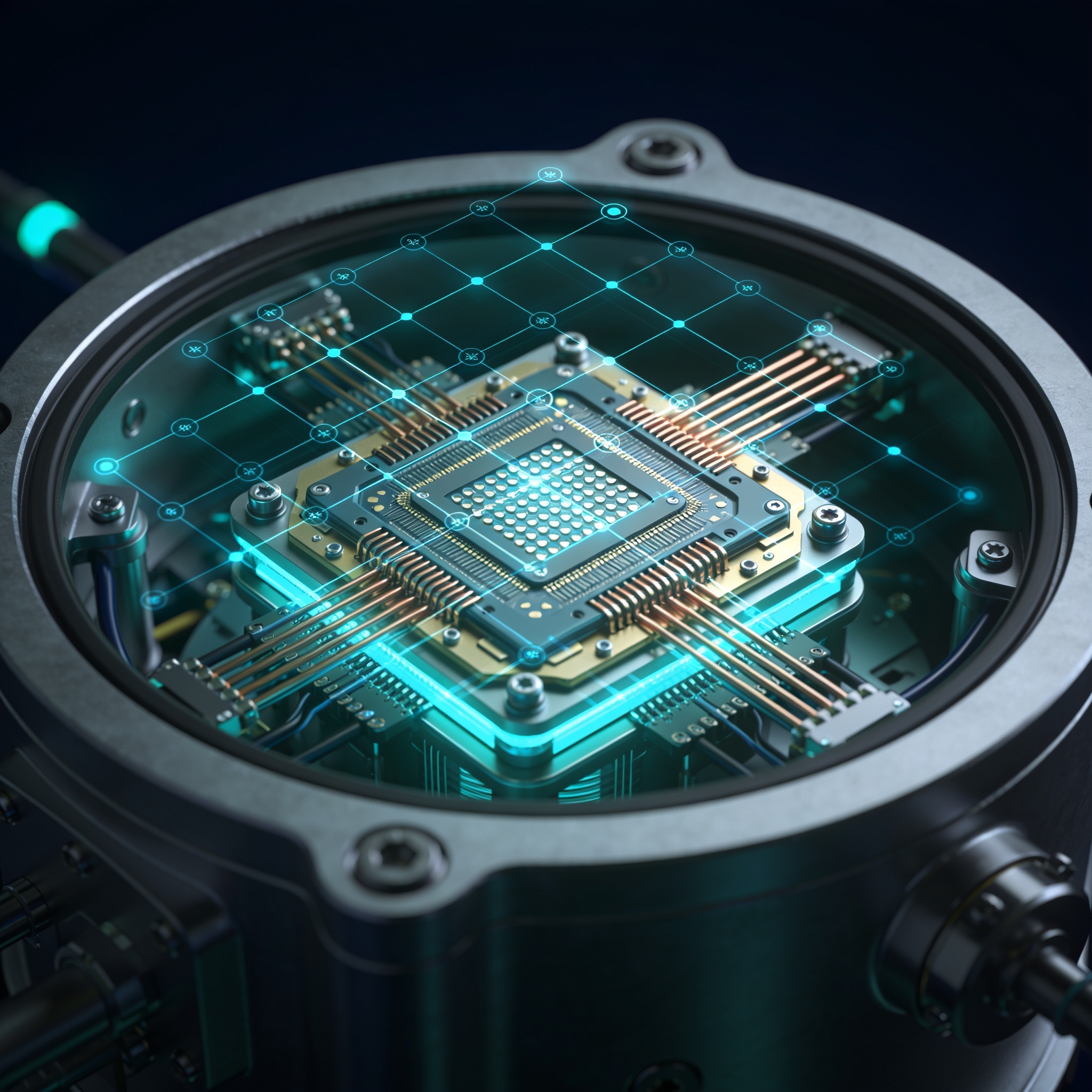
Not all measures of quantum information are created equal—and for stabilizer codes, the ones that matter most are finally falling into a strict hierarchy. The Rényi coherent information, a computable proxy long used to study mixed-state phases of matter and decodability transitions, has always lacked the operational meaning of its von Neumann counterpart. A preprint posted on arXiv on September 10, 2026, changes that. It proves that for Pauli noise driven by independent Bernoulli events, the Rényi coherent information of a stabilizer code is monotonic: it never decreases as the Rényi index rises. The result hands theorists and hardware engineers a rigorous tool for predicting when a noisy quantum processor will cross the threshold from losing information to recovering it. [arXiv:2609.11930]
Just four days later, on September 14, 2026, Rigetti Computing reported a complementary milestone. Its researchers demonstrated a qubit-efficient optimization algorithm on a 9-qubit superconducting processor, mapping classical variables into an entangled quantum state that uses fewer physical qubits than the number of variables themselves. The Sherrington-Kirkpatrick spin-glass instances they solved on Rigetti’s chip exploit an encoding strategy that cuts qubit overhead—a practical echo of the same stabilizer-code logic that the arXiv paper now places on rigorous mathematical footing.
The Connection
The two announcements belong together because they converge on a single, urgent hardware question: how many logical bits can a quantum processor reliably protect with a given number of physical qubits? The arXiv paper gives a sharp operational meaning to the Rényi coherent information, showing that it upper-bounds the ordinary coherent information achievable after any syndrome-conditioned recovery. Rigetti’s algorithm, meanwhile, demonstrates that encoding classical variables into stabilizer-like entangled states can slash the qubit count needed for hard optimization problems. Together they signal a moment when the theory of decodability transitions and the practice of qubit-efficient encoding are moving onto the same blueprint.
How It Works
A stabilizer code works like a secret-sharing scheme. You spread quantum information across many physical qubits, then check parity-like “syndrome” measurements that reveal errors without disturbing the encoded logical state. The coherent information quantifies how much of that logical information remains after the noise acts. For realistic Pauli noise—random bit-flip and phase-flip events—the von Neumann coherent information is the gold standard, but it is notoriously hard to compute. The Rényi versions, indexed by an integer n, are easier to calculate and have become the workhorse for identifying decodability transitions in large codes.
The theorem at the heart of the new preprint is a monotonicity law. When independent random bits are mapped linearly to a fine label T (the joint syndrome–logical class) and a coarse label C (the syndrome alone), the difference Hn(C) − Hn(T)—which is exactly the Rényi-n coherent information—is nondecreasing in n. The result holds for any classical linear code and any independent detector error model, but it lands with special force in the quantum domain. For a stabilizer code running on a quantum processor, the hierarchy tells you that if recovery works at one Rényi order, it will work at all higher orders.
The authors then give the Rényi-n coherent information a concrete operational meaning. They define a postselected channel: keep only those runs where the n–1 auxiliary blocks produce the same syndrome as the data block. “The Rényi-n coherent information also upper-bounds the ordinary coherent information achievable after any syndrome-conditioned recovery,” the paper states. When the bound is saturated, perfect logical-qubit recovery becomes possible in the asymptotic limit. The result transforms a convenient mathematical proxy into a rigorous diagnostic of decodability on any quantum chip, superconducting or otherwise.
Who’s Moving
Rigetti Computing (NASDAQ: RGTI) is the most immediate hardware player in this story. Its 9-qubit superconducting processor, cooled to millikelvin temperatures in a dilution refrigerator, ran the qubit-efficient optimization algorithm that uses parameter concentration to reuse optimal circuit settings across different problem instances. The approach matters because it hints at a scalable scheme for continuous optimization on near-term and early fault-tolerant hardware.
The competition is not standing still. IBM’s 1,121-qubit Condor processor, the largest superconducting quantum chip ever built, pushes qubit count to extremes while engineers work to improve gate fidelity and coherence time. Google Quantum AI’s Willow processor, with 105 superconducting qubits, demonstrated exponential error suppression below the surface-code threshold in late 2024, proving that scaling up physical qubits can indeed lower the logical error rate. Quantinuum’s H2 trapped-ion system, meanwhile, achieves two-qubit gate fidelities above 99.8%, though with a different qubit technology. All these platforms rely, at some level, on stabilizer codes to turn noisy physical qubits into useful logical qubits.
Why 2026 Is Different
The next 12 months will see multiple superconducting quantum processors cross the 100-logical-qubit mark, with surface-code patches validated by Rényi-information diagnostics like the one proved in the arXiv paper. Within three years, the first error-corrected logical qubits that outlive their constituent physical qubits will be demonstrated on chips with more than 1,000 physical qubits. Five years out, a logical qubit will be a purchasable resource, and the monotonic hierarchy of Rényi coherent information will be as standard a design tool as the bit-error-rate curves that semiconductor fabs rely on today. The quantum computing market, projected by McKinsey to reach $65 billion by 2030, is betting that the transition from noisy to fault-tolerant happens on exactly this timeline. The mathematical scaffolding for that bet is now falling into place.
In short: A quantum processor running stabilizer codes now has a provably monotonic information hierarchy that bounds decodability thresholds, turning a mathematical curiosity into a practical diagnostic for error correction.