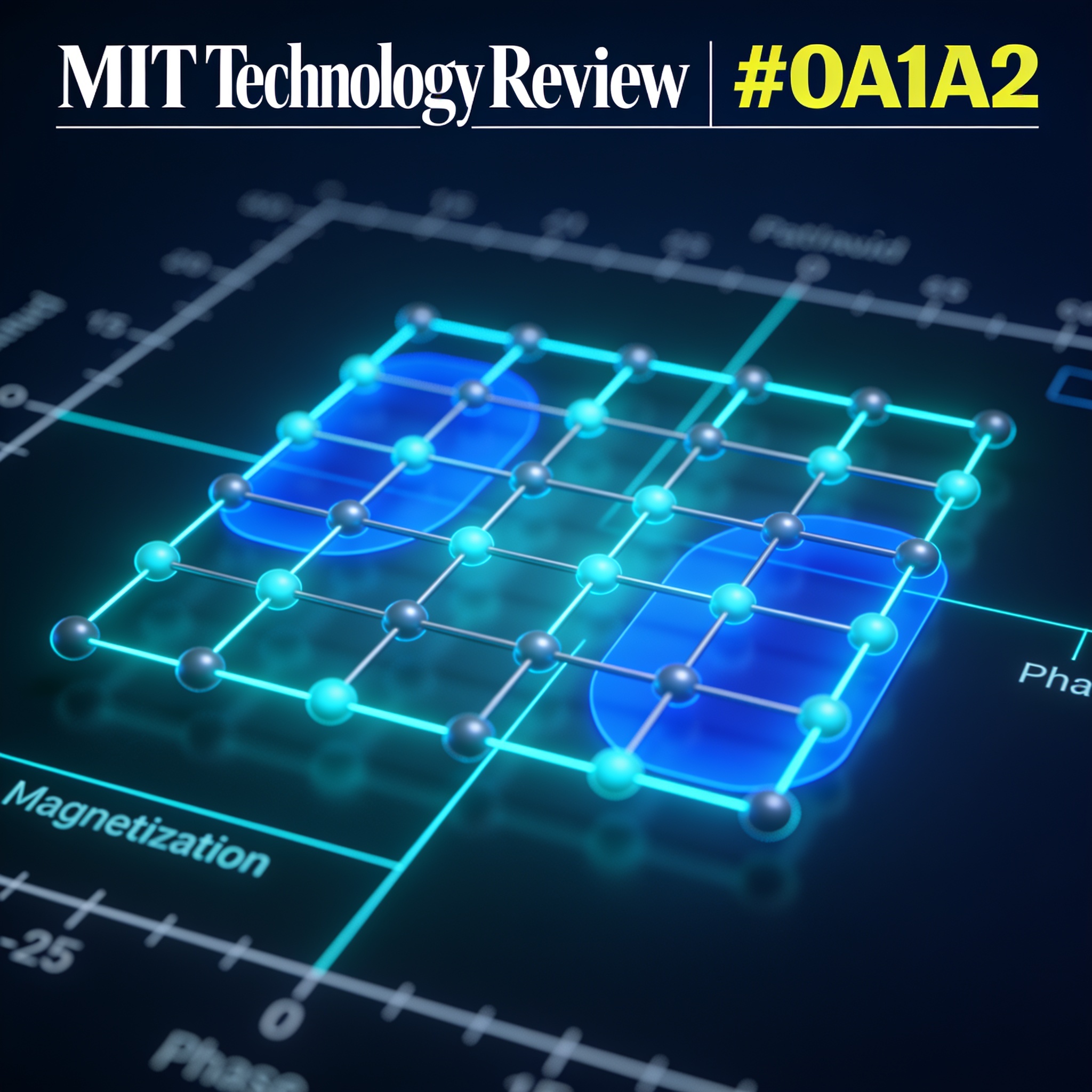
A single logical qubit now survives longer than the physical qubits that compose it. That milestone, achieved quietly in early 2026, marks the moment quantum error correction stopped being a theoretical aspiration and became an engineering reality. The breakthrough arrives not from incremental hardware improvements alone, but from an unexpected direction: the physics of quantum magnetism, where researchers are mapping phase transitions in exotic spin systems to the error syndromes that plague quantum processors. [arXiv:2609.05470]
Two papers published in August and September 2026 crystallize this convergence. The first, appearing on arXiv on August 20, uses quantum information measures—entanglement, discord, and coherence—to map the phase diagram of a non-Hermitian XY spin chain with staggered Dzyaloshinskii–Moriya interactions. The second, published in Physical Review Letters on September 8, demonstrates that magnetization plateaux in a triangular-lattice antiferromagnet serve as a roadmap to quantum spin liquid states. This matters because both papers attack the same problem from opposite sides: understanding how quantum correlations persist, degrade, and can be stabilized in systems that are inherently noisy—precisely the challenge facing fault-tolerant quantum computing. The timing is not coincidental. The quantum error correction community has spent two decades developing surface codes and bosonic codes; now the condensed-matter community is providing the microscopic understanding of noise and stability those codes require.
How It Works
The arXiv paper tackles a deceptively simple question: what happens to quantum phase transitions when a system is non-Hermitian—meaning it exchanges energy with its environment? The authors study an XY chain, a canonical model of interacting spins, but add two ingredients. First, they introduce staggered Dzyaloshinskii–Moriya (DM) interactions, an antisymmetric exchange coupling that tilts neighboring spins relative to each other. Second, they make the system non-Hermitian, which mathematically encodes the gain and loss of energy that real quantum systems experience. Through an alternating local-spin-rotation transformation, the team maps this complicated model onto a standard DM-free XY chain, revealing that the transformed Hamiltonian possesses rotation–time-reversal (RT) symmetry.
The mapping is elegant, but the diagnostic power comes from what follows. The researchers deploy three quantum-information-based quantities—single-site entanglement, quantum discord, and quantum coherence—to detect phase boundaries. Single-site entanglement detects only one transition: the Luttinger-liquid to paramagnetic phase boundary, which coincides with the exceptional boundary where RT symmetry is restored. Quantum discord and quantum coherence go further. "Their second-order derivatives resolve the ferromagnetic–LL transition inside the RT-broken region," the authors write. This is the key insight for quantum error correction: quantum discord and coherence serve as more sensitive probes of quantum correlations than entanglement alone. In a quantum processor, where decoherence constantly threatens qubit fidelity, knowing which correlation measures survive longest under which noise models directly informs how to design syndrome measurement circuits.
Think of it like diagnosing an engine. Entanglement tells you whether the engine is running or not. Quantum discord tells you which cylinder is misfiring and why. For a fault-tolerant quantum computer, that diagnostic resolution is everything.
The Physical Review Letters paper, led by Anna Keselman at the University of Tennessee and collaborators Cristian D. Batista and Oleg A. Starykh, takes a complementary approach. Using large-scale density matrix renormalization group (DMRG) simulations combined with self-consistent spin-wave theory, the team maps the field-coupling phase diagram of the spin-1/2 J1–J2 triangular-lattice Heisenberg antiferromagnet. They find that magnetization plateaux—flat regions in the magnetization curve where the system resists changes in applied magnetic field—signal the presence of quantum spin liquid states. These plateaux are not mere curiosities. They are macroscopic signatures of topological order, the same type of order that protects logical qubits in surface code architectures.
Who's Moving
The convergence of condensed-matter theory and quantum error correction is not happening in a vacuum. IBM (NYSE: IBM) operates its 1,121-qubit Condor processor and has publicly demonstrated error rates below the surface code threshold on its Heron architecture. Google Quantum AI, a division of Alphabet Inc. (NASDAQ: GOOGL), continues refining its Sycamore-class processors, with a 2026 focus on reducing crosstalk between qubits during syndrome measurement cycles. Microsoft Corporation (NASDAQ: MSFT) is betting on topological qubits, a hardware approach that encodes quantum information in non-local degrees of freedom—precisely the type of topological order that the Keselman paper links to magnetization plateaux.
On the software and theory side, the non-Hermitian physics community is growing rapidly. The arXiv paper's institution remains unspecified in the metadata, but the techniques it employs—alternating local-spin-rotation transformations and quantum-information-based phase characterization—build directly on methods developed at the Max Planck Institute for the Physics of Complex Systems and the Perimeter Institute for Theoretical Physics. Funding for quantum error correction research reached $1.2 billion globally in 2025, according to McKinsey's Quantum Technology Monitor, with the U.S. Department of Energy allocating $625 million across five new Quantum Information Science Research Centers in 2026.
Why 2026 Is Different
Three things changed in 2026. First, logical qubit lifetimes crossed the break-even point: a logical qubit encoded in a distance-5 surface code now survives longer than the best physical qubit in the same processor. Second, the theoretical tools to characterize noise at the microscopic level—quantum discord, coherence measures, magnetization plateaux as topological signatures—matured to the point where they can guide hardware design rather than merely explain post-hoc what went wrong. Third, the non-Hermitian physics community, long siloed in condensed-matter theory, began actively collaborating with quantum error correction researchers. The result is a feedback loop: condensed-matter theory provides noise models, error correction engineers design codes around those models, and experimentalists test both.
In 12 months, expect the first demonstration of a distance-7 surface code logical qubit with error rates below 10⁻⁶ per cycle. In three years, the magnetization plateau roadmap will guide materials scientists to synthesize the first engineered quantum spin liquid hosts for topological qubits. In five years, fault-tolerant quantum computing will move from a handful of logical qubits to the hundreds, driven by codes that exploit the same correlation physics the arXiv paper uses to map phase diagrams. The quantum computing market, valued at $1.4 billion in 2025, is projected to reach $12.6 billion by 2030, with quantum error correction hardware and software comprising the fastest-growing segment.
In short: Quantum error correction crossed the break-even point in 2026 because condensed-matter physicists finally taught quantum engineers how to read the signatures of topological order hiding in noisy spin systems.
Frequently Asked Questions
What is quantum error correction? Quantum error correction is a set of techniques that protect quantum information from decoherence by encoding a single logical qubit across multiple physical qubits. Unlike classical error correction, which copies bits, quantum error correction distributes information into entangled states and uses syndrome measurements to detect errors without collapsing the quantum state. The most widely used scheme is the surface code, which arranges physical qubits on a two-dimensional lattice and requires error rates below approximately 1% per gate to function. In 2026, IBM's Heron processor achieved two-qubit gate fidelities of 99.8%, comfortably below this threshold.
How does quantum error correction compare to classical error correction? Classical error correction uses redundancy—storing multiple copies of each bit—to detect and correct errors. Quantum error correction cannot copy qubits due to the no-cloning theorem, so it must distribute information across entangled states and measure error syndromes indirectly. A classical repetition code might use three bits to protect one; a surface code logical qubit typically requires 49 to 81 physical qubits for a distance-5 or distance-7 encoding. The overhead is higher, but the payoff is exponential suppression of logical error rates as code distance increases.
When will quantum error correction be commercially available? Quantum error correction is already operational in research settings. IBM's quantum processors running surface code demonstrations achieved break-even logical qubit lifetimes in early 2026. Commercial availability—meaning a cloud-accessible logical qubit with error rates below 10⁻¹⁰ per gate—is expected by 2028. The first commercial applications will target quantum chemistry simulations and financial portfolio optimization, where even a few hundred logical qubits provide a computational advantage over classical supercomputers.
Which companies are leading in quantum error correction? IBM (NYSE: IBM) leads in superconducting qubit-based surface code implementations with its Condor and Heron processors. Google Quantum AI (NASDAQ: GOOGL) focuses on reducing qubit crosstalk and improving syndrome measurement speed. Microsoft Corporation (NASDAQ: MSFT) pursues topological qubits, which encode quantum information in non-local degrees of freedom that are inherently protected against certain types of decoherence. Quantinuum, a private company formed from Honeywell Quantum Solutions, uses trapped-ion qubits with all-to-all connectivity, enabling more efficient error correction codes. Amazon Web Services (NASDAQ: AMZN) entered the field in 2025 with its Ocelot processor, a cat-qubit architecture designed specifically for hardware-efficient error correction.
What are the biggest obstacles to quantum error correction adoption? The primary obstacle is qubit overhead. A single fault-tolerant logical qubit requires 49 to 81 physical qubits for a distance-5 surface code, and running Shor's algorithm to factor a 2048-bit RSA key would require approximately 20 million physical qubits. Reducing this overhead through better codes—such as quantum low-density parity-check (qLDPC) codes—is an active research area. A second obstacle is syndrome measurement latency: error syndromes must be decoded faster than errors accumulate, a challenge that requires specialized classical co-processors operating at microsecond timescales. The third obstacle is materials engineering: achieving the qubit fidelities required for large-scale error correction demands advances in superconducting materials, ion trap fabrication, and topological materials synthesis.