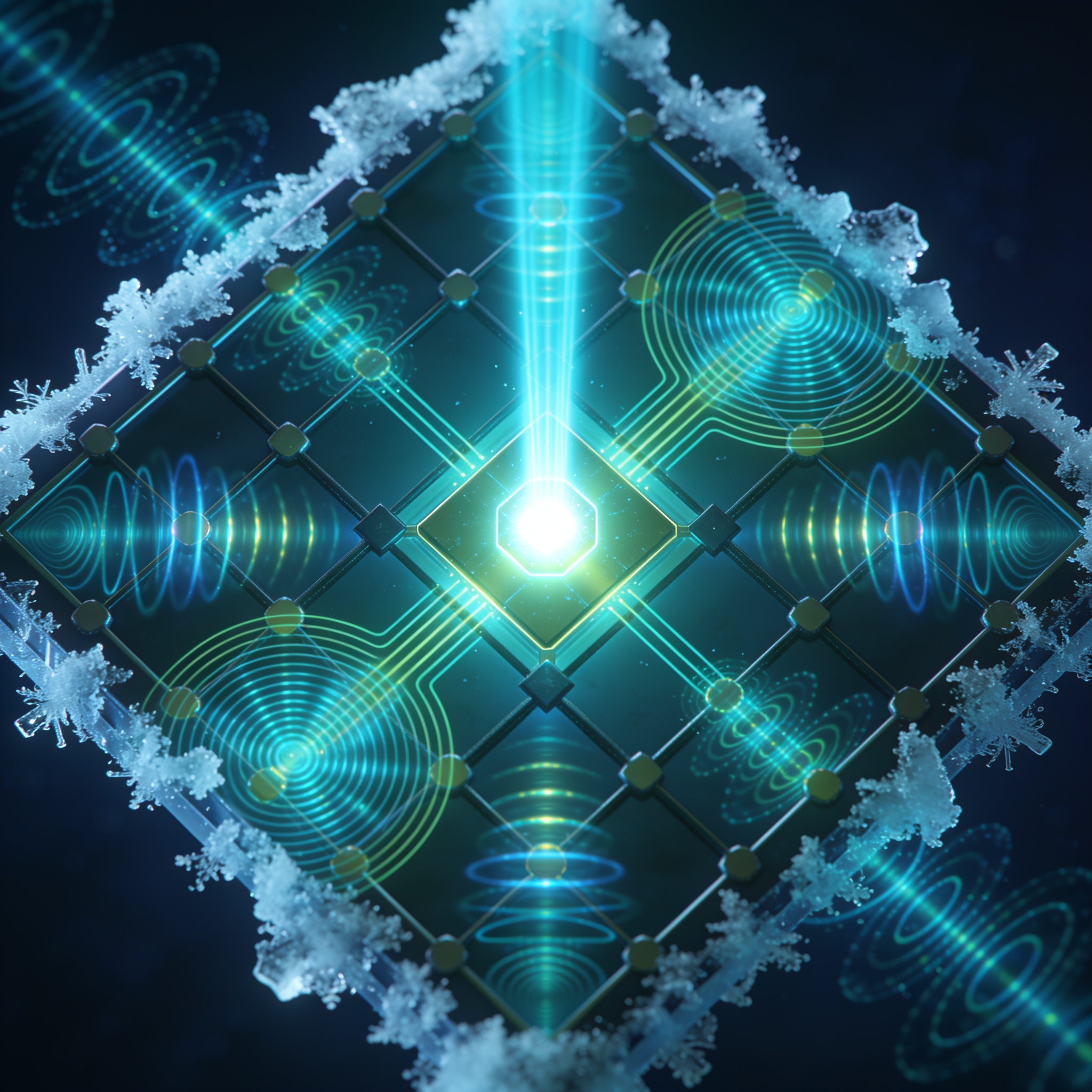
Damaged concrete heals itself when you stop squeezing it. The speed at which microcracks reseal—and the velocity of sound waves creeping back to normal—tells engineers exactly how strong the material was before anyone broke it. That same logic of watching a system relax after stress, measuring every microsecond of recovery while ruthlessly subtracting thermal noise, now lands inside a dilution refrigerator at Fujitsu, where tin-vacancy centers in diamond must hold coherence long enough to perform quantum error correction. [arXiv:2609.05456]
This matters because the fundamental obstacle to a useful quantum computer is not qubit count. It is signal stability. A logical qubit—the error-corrected abstraction that actually runs algorithms—requires thousands of physical qubits and real-time syndrome measurement to survive decoherence. The timing is not coincidental: in September 2026, Fujitsu fabricated a diamond-spin QPU prototype that leans on exactly the kind of self-referencing temperature correction a concrete dynamics paper published one month earlier proved essential. Two different materials, two different communities, one shared physics.
How It Works
Everything starts with a phenomenon called slow dynamics. Apply a compressive load to a concrete prism, release it, and the material does not bounce back instantly. Its internal stiffness drops—measured as a decrease in ultrasonic wave velocity—and then recovers over hours or days. The authors of Slow dynamics in concrete: Effects of temperature, strength variation, and microcracking damage, published on arXiv in August 2026, used coda wave interferometry to track this recovery with extreme precision. "A self-referencing temperature correction technique was used to minimize the effect of ambient temperature changes," the paper states, "demonstrating the importance of careful temperature control and correction."
Think of it like listening to a bell ring after striking it. A flawless bell sustains a pure tone. A cracked bell scatters the sound, its pitch blurred, its ring truncated. Recovery rate and velocity drop magnitude jointly encode the material's compressive strength. Intact 56 MPa concrete recovers in 6.6 hours. Intact 32 MPa concrete takes 9.9 hours. Alkali-silica reaction damage stretches recovery to 458 hours. The signal itself contains the diagnosis.
Now transpose that diagnostic logic to a diamond lattice at 1.4 Kelvin. Tin-vacancy centers—point defects where a tin atom sits between two missing carbons—emit photons with exceptionally stable frequency. But any stray electric field, any thermal fluctuation, shifts that frequency. Fujitsu's heterogeneous material bonding and nanometer-scale diamond thinning aim to suppress those perturbations. To verify suppression works, researchers must measure recovery after an intentional disturbance, while correcting for the temperature drift that mimics or masks the signal they care about. The concrete lab's self-referencing technique becomes a noise-suppression blueprint.
Who's Moving
Fujitsu Limited (TYO:6702) leads the diamond-spin effort, targeting a multi-module prototype by 2027 and a 1,000-logical-qubit system by fiscal year 2035. Their September 2026 prototype integrates tin-vacancy centers into photonic integrated circuits, operating at -271.6°C—warm by dilution refrigerator standards, where superconducting qubits from IBM and Google run near 15 millikelvin. The warmer operating point reduces the cooling overhead that cripples superconducting system economics, a fact Fujitsu is betting on for datacenter deployment.
The superconducting competition remains formidable. IBM's 1,121-qubit Condor processor, delivered in 2023, demonstrated scale without error correction. Alphabet's Google Quantum AI holds the surface code roadmap and the 2023 demonstration of below-threshold logical error rates on a 49-qubit surface code. Quantinuum's H2 trapped-ion system maintains the industry's highest two-qubit gate fidelities. In this landscape, Fujitsu is not chasing raw physical qubit count. It is chasing qubit fidelity per photon, per temperature cycle, per syndrome measurement round.
No dedicated funding round for the diamond-spin QPU has been disclosed. However, Fujitsu's quantum computing investment sits within a broader ¥300 billion ($2 billion) R&D allocation spanning fiscal years 2024 through 2028, as outlined in the company's Medium-Term Management Plan.
Why 2026 Is Different
The next 12 months will see the first multi-module diamond-spin prototype take shape inside Fujitsu's Atsugi laboratories, with photon-mediated entanglement linking separate diamond chips. Within three years, heterogeneous architectures—Fujitsu's diamond QPU networked to superconducting hardware—will undergo real-world co-processing trials. Within five years, the fault-tolerant quantum computing threshold of 1,000 logical qubits becomes a deliverable, not a slide deck projection. The quantum computing market, pegged at $4.5 billion in 2026 by several analyst consensus estimates, will bifurcate into error-corrected and NISQ-era segments. Only error-corrected machines unlock pharmaceutical molecular dynamics, materials science band-gap prediction, and financial derivatives pricing at scale.
The concrete paper's 458-hour recovery window for ASR-damaged specimens tells the same story in a different medium: damage stretches recovery, and recovery time encodes structural integrity. For a logical qubit, damage is decoherence. Recovery is syndrome measurement and correction. Stretch the recovery time with poor temperature control, and the logical qubit collapses before the surface code cycle completes.
In short: quantum error correction demands the temperature-stabilization rigor already proven essential in materials diagnostics, and Fujitsu's diamond-spin architecture bakes that discipline into its hardware from the first prototype.
FAQ
What is a tin-vacancy center in diamond? A tin-vacancy (SnV) center is a point defect in diamond crystal where a tin atom replaces two adjacent carbon atoms, leaving vacancies. When optically excited, it emits bright, spectrally narrow photons that serve as a qubit's quantum state carrier. SnV centers resist electric field noise far better than nitrogen-vacancy centers and function at temperatures above 1 Kelvin, simplifying cryogenic engineering.
How do diamond-spin qubits compare to superconducting qubits? Superconducting qubits from IBM and Google require millikelvin temperatures and are sensitive to electromagnetic interference, but offer fast gate speeds and established fabrication pipelines. Diamond-spin qubits run warmer, emit photons for direct optical networking, and promise better isolation from environmental noise due to their atomic-scale footprint inside a rigid diamond lattice. The tradeoff is lower raw gate speed and smaller manufacturing infrastructure.
When will fault-tolerant quantum computing become commercially available? Fujitsu targets a 1,000-logical-qubit system by fiscal year 2035. Google Quantum AI and IBM have internal roadmaps pointing to early fault-tolerant demonstrations before 2030. A commercially relevant, error-corrected machine solving problems a classical supercomputer cannot will likely appear between 2030 and 2035 for narrow-domain applications like molecular simulation.
Which companies are leading in diamond quantum computing? Fujitsu is the most prominent system integrator with its diamond-spin QPU prototype. Quantum Brilliance (Australia) commercializes room-temperature diamond nitrogen-vacancy accelerators. Element Six (De Beers subsidiary) supplies engineered diamond substrates. Academic leaders include the University of Cambridge's diamond photonics group and MIT's Quantum Engineering Group.
What are the biggest obstacles to adopting diamond-spin quantum technology? Nanometer-scale diamond thinning across wafer-level substrates remains a yield-limited process. Tin-vacancy centers must be positioned with near-atomic precision relative to photonic waveguides. Photon collection efficiency from single emitters still constrains entanglement generation rates between remote qubits. Each of these obstacles forms an active engineering threshold, not a fundamental physical limit.