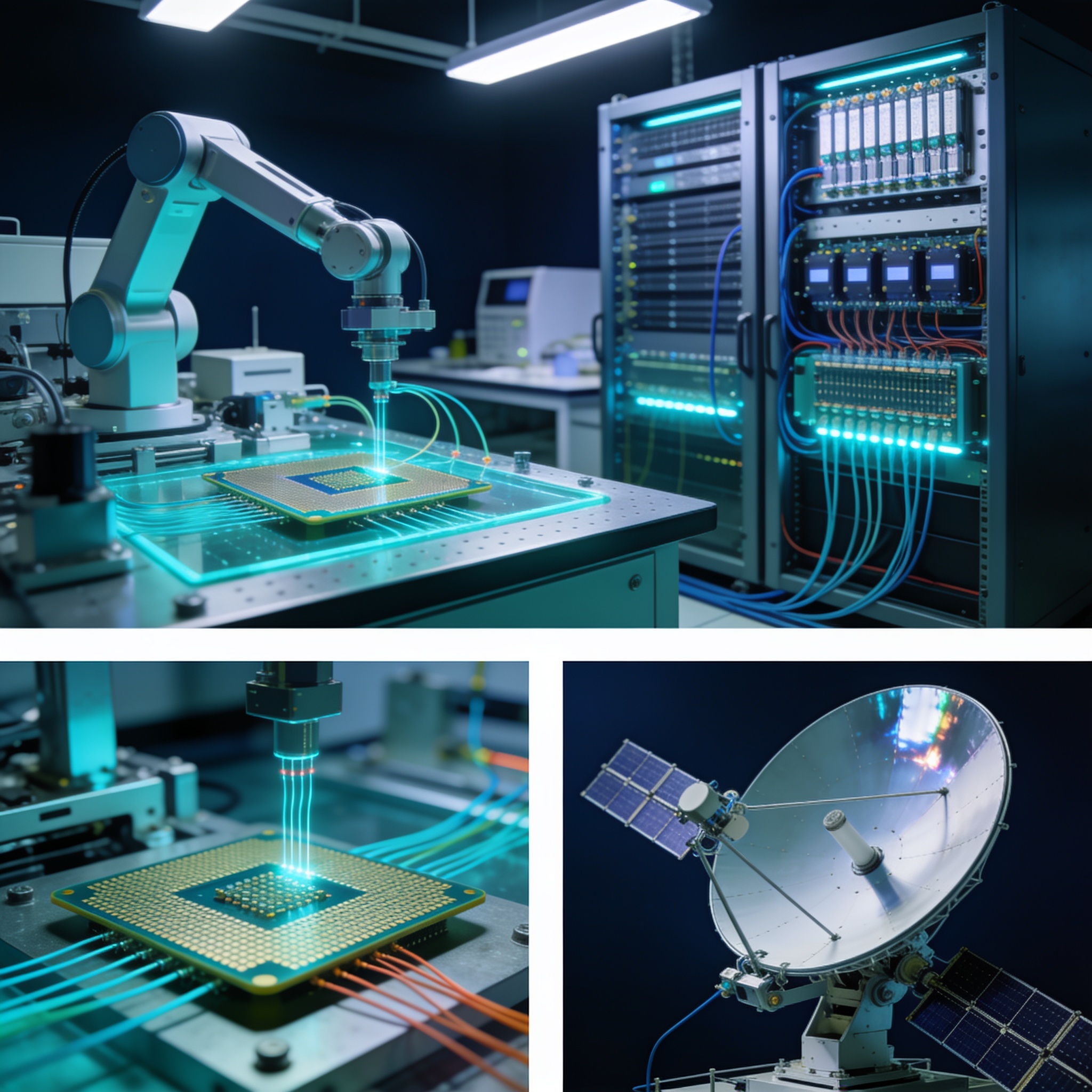
The week ending September 5, 2026 delivered a flurry of quantum computing developments spanning photonics, superconducting qubits, silicon spin processors, and quantum-safe satellite links. Canada pledged CAD 195 million to Xanadu for a dedicated photonic chip fabrication plant, dubbed Inception. IBM released details of its 120-qubit Nighthawk r2 processor, which executes more than 100,000 circuits per second. Diraq, a silicon quantum dot startup, reserved an Equinix colocation cage in Sydney, signaling intent to deploy hardware in a carrier-neutral data center. Meanwhile, Pasqal inked a multi-year quantum-safe research agreement with Saudi Arabia’s KACST, and quantum-safe overlays were tested on the Es’hail-1 and Greece-Cyprus satellite paths.
What They're Actually Building
Xanadu’s Inception plant represents a bet on photonic quantum computing—using squeezed light to process quantum information. The CAD 195 million government investment aims to construct a fabrication facility for integrated photonic chips, a necessary step to scale from tabletop experiments to multiple quantum processing units. Xanadu’s current cloud-accessible systems, based on its X-series chips, have demonstrated programmable Gaussian boson sampling. The Inception fab could allow Xanadu to produce larger, more complex photonic integrated circuits, moving closer to fault-tolerant photonic architectures. In photonics, the primary competitor PsiQuantum is pursuing a fusion-based approach with silicon photonics and has raised over $1 billion, but it has not yet disclosed a dedicated fab of this scale fully funded by a government.
IBM’s Nighthawk r2, a revision of the 133-qubit Heron-era design, now specified at 120 qubits, focuses on speed rather than raw qubit count. The headline metric—100,000 circuit evaluations per second—matters for variational algorithms and error mitigation techniques that require many shots. IBM’s quantum cloud service already uses such processors, and this throughput gain directly reduces runtime for users. Competitively, Google Quantum AI’s Sycamore-class processors are not publicly benchmarked on this metric, while Rigetti’s Ankaa-3 targets 84 qubits with similar speed ambitions. IBM’s roadmap places Nighthawk as a step toward the 1,000-qubit Flamingo system expected later in the 2020s, though logical error rates remain the critical missing piece.
Diraq’s Equinix cage reservation is a tangible infrastructure move for silicon spin qubits. The company, spun out of UNSW Sydney, uses electron spins in silicon quantum dots fabricated on standard CMOS processes. Securing space in Equinix’s SY3 data center suggests Diraq plans to install a dilution refrigerator and control electronics, offering low-latency access to quantum computing resources for customers in the Asia-Pacific region. This follows a growing trend of quantum-as-a-service providers moving beyond shared cloud instances toward dedicated, physically co-located hardware. It also positions Diraq to offer on-premise-like deployment models, a differentiator against purely cloud-based providers.
The quantum-safe overlays tested on Es’hail-1 and the Greece-Cyprus satellite link signal early deployment of post-quantum cryptography or hybrid QKD on operational satellite communications. Es’hail-1, a Qatari geostationary satellite, and the Greece-Cyprus path—likely a terrestrial or low-earth-orbit relay—represent real infrastructure, not lab setups. Such overlays aim to protect data against future attacks by quantum computers. This is distinct from pure QKD experiments; it suggests a pragmatic hybrid approach combining classical PQC algorithms with quantum key distribution, though technical details were not disclosed in the round-up.
Winners and Losers
The Canadian government’s backing of Xanadu tightens the photonic quantum race. PsiQuantum, which also relies on photonics but with a different error correction model, may feel pressure to showcase its own manufacturing progress. Xanadu now has a state-funded path to volume production, potentially lowering per-chip costs and accelerating iteration. For quantum cloud services, IBM’s Nighthawk r2 speed bump strengthens its enterprise value proposition: shorter job runtimes mean lower wait times for customers running variational quantum eigensolvers or QAOA. That puts pressure on IonQ and Rigetti to demonstrate comparable throughput improvements on their hardware. Diraq’s Equinix move could disrupt the quantum colocation market; if successful, it might draw other silicon spin startups, such as Quantum Motion or Equal1, to pursue similar deployments. Equinix itself benefits as quantum hardware becomes another colocation tenant. The satellite quantum-safe overlays primarily benefit satellite operators and national security agencies seeking to proof their infrastructure against quantum threats; they do not directly threaten any company but may validate the hybrid QKD-PQC market that players like ID Quantique and Toshiba are targeting.
The Bigger Picture
These announcements come as governments worldwide pour billions into quantum infrastructure. Canada’s CAD 195 million for Xanadu follows its CAD 360 million National Quantum Strategy launched in 2023. Saudi Arabia’s KACST deal with Pasqal signals that Middle Eastern nations are diversifying beyond fossil fuels into deep tech, joining the UAE’s earlier quantum investments. In 2026, the quantum computing landscape remains fragmented across qubit modalities, but the common thread is a push toward manufacturing and integration. IBM’s previous 1,121-qubit Condor chip in 2023 was a physics experiment; Nighthawk r2’s metric emphasizes utility. Similarly, Xanadu’s fab and Diraq’s data center cage are steps toward making quantum a real-world service, not a lab curiosity.
The Signal
The signal this week is unmistakable: quantum computing’s center of gravity is shifting from research papers to production floors and colocation racks. Canada’s fab investment, Diraq’s Equinix cage, and IBM’s circuit throughput advance are not breakthroughs in logical qubits or error correction. They are, however, the kind of infrastructure moves that transform scientific demonstrations into products. The field still lacks a universal fault-tolerant quantum computer, but the pieces—manufacturing, speed, deployment logistics—are falling into place. The next milestone that would truly validate these investments is a clear demonstration of a logical qubit with error rates below physical qubits, at scale. Until then, the industry is laying the tracks.
This week’s quantum moves show a sector no longer just tinkering with qubits, but building factories, testing satellite overlays, and installing processors in data centers—the quiet industrial phase before fault tolerance.
In short: quantum computing weekly round-up September 2026 captures a pivot to manufacturing, speed, and real-world deployment across photonics, superconducting, and silicon spin platforms.