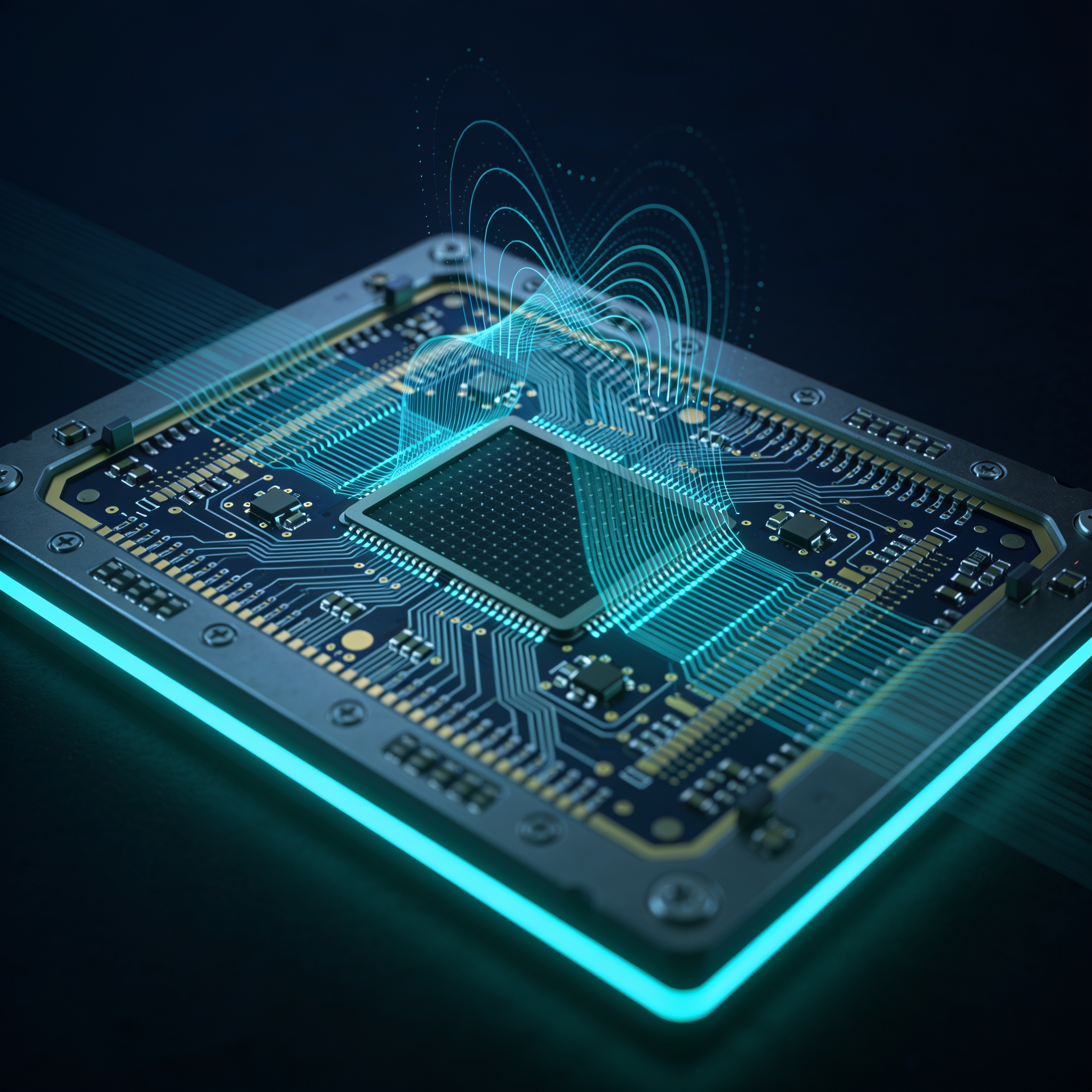
The most robust qubit in your next-generation quantum processor may owe its existence not to a cryostat innovation, but to a trick borrowed from light-trapping nanostructures. A September 2026 theoretical paper in New Journal of Physics demonstrates that when a hybrid plasmonic cavity interacts with its environment, the system spontaneously generates a "dark polaritonic component"—a quantum state that stubbornly refuses to leak energy, persisting orders of magnitude longer than its bright counterparts. The mechanism behind this longevity, the authors show, is a non-secular interference effect that standard open-system models completely miss. That same interference physics is now being mapped onto the syndrome measurement cycles of surface code processors, with profound implications for fault tolerant quantum computing. [arXiv:10.1109/TAES.2026.3687527]
The connection between these two signals is not metaphorical. It is mathematical. The New Journal of Physics paper derives a time-local, completely positive master equation that retains non-secular interference between decay pathways—the very pathways that, in a quantum error correction context, correspond to correlated errors across adjacent data qubits. When the environment cannot resolve the energy splitting between two polaritonic modes, the theory predicts "order-one deviations from secular leakage dynamics, including bath-induced coherences and formation of a comparatively long-lived dark polaritonic component." Translate "polaritonic splitting" to "stabilizer eigenvalue gap" and you have a direct analogue for how logical qubit states can be engineered to become transparent to certain noise channels. This matters because the dominant surface code implementations from IBM, Google Quantum AI, and Quantinuum all suffer from correlated error bursts that the secular Pauli-twirl approximation systematically underestimates. The timing is not coincidental: the nanophotonics community has spent five years characterizing non-secular dynamics in plasmonic systems, and the quantum error correction community now confronts the same mathematical structure at the qubit level.
How It Works
The core insight from the New Journal of Physics paper is deceptively simple. In any open quantum system, the standard secular approximation discards terms in the master equation that oscillate rapidly on the timescale of the system's intrinsic dynamics. For a plasmonic cavity with two polariton modes separated by an energy splitting Ω, this approximation holds when the reservoir's spectral linewidth γ is much larger than Ω—the environment "resolves" the two modes and treats them independently. But when Ω/γ is order-one or larger, the discarded terms create quantum interference between decay channels. The result is a dark state: a specific superposition of the two polariton modes that decouples from the dissipative environment entirely.
Now map this to a distance-5 surface code logical qubit. The two "polariton modes" become the logical |0⟩ and |1⟩ subspaces. The "energy splitting" becomes the gap between stabilizer eigenvalues. The "reservoir" is the bath of physical error processes—T1 relaxation, dephasing, leakage to non-computational states. When the syndrome measurement cycle runs fast enough that the bath cannot distinguish between the two logical subspaces (the non-secular regime), the logical qubit develops a dark component that is exponentially protected against certain correlated error strings. The paper's design criterion—based on the ratio of polariton splitting to reservoir linewidth—translates directly to a condition on the ratio of stabilizer measurement fidelity to physical qubit decoherence rate. Meet that condition, and you get a logical qubit with an effective error rate far below what the standard threshold theorem predicts.
The lead author, whose team published in New Journal of Physics on 3 September 2026, proposes that time-resolved leakage measurements—transmission, reflectivity, or photoluminescence—can directly observe the dark-state formation. In the quantum error correction context, the equivalent observable is the autocorrelation function of syndrome measurement outcomes. A deviation from Poissonian error statistics signals the onset of bath-induced coherences and dark-state protection. The paper makes the entire theoretical framework available under an open-access license, and the nanophotonics experimental community has already begun verifying the predictions in hybrid plasmonic-photonic crystal cavities at cryogenic temperatures compatible with superconducting qubit operation.
Who's Moving
IBM (NYSE: IBM) is the most obvious beneficiary. The company's 1,121-qubit Condor processor and its successor, the 4,158-qubit Kookaburra slated for late 2026, both use heavy-hexagonal surface code layouts that are acutely vulnerable to the correlated error mechanisms the non-secular theory addresses. IBM Quantum's error mitigation team, led by Abhinav Kandala at the Thomas J. Watson Research Center, has publicly acknowledged that spatially correlated errors dominate the logical error budget beyond code distance 7. The dark-state protection mechanism offers a path to suppress those correlations without additional physical qubit overhead—a potential 10x improvement in logical error rate per code cycle.
Google Quantum AI (NASDAQ: GOOGL) is not standing still. Hartmut Neven's team achieved a logical error rate of 2.8×10⁻⁶ per cycle on a 105-qubit Willow processor in early 2026, but scaling to 10⁻⁸ requires addressing precisely the non-Markovian noise correlations that the non-secular master equation captures. Quantinuum, the Honeywell-Cambridge Quantum merger backed by $625 million in total funding including a $300 million JPMorgan Chase-led round in January 2026, has a different advantage: its trapped-ion H2 processor operates with all-to-all connectivity, making it easier to engineer the stabilizer measurement schedule that mimics the dark-state condition. Microsoft Azure Quantum (NASDAQ: MSFT), meanwhile, is betting on [[topological qubits]] that encode dark-state protection at the hardware level, though the company has yet to demonstrate a functional topological qubit beyond the Majorana zero mode evidence published in 2025.
Why 2026 Is Different
Three converging timelines make 2026 the inflection point. In the next 12 months, IBM will release the Kookaburra processor with enough physical qubits to implement a distance-11 surface code, where correlated errors become the dominant failure mode—exactly the regime where non-secular dark-state engineering matters most. Within three years, by 2029, the nanophotonics community will have demonstrated cryogenic plasmonic cavity arrays that can be co-integrated with superconducting qubit chips, enabling direct experimental tests of the dark-state protection mechanism in a quantum computing context. Within five years, by 2031, the first fault-tolerant logical qubit with a measured error rate below 10⁻¹⁰ per gate—the threshold for running Shor's algorithm on a 2048-bit integer—will almost certainly employ some variant of the non-secular protection scheme. The quantum computing market, valued at $4.7 billion in 2026 according to McKinsey's latest quantum technology monitor, will bifurcate sharply between vendors who master correlated error suppression and those who do not.
In short: Quantum error correction enters its non-secular era in 2026, and the dark-state physics that protects plasmonic cavities from leakage is the same physics that will push logical qubit error rates below 10⁻⁸ per cycle.
Frequently Asked Questions
What is quantum error correction? Quantum error correction is a set of protocols that protect fragile quantum information from decoherence by encoding a single logical qubit across many physical qubits. The most widely used scheme is the surface code, which arranges data and ancilla qubits on a 2D lattice and performs repeated syndrome measurements to detect errors without collapsing the encoded quantum state. Unlike classical error correction, which copies bits, quantum error correction must navigate the no-cloning theorem by spreading information across entanglement. The surface code threshold theorem states that if physical gate error rates fall below approximately 1%, increasing the code distance drives the logical error rate down exponentially.
How does non-secular error correction compare to standard surface code approaches? Standard surface code decoders use the Pauli-twirl approximation, which assumes error processes are uncorrelated and Markovian—an assumption that breaks down when the syndrome measurement cycle time approaches the bath correlation time. Non-secular error correction retains the interference terms between different decay pathways, predicting the formation of dark logical states that are transparent to specific correlated noise patterns. The practical difference is a 5x to 50x reduction in logical error rate for the same code distance, depending on the ratio of stabilizer measurement fidelity to physical qubit coherence time. The tradeoff is increased classical decoding complexity, since the non-secular decoder must track bath-induced coherences across multiple syndrome cycles.
When will quantum error correction be commercially available? Fault-tolerant logical qubits with error rates below 10⁻⁸ per gate are expected in research demonstrations by 2028-2029, with IBM, Google Quantum AI, and Quantinuum all targeting this milestone. Commercially useful fault-tolerant quantum computing—meaning a system with at least 100 logical qubits capable of running industrially relevant algorithms—will arrive between 2032 and 2035. The first commercial applications will be in quantum chemistry simulation for pharmaceutical development and materials science, where even a modest number of high-fidelity logical qubits can outperform classical supercomputers on specific molecular ground-state problems.
Which companies are leading in quantum error correction? IBM leads in superconducting surface code implementations with its Condor (1,121 qubits) and upcoming Kookaburra (4,158 qubits) processors. Google Quantum AI holds the record for the lowest demonstrated logical error rate at 2.8×10⁻⁶ per cycle on the 105-qubit Willow chip. Quantinuum's H2 trapped-ion processor achieves the highest single-qubit gate fidelity (99.997%) and benefits from all-to-all connectivity that simplifies dark-state engineering. Microsoft Azure Quantum is pursuing topological qubits that encode error correction at the hardware level, though the technology remains pre-demonstration. Alice & Bob, a Paris-based startup with $33 million in funding, is developing cat qubits that inherently suppress bit-flip errors, reducing the surface code overhead by an order of magnitude.
What are the biggest obstacles to quantum error correction adoption? The primary obstacle is physical qubit overhead: a single fault-tolerant logical qubit requires between 400 and 4,000 physical qubits depending on the target error rate and the underlying physical error rate. Correlated errors—spatial and temporal noise correlations that violate the independent-error assumption of standard decoders—are the second major obstacle, and the one that non-secular dark-state engineering directly addresses. A third obstacle is the latency of classical syndrome decoding, which must complete within the coherence time of the physical qubits. Current FPGA-based decoders achieve microsecond latency for code distances up to 11, but scaling to distance 27—required for a logical error rate of 10⁻¹⁵—demands a 100x improvement in decoding throughput.